
Plan Grill
iustin-nita/plan-grill
Resolva decisões críticas com perguntas estruturadas antes de construir
Ver no GitHubSkill que estrutura decisões de projeto através de perguntas de múltipla escolha antes da implementação. Explora o codebase, identifica pontos críticos de bifurcação e apresenta opções com tradeoffs concretos e recomendações fundamentadas, transformando as respostas em um plano de ação sequenciado.
Instalação
npx convez-ai iustin-nita/plan-grill1 comando no terminal: detecta o formato do repositório (marketplace ou plugin avulso) e instala via Claude Code. Requer Node 18+ e o Claude Code instalado.
Métricas
Casos de uso
- Planejamento de features com múltiplas abordagens possíveis
- Scoping de migrações de tecnologia com tradeoffs complexos
- Validação e stress-test de arquitetura antes da implementação
Veredito

Skill bem-pensado que resolve um problema real: planos falham por falta de decisões explícitas, não por falta de código. O uso de UI estruturada com recomendações é prático e força clareza. Recomendado para times que precisam documentar decisões de design antes de começar.
README
A tradução para o português deste README ainda está na fila.
plan-grill
Before you build, get grilled. A Claude Code / Agent Skill that surfaces the real decisions in a task and resolves them with you through structured multiple-choice questions — each with concrete options, honest tradeoffs, and a recommended answer — then turns your choices into a concrete implementation plan.
Most weak plans don't fail on coding ability. They fail because nobody resolved the decisions that actually shape the implementation. plan-grill front-loads that: it explores your codebase, finds the forks that matter, and asks them as clean choices — not vague "what do you think?" prose.
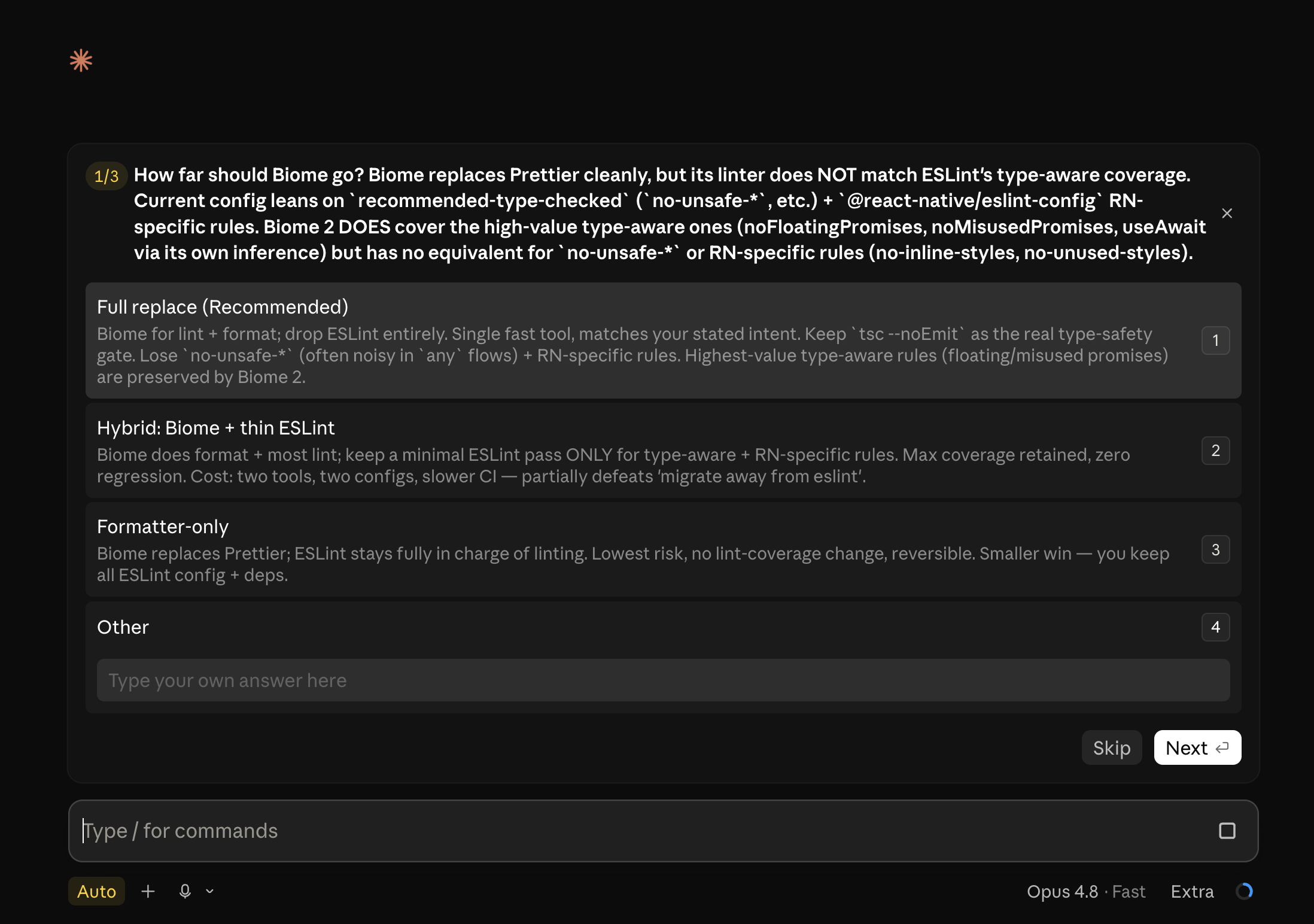
A real plan-grill question screen, mid-session — deciding how far a Biome migration should go.
Install
npx skills add iustin-nita/plan-grill
Then trigger it in Claude Code / Claude:
make a plan for adding offline mode — grill me first
What makes it different
Compared to a plain "interview me" prompt, plan-grill:
- Asks through the structured-choice UI (
AskUserQuestion) — clickable options, not a wall of text. This forces concrete, mutually-exclusive answers and makes deciding a single tap. - Always recommends. Every question marks a recommended option and says why.
- States real tradeoffs. Each option spells out what you gain vs. give up.
- Researches first. It reads the codebase before asking, so it never asks what the code already answers, and its options are grounded in your actual files.
- Batches related questions (up to 4 per screen) and ends with a concrete, sequenced plan.
The loop
- Understand & research — read the request, explore the codebase, answer what it can on its own.
- Find the decisions that matter — the genuine forks where the implementation branches.
- Ask — structured options, real tradeoffs, recommended pick.
- Know when to stop — quit once remaining unknowns are low-stakes.
- Synthesize the plan — turn resolved answers into an implementation plan.
When it triggers
Planning, designing, or scoping a feature/change/migration with open decisions; "grill me"; vet / stress-test / poke holes in a plan before building; "ask me questions first", "give me options with tradeoffs".
It deliberately stays out of the way when you've already decided and just want it built, for pure debugging or code explanation, for plain ship checklists, or for non-engineering planning.
Optional: reliable triggering via a hook
Skill activation is the model's judgment call — a good description makes it likely, never guaranteed. On natural prompts like "let's plan the migration" the model sometimes just starts planning inline without consulting the skill.
If you want plan-grill to fire deterministically on planning phrases, add a UserPromptSubmit hook to your ~/.claude/settings.json. It pattern-matches your prompt and, on a hit, injects a reminder to use the skill (it stays silent otherwise — only fires on a match):
{
  "hooks": {
    "UserPromptSubmit": [
      {
        "hooks": [
          {
            "type": "command",
            "command": "in=$(cat); printf \"%s\" \"$in\" | grep -qiE \"let.?s plan|let.?s make a plan|make a plan|plan how to|plan on how to|how to migrate|let.?s think about how to|let.?s think through|how should we approach|the best tool|which tool should|make a choice|plan the migration|migrate from .* to |grill me\" && printf \"%s\" \"{\\\"hookSpecificOutput\\\":{\\\"hookEventName\\\":\\\"UserPromptSubmit\\\",\\\"additionalContext\\\":\\\"The user prompt signals planning intent. Strongly consider using the plan-grill skill: surface the real decisions and ask them as structured AskUserQuestion screens with concrete options, honest tradeoffs, and a recommended pick, then synthesize a concrete plan.\\\"}}\"; true",
            "timeout": 5
          }
        ]
      }
    ]
  }
}
Matches: let's/lets plan, make a plan, plan how to / plan on how to, how to migrate, let's think about how to / think through, how should we approach, the best tool, which tool should, make a choice, plan the migration, migrate from … to …, grill me. Tune the regex to taste.
Merge it into your existing hooks object (don't replace the whole file). If it doesn't fire right after editing, open /hooks once or restart — Claude Code's config watcher may not hot-reload a mid-session edit. Manage or disable it later from the /hooks menu.
Evaluation
The skill was benchmarked against a no-skill baseline on 3 realistic planning prompts, graded on 5 objective assertions (structured options, recommended pick, per-option tradeoff, codebase grounding, concrete plan). See evals/.
| Configuration | Pass rate |
|---|---|
| With plan-grill | 100% (15/15) |
| Baseline (no skill) | 53% (8/15) |
The skill's value concentrates exactly where the baseline falls short: delivering labeled options with tradeoffs and a recommendation, rather than open-ended prose questions. (Grounding the plan in the codebase and producing a plan at all — the baseline already does those well.)
License
MIT © Iustin Nita