
Kaji — Central de Controle para Agentes IA
Central de missão para coordenar agentes IA em Rust — terminal, telefone, sem vendor lock-in
Ver no GitHubPlataforma de orquestração para gerenciar múltiplos agentes de código (Claude, Codex, etc.) via uma interface unificada em terminal e web. Oferece visibilidade em tempo real da frota, controle de quota de uso e acesso remoto via telefone, eliminando troca de contexto entre workers.
Instalação
npx convez-ai interesting-vibe-coding/kaji1 comando no terminal: detecta o formato do repositório (marketplace ou plugin avulso) e instala via Claude Code. Requer Node 18+ e o Claude Code instalado.
Métricas
Casos de uso
- Orquestração de múltiplos agentes de código em paralelo
- Monitoramento de uso e quota de APIs em tempo real
- Controle remoto de agentes via navegador (desktop e mobile)
- Automação de tarefas complexas que exigem coordenação entre workers
Veredito

Kaji resolve um problema real: coordenar múltiplos agentes IA sem perder contexto. A arquitetura agnóstica e a interface minimalista (terminal + phone) refletem pensamento de design sólido, mas exige familiaridade com CLI e infraestrutura. Projeto maduro e focado.
README
A tradução para o português deste README ainda está na fila.
Kaji runs a crew of coding agents — Claude Code and Codex, side by side — and gives you one calm surface to steer them all: every worker visible at once, quota at a glance, and a phone page that works from anywhere. You hold the rudder (舵, kaji); the agents row.
Your prefrontal cortex is finite. Stop spending it switching context between agents.
(ᴗ‿ᴗ)
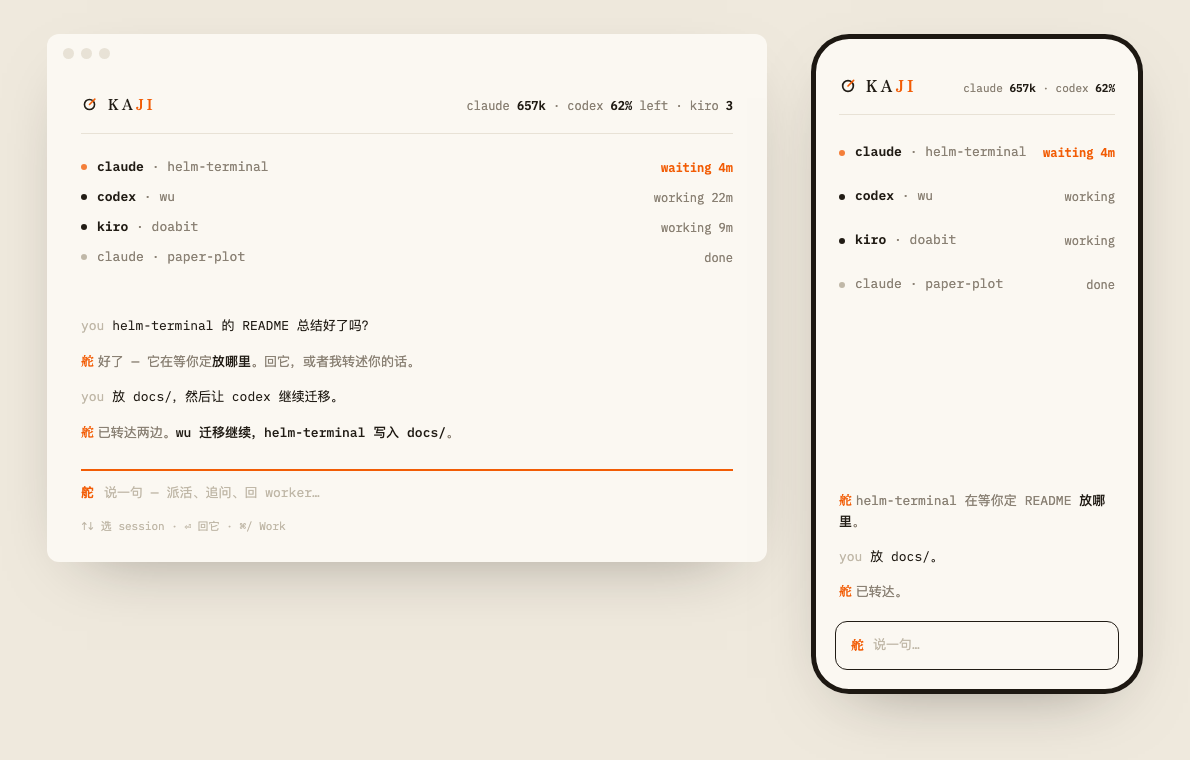
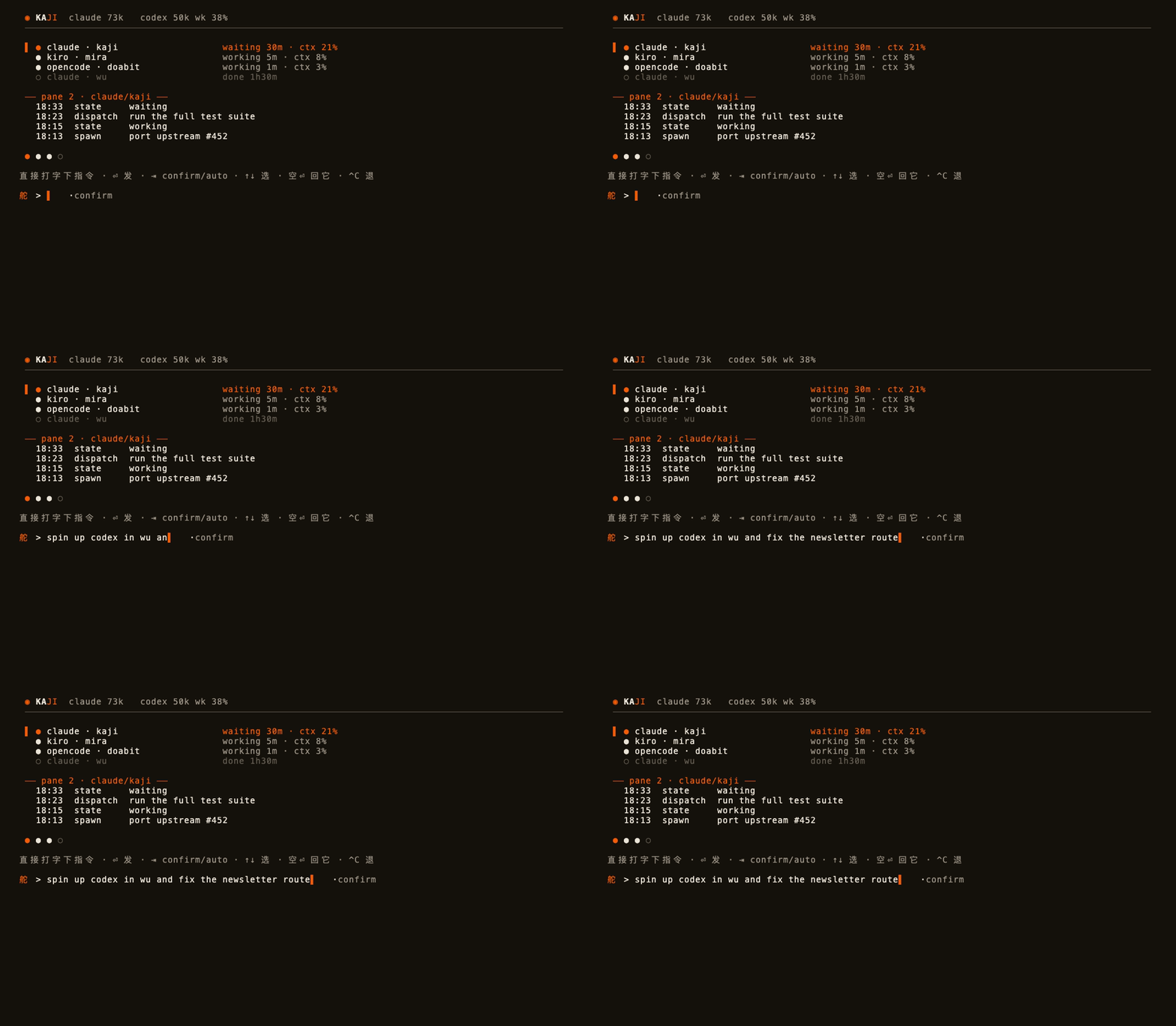
The cockpit, live: ask the First Mate, get an answer, give an order — confirm — it rows.
Install
curl -fsSL https://raw.githubusercontent.com/interesting-vibe-coding/kaji/main/install.sh | bash
Open Kaji. Mission Control greets you. Say what to build.
What you get
A First Mate, not a form. Mission Control opens on the helm line — talk to
it ("spin up codex in wu and fix the newsletter route"). The mate converses:
it reads the fleet itself, answers questions, and when an order means action it
proposes the exact spawn/send for you to confirm with arrow keys (or flip to
auto mode with Tab). Dispatch runs on a free model by default — an
OpenRouter :free model when you have a key, falling back to Claude haiku —
so steering costs you $0 in agent quota.
Two views, one key. Cmd+/ flips between Mission Control (the fleet,
the quota, the helm line) and Work (the worker you were just steering).
That's the whole navigation model. Cmd+Shift+K launches a harness;
workers tile side by side — claude next to codex.
A fleet you can read in one glance. Kaji Sun, day and night: one persimmon
accent that means exactly one thing — a worker needs you. Working is ink,
done fades to ash. Every session shows how full its context window is
(ctx 18%) before it forgets your morning.
Quota you can trust. Real five-hour and weekly usage straight from the providers' own endpoints (Claude OAuth usage API, Codex app-server) — on the cockpit, the status bar, and your phone. Know before you burn the evening's budget.
Your fleet, from your phone. kaji-brain serve + the built-in relay put
the same cockpit — helm line included — in your phone's browser over plain
HTTPS. Tap a session to watch its actual screen, live. No inbound ports on
your Mac, no VPN slot on your phone, works behind any proxy.
See docs/remote.md.
Engine-agnostic by design. The Brain is a thin service (CLI + HTTP + MCP) over an append-only event substrate — not a model. Any harness can be a worker; any client (terminal cockpit, phone, a script, an LLM if you want one) can hold the rudder.
Why this shape
Remote-control-your-agent is a crowded space — but every player locks you to one vendor's agent. Kaji's bet is the opposite: the hard part isn't talking to one agent, it's running a fleet of different ones without shredding your attention. So the trunk is harness-agnostic fleet control with shared memory — and the terminal it lives in is built for exactly that.
Built on the shoulders of Kaku, WezTerm, and the push from Ghostty. MIT — see LICENSE.md.