
Mood Mixer
illinigirl/mood-mixer
Playlists Spotify criadas por mood — sem os audio features deprecados do Spotify
Ver no GitHubServidor MCP que cria playlists Spotify baseadas em humor/mood a partir de sua biblioteca de músicas favoritas. Reconstrui os audio features que Spotify descontinuou (Nov 2024) usando dados comunitários (AcousticBrainz/GetSongBPM) e permite criar playlists via conversas naturais com Claude.
Instalação
npx convez-ai illinigirl/mood-mixer1 comando no terminal: detecta o formato do repositório (marketplace ou plugin avulso) e instala via Claude Code. Requer Node 18+ e o Claude Code instalado.
Métricas
Casos de uso
- Criar playlists temáticas (chill, focus, workout, party) a partir da sua biblioteca
- Automatizar curação de música baseada em estado emocional via conversa natural
- Recuperar dados de audio features de músicas após deprecação da API Spotify
Veredito

Solução engenhosa que contorna a deprecação do Spotify com dados comunitários e oferece integração natural via MCP. Bem-estruturado, testado e focado em resolver um problema real — ideal para quem quer automação de playlists sem depender de endpoints removidos.
README
A tradução para o português deste README ainda está na fila.
mood-mixer
A self-contained MCP server that builds mood-based Spotify playlists from your liked library — then saves them to your account. Talk to Claude ("make me a chill playlist"); mood-mixer does the matching and the playlist.
The catch it solves: Spotify deprecated its audio-features endpoint in Nov
2024, so a new app can't ask Spotify how energetic or happy a track is.
mood-mixer rebuilds that signal from community data (AcousticBrainz +
GetSongBPM), caches it, and matches your library against tunable mood presets
with exact, deterministic math.
pip install -e ".[test]" && python -m pytest -q        # 35 tests, no network
PYTHONPATH=src python -m moodmixer.cli moods
PYTHONPATH=src python -m moodmixer.cli preview workout  # runs on the bundled sample
In Claude Desktop
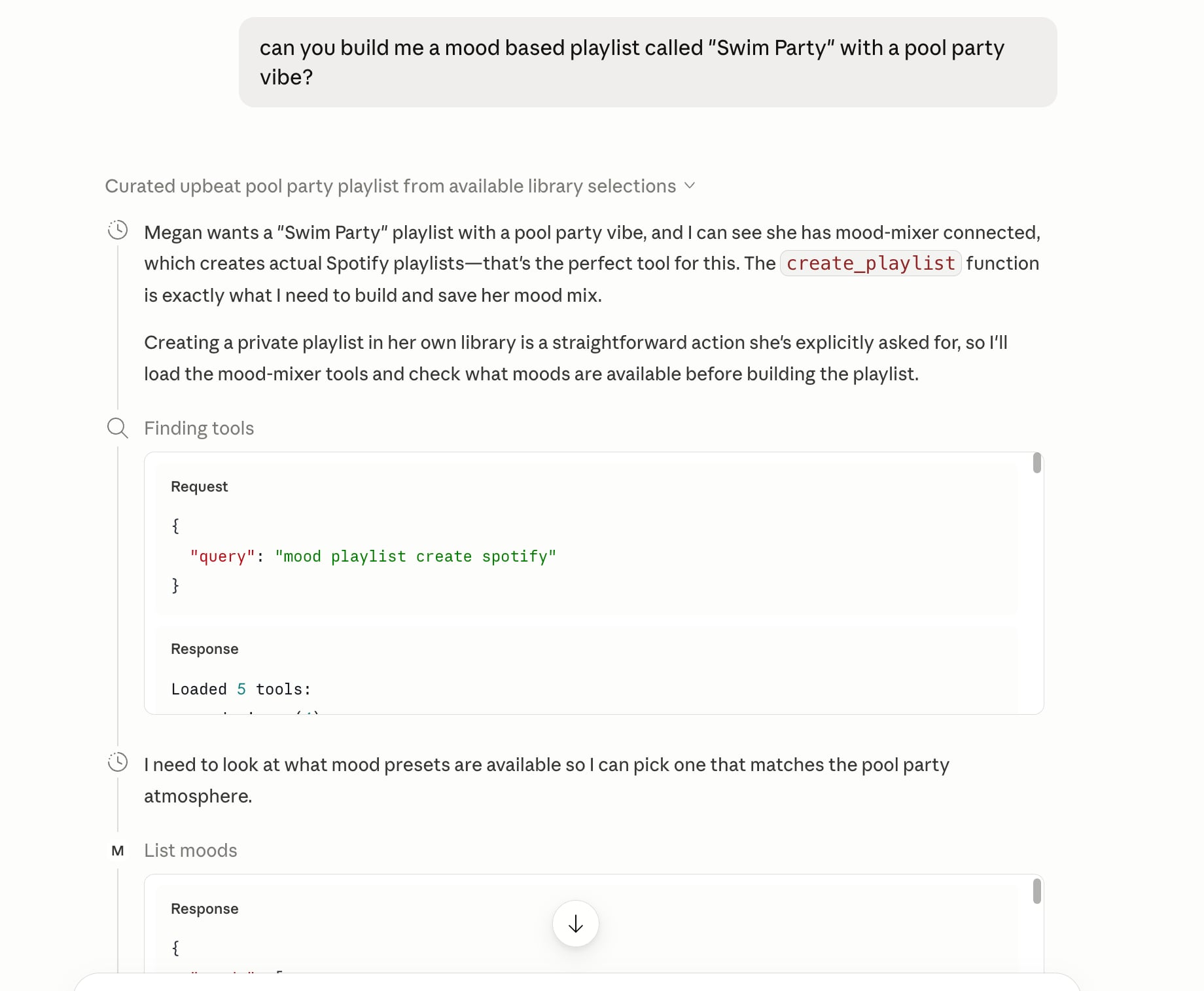
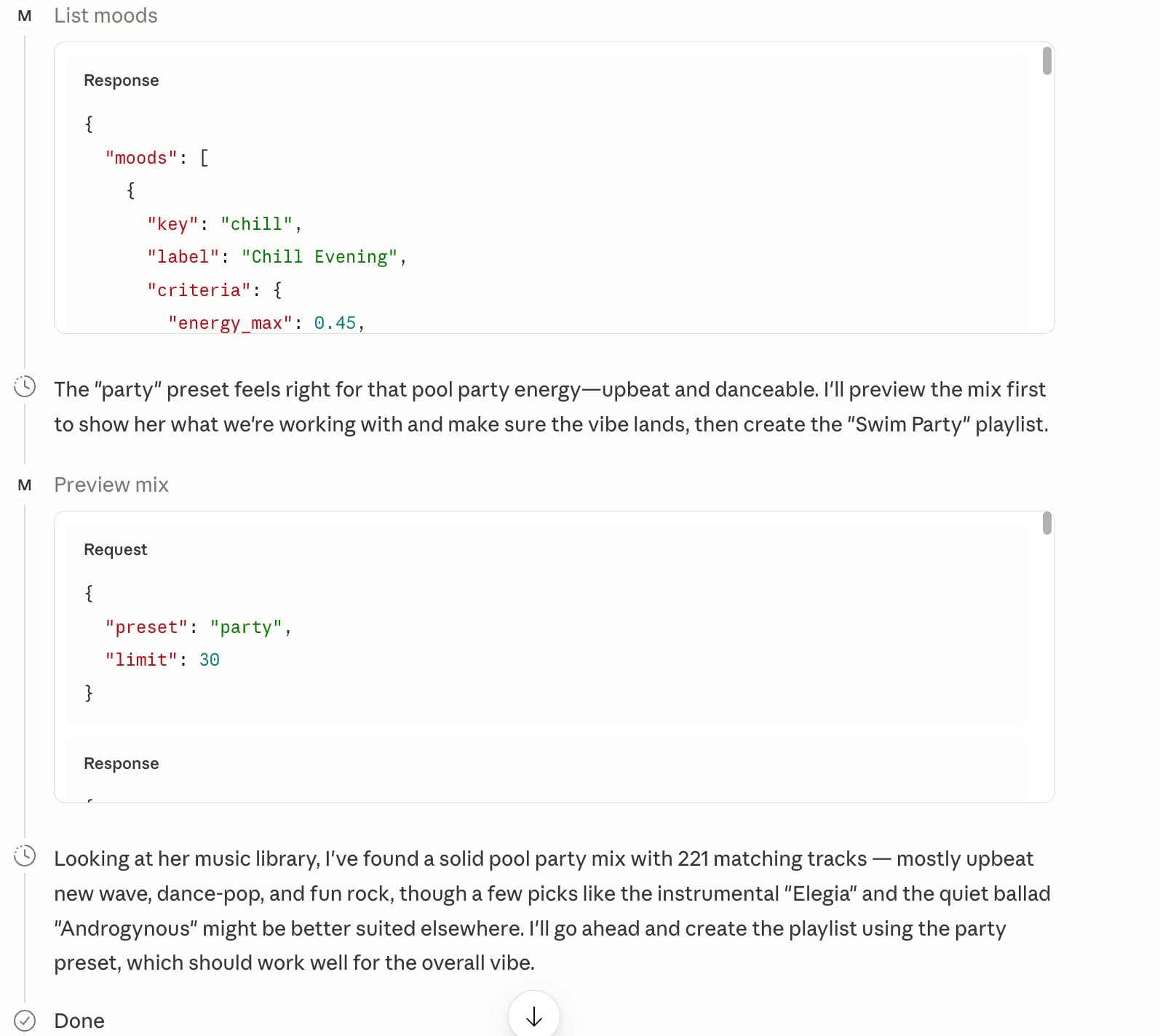
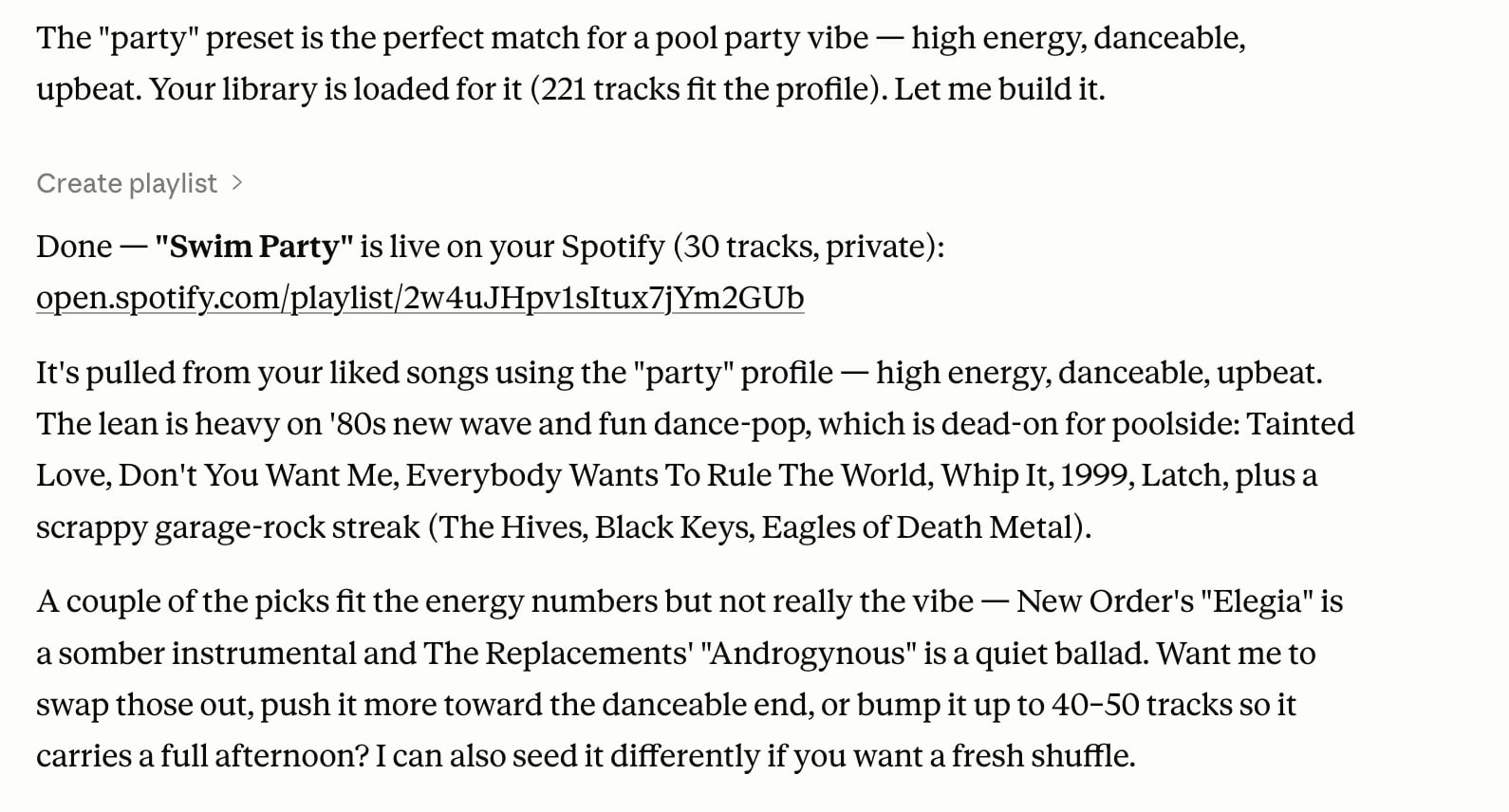
Connected as an MCP server, Claude takes a plain-language ask end-to-end — it finds the tools, previews the mix against your library, then creates the real Spotify playlist:
Why an MCP (and not just asking Claude)?
A tool only earns its place if it does something the model can't. This clears the bar on all four counts:
| Need | Plain Claude | mood-mixer |
|---|---|---|
| Work over your library | ❌ doesn't know it | ✅ your liked songs (refresh_library) |
| Know a track's mood after Spotify killed the data | ❌ can't | ✅ community features, cached (enrich_features) |
| Match a mood exactly | ❌ hand-waves | ✅ deterministic threshold filter |
| Create a real playlist in your account | ❌ can't act | ✅ create_playlist (side effect) |
The model picks the mood and talks it through; the server supplies the private data, the missing audio features, the exact matching, and the playlist.
Tools
list_moods— the presets (chill, morning, focus, roadtrip, workout, melancholy, party) and the feature thresholds that define each.preview_mix(preset)— the tracks a mood would pick, without creating anything. The grounding step.create_playlist(preset, name?)— build the mix and save it as a real private Spotify playlist. Returns the URL.refresh_library— pull your liked songs (with artist genres) into a local cache.enrich_features(limit)— backfill community audio features for the cache (rate-limited; run in batches). This is what makes matching accurate rather than genre-estimated.get_library_status— track count, source, and feature coverage.add_exclusion/remove_exclusion/list_preferences— standing "skip this from now on" rules (by track, artist, or genre, each with a note), and the saved preferences behind them. The cross-session memory that makes the mixes feel personal over time.
How "mood" survives the deprecation
Each track gets features from the best source available, in order:
- AcousticBrainz — community-computed features from MusicBrainz (~28M tracks, frozen 2022, great for catalog). Free, no key. Energy/valence are derived from its mood classifiers; tempo/danceability come straight from it.
- GetSongBPM — community BPM for newer/niche tracks AcousticBrainz misses (needs a free key). Tempo only.
- Genre estimate — a coarse genre→{energy,valence} table, so a track is never dropped just because community data lacked it.
Everything is cached forever in SQLite (misses too, so we never re-fetch). The matching math is deterministic and lives in the pure engine — the model never estimates a number.
Architecture
Pure mood engine + thin adapters. The engine is I/O-free and unit-tested without Spotify or a network; two modules do all the outside-world work.
src/moodmixer/
  models.py    Track (+ audio features)                              (pure)
  moods.py     presets · genre fallback · filter · build_mix         (pure)
  features.py  AcousticBrainz / GetSongBPM enrichment + SQLite cache (I/O)
  spotify.py   OAuth · read liked library · create playlist          (I/O)
  store.py     library cache + feature hydration                     (I/O)
  server.py    MCP adapter (FastMCP), dual stdio/HTTP transport
  cli.py       CLI adapter (also hosts the one-time `authorize`)
data/sample-library.json   bundled fabricated library (runs cold)
Your Spotify token, liked-library cache, and features DB live in
~/.mood-mixer/ (override with MOODMIXER_DATA_DIR), gitignored — personal data
never lands in a commit.
Setup (self-hosted, single-user)
Why self-hosted? Spotify restricts apps to a manually-managed allowlist and doesn't permit public distribution. So each person runs their own app with their own credentials — mood-mixer is easy to run, but not zero-setup the way a fully offline tool is.
- Create a Spotify app at https://developer.spotify.com/dashboard. Add a
redirect URI of
http://127.0.0.1:8888/callback. Add your own account under the app's user-management (the allowlist). - Set credentials (see
.env.example):export MOODMIXER_SPOTIFY_CLIENT_ID=... # from the dashboard export MOODMIXER_SPOTIFY_CLIENT_SECRET=... export MOODMIXER_GETSONGBPM_KEY=... # optional, for newer tracks - Authorize once (opens a browser):
pip install -e . python -m moodmixer.cli authorize # opens a browser to authorize Spotify - Pull your library + features:
python -m moodmixer.cli refresh
python -m moodmixer.cli enrich --limit 200   # repeat until coverage is good (slow, rate-limited)
Use it from Claude
Dual transport from one codebase — stdio for a local Claude Desktop subprocess, or streamable-HTTP as a custom connector.
Claude Desktop (stdio). After pip install -e .:
{
  "mcpServers": {
    "mood-mixer": {
      "command": "/path/to/mood-mixer/.venv/bin/mood-mixer",
      "env": {
        "MOODMIXER_SPOTIFY_CLIENT_ID": "...",
        "MOODMIXER_SPOTIFY_CLIENT_SECRET": "..."
      }
    }
  }
}
Then talk: "What moods can you make? Preview a workout mix, then save it as 'Friday Sweat'."
As a connector (HTTP): mood-mixer --http --port 8765 → add
http://localhost:8765/mcp.
Try it yourself — drive it with Claude Code
Built to be worked in by an agent. Easiest first:
- Run the tests —
pip install -e ".[test]" && python -m pytest -q(35, no network — Spotify and the feature APIs are stubbed). - Preview on the sample —
PYTHONPATH=src python -m moodmixer.cli preview chill(works with zero credentials). - Tune a preset — adjust the thresholds in
moods.MOOD_PRESETSand watch a preview change. - Extend it — the documented next steps live in
CLAUDE.md: discovery (similar-track candidates beyond your library), recent-play avoidance, more feature sources.
CLAUDE.md is the orientation file: architecture, the four-part MCP test, design
decisions, and every deliberate simplification.
Credits
mood-mixer stands on community data that fills the gap Spotify left:
- AcousticBrainz + MusicBrainz — community-computed audio features and the recording IDs to look them up.
- GetSongBPM — community tempo data for tracks AcousticBrainz doesn't cover.
- Built on the Model Context Protocol; talks to the Spotify Web API.
Please respect each source's rate limits and terms of use.
License
MIT.