
Operations Productivity Intelligence
heemaniar/ops-productivity-intelligence
Analytics + ML + LLM para otimizar operações e medir ROI de KB
Ver no GitHubSistema completo de analytics para operações com dados sintéticos Salesforce-style, integrando BigQuery, dbt e Data Studio. Combina pattern discovery com ML clássico e triage com Claude para medir impacto real de KBs e otimizar ticket handling em equipes de client services financeiro.
Instalação
npx convez-ai heemaniar/ops-productivity-intelligence1 comando no terminal: detecta o formato do repositório (marketplace ou plugin avulso) e instala via Claude Code. Requer Node 18+ e o Claude Code instalado.
Métricas
Casos de uso
- Medir redução de tempo médio de resolução (AHT) com analytics end-to-end
- Descobrir padrões de tickets e priorizá-los com ML + Claude
- Automatizar drafting de KB articles baseado em casos recorrentes
- Triage inteligente de casos com bake-off entre ML clássico e LLM
Veredito

Projeto maduro de referência que demonstra arquitetura real de analytics operacional com stack moderno (BigQuery → dbt → Data Studio) combinado com automação LLM. Destaca-se por ser 100% sintético mas mensurável, com decisões de negócio fundadas em dados — ideal como blueprint para operações em empresas de serviços financeiros.
README
A tradução para o português deste README ainda está na fila.
Operations Productivity Intelligence
Synthetic Salesforce-style Case data for a Client Services / Operations team that supports financial advisors selling life insurance & annuity products across multiple carriers. It reconstructs the kind of ops-analytics engagement that drives real efficiency wins — surfacing the most common ticket patterns with ML + LLM analysis, standing up a knowledge base, and measuring the lift end-to-end rather than asserting it.
Headline (measured from the data, shown in the dashboard): average handle time on knowledge-base-addressable tickets fell 24% (26.0 → 19.7 min) in the 6 months after the KB launch — every figure traceable to the generated data.
Stack: Salesforce (source shape) → CSV/ELT → BigQuery → dbt → Data Studio, with a Python + LLM layer for ticket-pattern mining and KB drafting.
⚠️ 100% synthetic. Carrier names are real companies used only as realistic labels. All clients, advisors, agents, cases, messages, dollar amounts and metrics are fictitious and represent no real person or company.
Start here: Live dashboard · Decision brief (what leadership should do) · Metrics dictionary (the KPI single source of truth)
Quick start
python3 -m venv .venv && source .venv/bin/activate
pip install -r requirements.txt

python simulate_ops_data.py        # 1. generate the dataset → data/*.csv
python analyze_patterns.py         # 2. rank ticket patterns → KB backlog (out/*.csv)
python ml_patterns.py              # 3. unsupervised discovery + ARI validation
python ml_classify.py              # 4. triage bake-off (classic ML; add --claude for the LLM)
# 5. (optional) warehouse + Data Studio path:
gcloud auth application-default login
export BQ_PROJECT=mallpulse-hackathon BQ_DATASET=ops_intel
python load_bigquery.py             #    EL: land raw fact tables in BigQuery
cd dbt && dbt seed && dbt build     #    dbt: seed dims, build staging+marts, run tests
dbt docs generate && dbt docs serve #    lineage DAG (great portfolio screenshot)
#    then assemble the dashboard on the marts → see DATA_STUDIO_GUIDE.md

# Claude tiers (need ANTHROPIC_API_KEY):
export ANTHROPIC_API_KEY=...
python ml_classify.py --claude --draft   # head-to-head + sample drafted replies
python analyze_patterns.py --llm         # draft KB articles → out/kb_articles.md
What gets generated
| File | Grain | Rows | Notes |
|---|---|---|---|
data/dim_vendor.csv | carrier | 12 | Pacific Life, Lincoln, Athene, … + product lines & portal |
data/dim_agent.csv | ops team member | 8 | role, specialization, seniority |
data/dim_client.csv | advisory firm (SF Account) | 120 | type, segment, region, book size |
data/dim_case_type.csv | ticket taxonomy | 28 | category/subcategory, SLA, FCR & reopen baselines, kb_addressable |
data/fact_cases.csv | case (SF Case) | 7,500 | the core table — see columns below |
data/fact_case_comments.csv | message | ~15,000 | threaded client ↔ agent messages |
fact_cases columns (Salesforce Case ↔ analytics)
- Identity / routing:
case_id,case_number,client_id,contact_name,owner_agent_id,vendor_id,product_line,product_type - Classification:
case_type_id,category(true intent),category_tagged(recorded at intake — carries ~12% mis-tag noise),is_mistagged,subcategory,subject,reason_code,priority,origin(Email/Phone/Web Portal/Chat),status - Free text (for LLM):
description(client's inbound message),resolution_summary,csat_comment - Time / productivity:
created_date,first_response_at,closed_date,first_response_minutes,handle_time_minutes(active touch time),resolution_time_hours(created→closed, business hours) - Quality:
reopened_count,escalated,sla_target_hours,sla_met,is_first_contact_resolution,csat_score(1–5),kb_addressable
Star schema
                 dim_vendor ─┐
dim_client ──────────────────┤
dim_agent  ──── fact_cases ──┼──── dim_case_type
                             └──── fact_case_comments (via case_number)
The 28 case types (ticket taxonomy)
Across 7 categories, modeled on a real annuity/life ops desk:
- Product Information — features/riders, rates & crediting, cross-vendor comparison, suitability/illustration
- New Business — application help, NIGO (not-in-good-order), e-signature, portal submission, status check, underwriting
- Documents — forms list, wrong form version, upload failure, 1035 exchange paperwork
- Policy Servicing — beneficiary change, contact update, billing, cash value, loan/withdrawal, annuity annual-growth question
- Process — commission, carrier appointment/licensing, general how-to
- Claims & Maturity — death claim, annuitization/maturity, surrender
- Technical — portal access, book-of-business data request
The ↑24% efficiency story (built into the data)
A knowledge-base program launches 2025-09-01 (KB_LAUNCH). After launch, the
KB-addressable case types show progressively lower handle time & first-response,
higher first-contact resolution, and fewer reopens. The generator prints the
realized lift — ~24% lower handle time on KB-addressable cases post-launch
(26.0 → 19.7 min) — a clean before/after for a Data Studio time-series.
Honest framing: this number is measured from the data, not asserted. Quote it as "average handle time on KB-addressable tickets fell 24% over the 6 months after the KB launch," and show the chart — don't stack invented percentages for the ML and LLM layers on top of it.
Dashboard (Data Studio)
Live report: https://datastudio.google.com/s/g6Y--JQTi6E — 4 pages, built directly on the dbt marts.
Executive overview
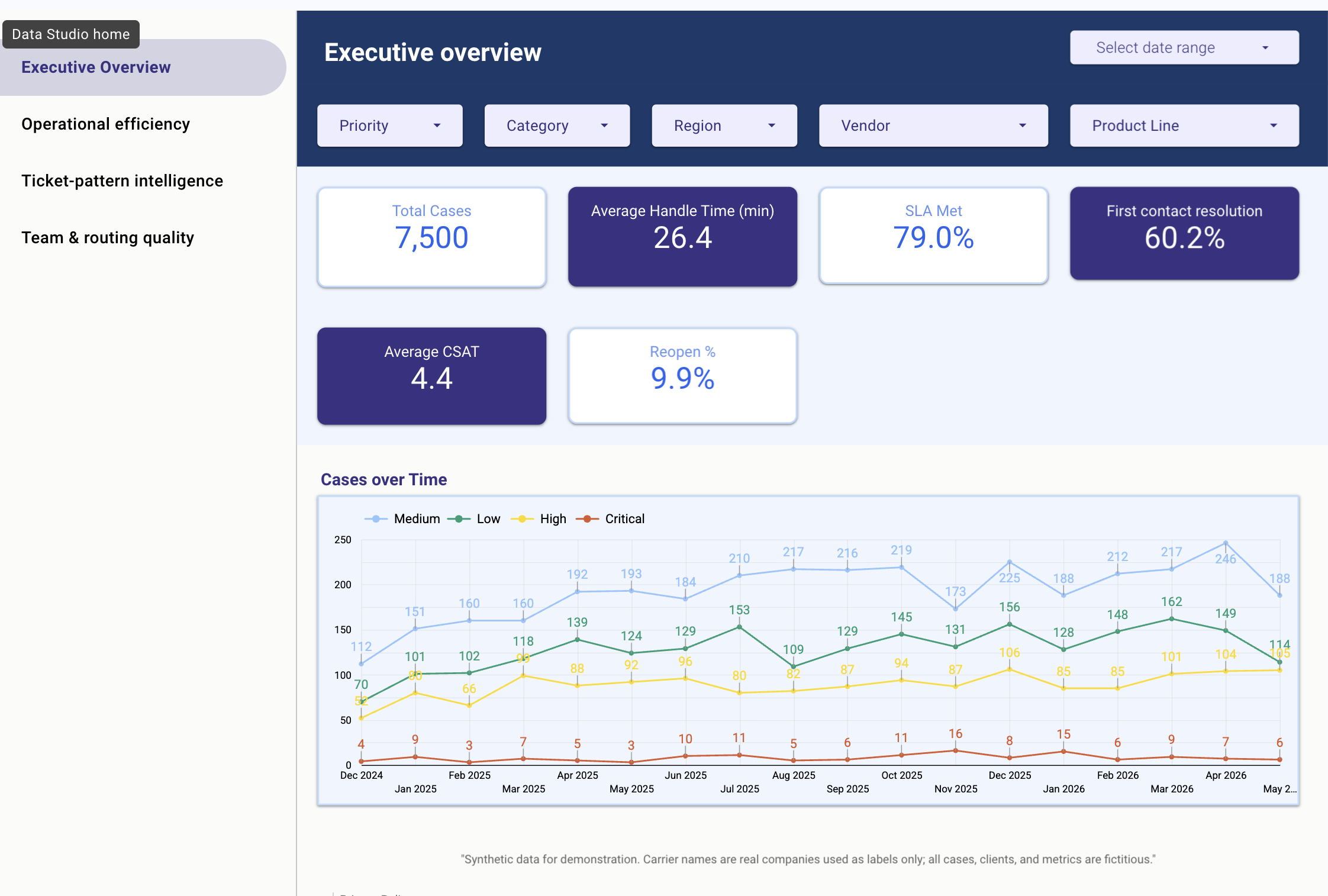
KPI scorecards (7,500 cases · 26.4 min avg handle · 79.0% SLA met · 60.2% first-contact resolution · 4.4 CSAT · 9.9% reopen), case volume over time by priority, and page filters for priority / category / region / vendor / product line.
Operational efficiency — the ↑24%
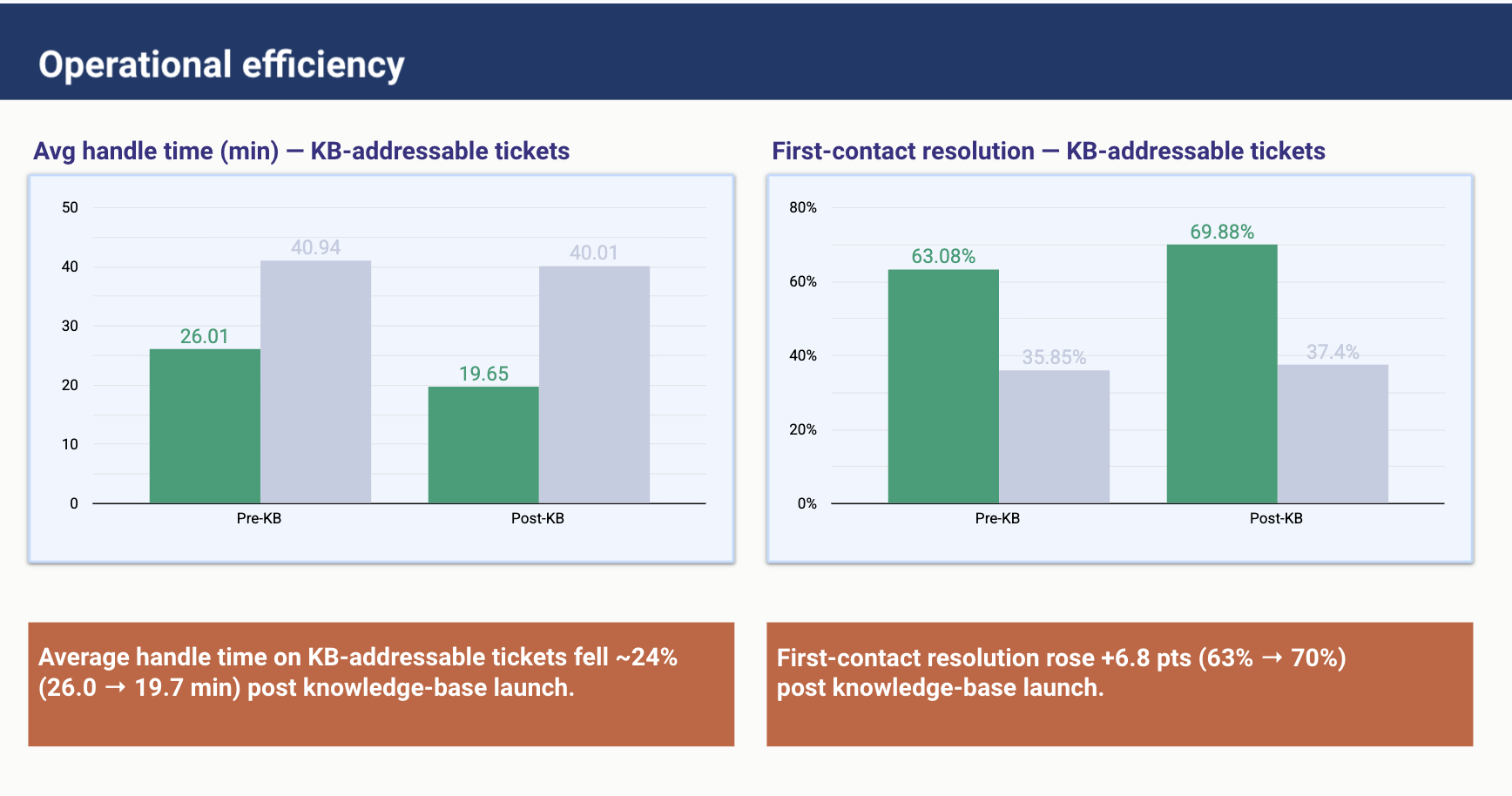
Pre/post-KB handle time (26.0 → 19.7 min, −24%) and first-contact resolution (63% → 70%, +6.8 pts) on KB-addressable tickets — each shown against a flat control group (non-KB-addressable: ~41 → 40 min, ~36% → 37% FCR), so the gain is attributable to the knowledge base, not a general efficiency trend.
Team & routing quality — intake mis-routing
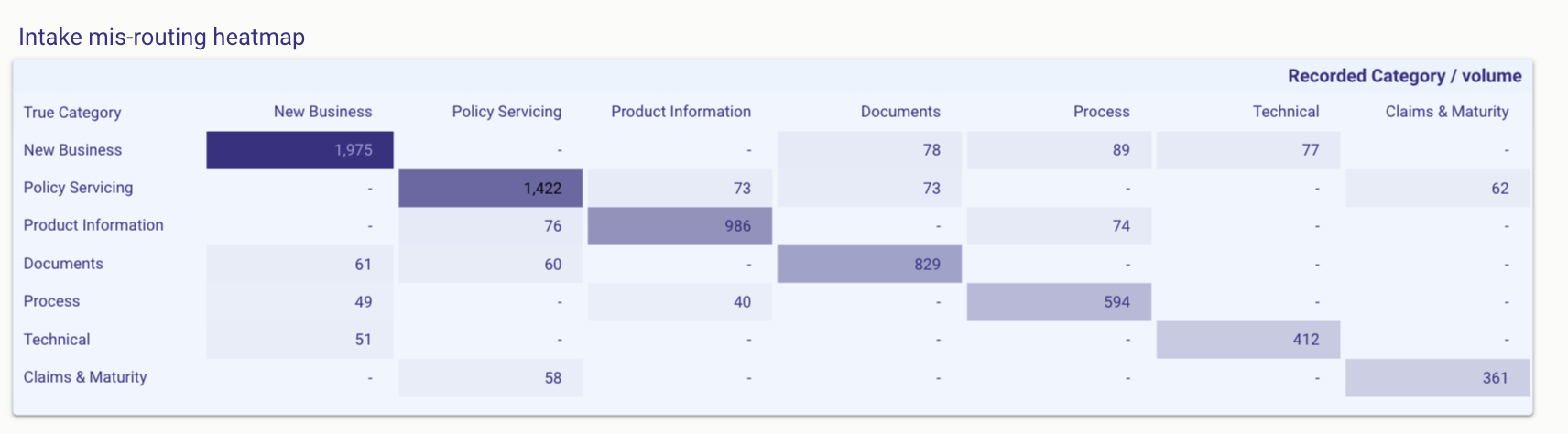
True vs. recorded category. The diagonal dominates; ~12% of tickets are routed to the wrong queue at intake (adjacent-category confusion, e.g. NIGO ↔ Documents) — the exact problem the triage bake-off (Tier 2) targets.
Warehouse lineage (dbt)
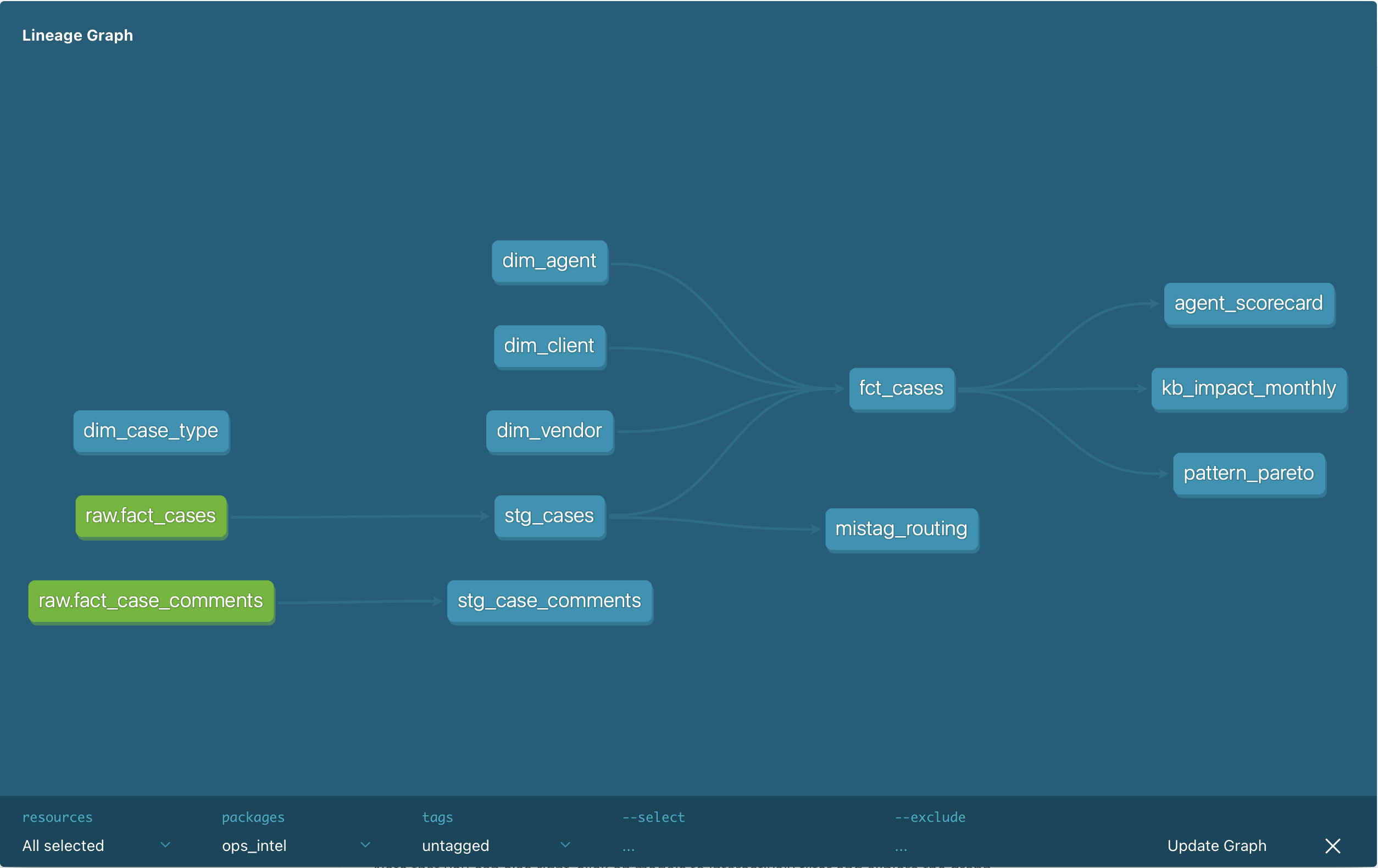
dimension seeds + fact sources → staging → marts, with data tests and generated docs.
(Two more pages not shown: Ticket-pattern intelligence — Pareto of volume by case
type + a cost-vs-fixability bubble; and the rest of Team & routing — agent scorecard
with conditional formatting and SLA & handle-time by category. Build steps: DATA_STUDIO_GUIDE.md.)
The analysis layers (the portfolio substance)
Three tiers, no stacked invented numbers — each result is measured.
Tier 1 — Classic ML (the Signal Advisors-style work)
analyze_patterns.py— ranks case types by a KB-opportunity score (volume × handle time × (1−FCR) × reopens) →out/ticket_patterns.csvand a prioritizedout/kb_backlog.csvwith estimated deflectable agent-hours/month.ml_patterns.py— unsupervised pattern discovery, honestly validated: TF-IDF → KMeans on raw client messages (no labels), scored against ground truth. Recovers the taxonomy at ARI ≈ 0.58 / NMI ≈ 0.85, 84% category accuracy, with NMF themes per cluster. Proves the patterns are real structure, not artifacts of the generator. Curated domain stop-list strips carrier names + intake boilerplate so clusters key on the issue.
Tier 2 — Triage bake-off: classic ML vs. Claude (ml_classify.py)
The centerpiece. Same task — route a message to 1 of 7 ops queues — scored two ways against ground truth that carries ~12% realistic intake-tag noise:
- TF-IDF + Logistic Regression (trains on 6k examples): macro-F1 0.855.
- Claude zero-shot (no training data): macro-F1 0.833.
- On the 150-ticket head-to-head, the classifier edges Claude (0.865 vs 0.833) and recovers the true queue on intake-mislabeled tickets 94.7% vs Claude's 84.2%.
The takeaway is judgment, not "the LLM wins": for a high-volume, well-defined task with labeled history, a $0 classifier beats a per-call LLM — so route triage to the cheap model and reserve Claude for the zero-training-data cold start, KB drafting, and reply assist (Tier 3).
Tier 3 — Claude assist
ml_classify.py --draft— Claude drafts first-response replies for sample tickets (out/draft_replies.md). A demo of the assist layer, not a metric claim.analyze_patterns.py --llm— Claude drafts self-serve KB articles for the top patterns from representative client messages (out/kb_articles.md); falls back to a deterministic template when no key is set, so the pipeline always runs.
export ANTHROPIC_API_KEY=...
# optional cheaper model for the high-volume classification:
export OPS_LLM_MODEL=claude-haiku-4-5   # default is claude-opus-4-8
python ml_classify.py --claude --sample 150 --draft
Reproducibility
Seeded (random/numpy seed = 7) — every run produces the same dataset.
Tunables at the top of simulate_ops_data.py: N_CASES, START/END,
KB_LAUNCH, team roster, client count, and the case-type catalog.