
Apex Prime - CONSUME Architecture Assessment
Haris88m/agentic-os-audit
Arquitetura de agentes com avaliação numérica reproduzível e safety mecânico
Ver no GitHubAgent de avaliação profissional da arquitetura CONSUME para sistemas autônomos, com simulações numéricas reproduzíveis em Python puro. Analisa crescimento de capacidade, custos BYOM, resiliência a choques de providers, alavancagem de consumo e segurança de autonomia através de evidências verificáveis.
Instalação
npx convez-ai Haris88m/agentic-os-audit1 comando no terminal: detecta o formato do repositório (marketplace ou plugin avulso) e instala via Claude Code. Requer Node 18+ e o Claude Code instalado.
Métricas
Casos de uso
- Avaliação arquitetural de sistemas de agentes autônomos
- Análise de custo-benefício entre estratégias de harness vs. consumo de ecossistema
- Simulações de resiliência a mudanças de providers de LLM
- Planejamento de implementação de autonomia com gatilhos de segurança
Veredito

Projeto rigoroso e técnico que combina arquitetura de agentes com simulações determinísticas e reproduzíveis. Ideal para equipes buscando implementar autonomia com controle mecânico de segurança e minimizar lock-in de providers — os números são argumentos executáveis, não marketing.
README
A tradução para o português deste README ainda está na fila.
Apex Prime — The CONSUME Architecture
A Professional Engineering Assessment, in Numbers





Architecture & design: Haris Mekic (MEKreflect) · Assessment & simulations: Claude (Anthropic) · 2026-06
The thesis, in the architect's words: "It's not a harness. It's CONSUME."
A harness ships an environment and optimizes agents inside it. The CONSUME architecture inverts the relationship: harnesses, models, frameworks and the open-source ecosystem are raw material — consumed one-way through a license/value intake gate, re-implemented as owned modules, run behind a mechanical human-gate layer with a hard safety floor, and sealed on the way out. The model is a replaceable engine behind one knob. The memory is plain files. The autonomy is an architectural property with a mechanical conscience — not a model behavior.
This repository is a professional engineering assessment of that design: what it is, how any team can implement it, what it is worth in numbers, and how it compares to the harness strategy at the head of the category. Every figure is generated by a deterministic, stdlib-only simulation suite you can re-run in seconds — the numbers are an argument you can re-execute, not a brochure.
Headline numbers
| Finding | Evidence | |
|---|---|---|
| 4.5× | capability growth advantage of gated ecosystem consumption over harness-native optimization at 36 months (base scenario; 3.1–5.8× across sweeps) | SIMULATED |
| 30.9× | per-task cost spread harvested by the BYOM engine knob — $1.16 frontier-pinned vs. $0.038 on the fleet's actual engine | VERIFIED arithmetic |
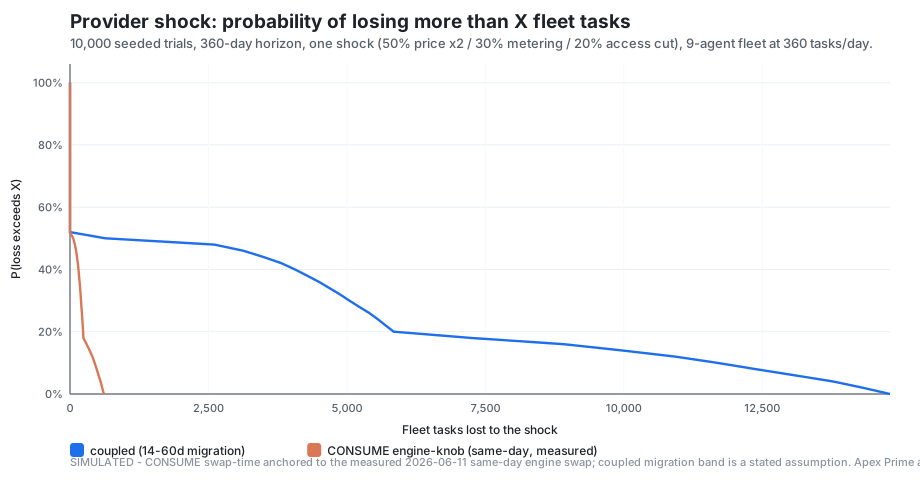
| 26× | fewer fleet tasks lost under a provider shock vs. a coupled architecture (1.2 vs. 30.6 mean days degraded) | SIMULATED, anchored |
| 3.0× | engineering leverage per owned capability via the consume intake gate (15h vs. 44h); ~3× yearly capability throughput | SIMULATED |
| −47% | expected unsafe pass-through at maximum autonomy, bought by the design's always-gate-high-risk floor for ≈3 human reviews/day | SIMULATED, anchored |
| 10.533B | tokens the real system processed in 19 recorded build days (95.6% cache-read; ≈$26.9K API-equivalent, not cash) — one operator, with AI; plus 165 skills, 247 logged iterations, 91 failure immunities, measured live | MEASURED |
And the two measured proof events (2026-06-11): the production 9-agent fleet swapped its entire reasoning engine to a different provider same-day (designed → implemented → sealed → verified live 9/9) four days ahead of a provider billing change; and the architecture's published Apache-2.0 reference shell passed a stranger's clean-room run — 8/8 verification, 160/160 tests — during which the consume method found and same-day-fixed a real metering defect in its own artifact. VERIFIED.
The assessment
| # | Document | What it answers |
|---|---|---|
| 00 | Executive Assessment | The design, the numbers, the proof events, the verdict — in four pages |
| 01 | The Architecture | Apex Prime at pattern level: the CONSUME gate, the BYOM knob, the autonomy floor, file memory, the seal, the fan-out, the regression bank |
| 02 | Implementation Guide | How a team adopts the architecture: six stages with acceptance criteria, three adoption profiles, the real failure modes |
| 03 | The Numbers | The five-study simulation report: models, anchors, results, honest readings |
| 04 | CONSUME vs. Harness | The founder thesis tested against the category's 213K-star harness flagship — with the asymmetry that decides the argument |
| 05 | Limits & Reproducibility | Everything that bounds these claims, in one honest place |
| 06 | The Real System — Full Data | The veil off, at the architect's order: the real system (ALFRED, the Apex architecture), its self-improvement loop, and every number measured live from its own substrate — 165 skills, 247 logged iterations, 91 failure immunities, 10.533B tokens |
| 07 | Fable, Unsealed | The engine speaks for itself: the model's own unsoftened opinion of the system it runs inside — what is real, what is weak, where it can go — published exactly as written |
| — | References · Simulation suite · Measured snapshot · v1 audit (archived) |
Run the numbers yourself
git clone https://github.com/Haris88m/agentic-os-audit
cd agentic-os-audit/simulations
python run_all.py     # Python 3.10+, standard library only, deterministic
Five studies, ~3 seconds, every chart and table in this repository regenerated.
Evidence standard
Every non-trivial claim is labeled VERIFIED (public artifact or re-runnable computation), PARTIAL (supported, bounded), SIMULATED (stated model; anchored parameters cited, assumptions sensitivity-swept), or MEASURED (live walk of the real system's own substrate, method published). No claim of outperforming frontier models, of full sovereignty, or of "AGI" appears anywhere, by standing policy. Docs 00–05 describe the architecture at pattern level; doc 06 drops the veil at the architect's explicit order and assesses the real running system with its real names and measured numbers — only credentials and personal data stay out, as basic security. Doc 05 carries the full honesty ledger, including what this assessment is not (it is not an independent third-party audit, and says so).
Built with Claude
The architecture, the CONSUME stance, the autonomy-policy design and the engineering direction are the work of Haris Mekic. The implementation, this assessment, and the simulation suite were written, tested and mechanically verified by Claude (Anthropic) operating under the architect's human-gated workflow — the same gate-layer discipline the assessment describes. The relationship is disclosed everywhere it matters: this is an architect-directed AI-authored assessment with a public evidence standard, not an independent audit.
Related: the architecture's published reference shell — a verifiable, gate-first, BYOM agent-OS — lives at Haris88m/servari-open (Apache-2.0).
License
CC-BY-4.0 — share and adapt with attribution. The simulation code in simulations/ is yours to re-run, modify and extend under the same terms.