
TRADING-BOT
Hafida3/TRADING-BOT
Autonomous AI trading agent · Claude-powered ReAct loop · 8+ weighted signals · coded governance gates · 24/7 on Linux VPS · real-time Matrix dashboard
Instalação
npx convez-ai Hafida3/TRADING-BOT1 comando no terminal: detecta o formato do repositório (marketplace ou plugin avulso) e instala via Claude Code. Requer Node 18+ e o Claude Code instalado.
Métricas
README
A tradução para o português deste README ainda está na fila.
Oracle — SOL/USDC Autonomous Trading Agent
An autonomous AI trading agent running 24/7 on a Linux VPS, where a Claude-powered ReAct loop makes trading decisions under the supervision of hard-coded governance gates. Built as a deep exploration of one question: how do you let an LLM trade — and how do you stop it when it's wrong?
Philosophy: signals propose, the LLM can refuse, the code decides.
https://github.com/user-attachments/assets/d56fae52-928c-401f-b4fc-6b3f3fc3fa76
Live Dashboard — Matrix Trader
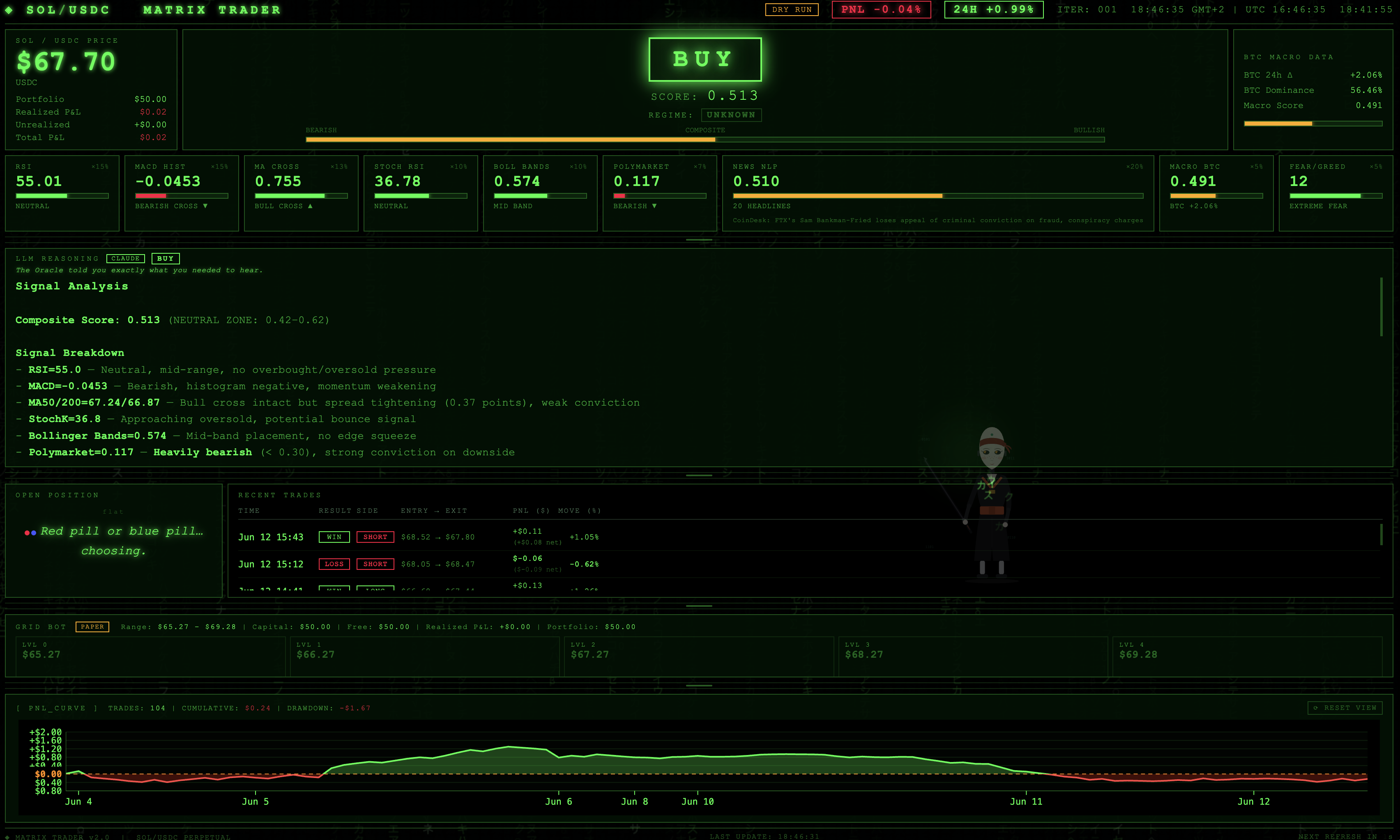
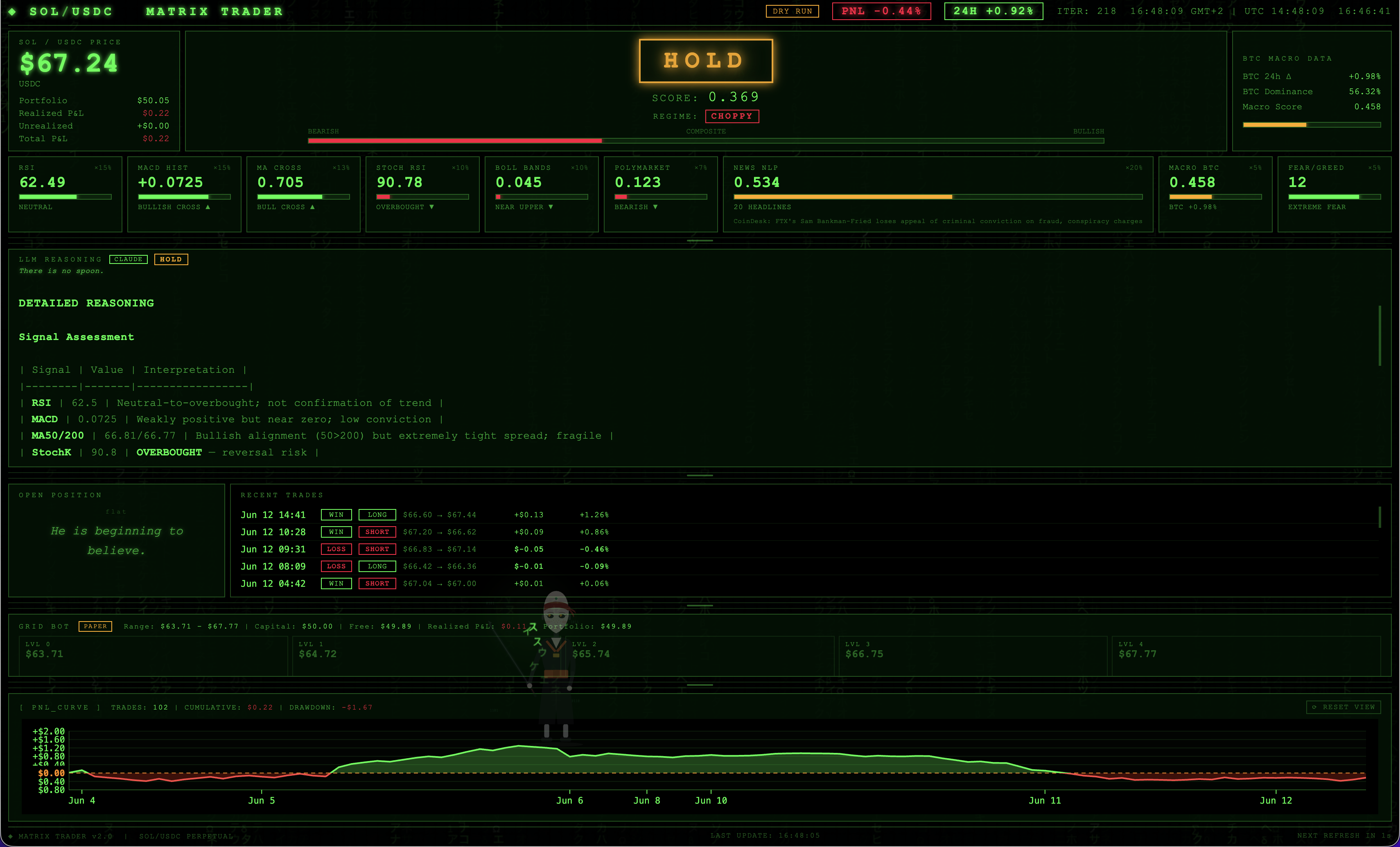
Real-time monitoring served by the bot itself (vanilla HTML/JS, no build step):
- Live PnL curve — pan, wheel-zoom, crosshair tooltip, per-trade markers
- LLM Reasoning panel — the agent's full chain of thought for every tick, rendered as markdown, with the model source badge (CLAUDE / GROQ / FALLBACK)
- Gate-status indicators — when the LLM says BUY but a gate blocks it, the dashboard says so:
THE DOOR IS LOCKED, NEO(consensus gate) orDENIED BY THE ARCHITECT(hard rule veto) - R_Pulse — an animated avatar overlay drifting across the dashboard, reflecting live health, regime and open positions, with a particle trail and state-colored aura
- Grid bot panel, signal bars, regime badge, BTC macro data
Accessible locally at http://localhost:8080, or through an SSH tunnel when deployed:
ssh -L 8080:localhost:8080 user@your-vps
Decision Engine — Claude + ReAct
Every 300 seconds, the agent runs a full Observe → Reason → Act → Reflect cycle:
| Step | What happens |
|---|---|
| Observe | Collect 9 weighted signals + market regime (ADX/ATR) + memory of recent trades |
| Reason | Claude Haiku (primary LLM) reasons across all signals with soul.md injected as its constitution; Groq serves as automatic failover if the Anthropic API is unavailable |
| Act | Proposed action passes through the governance gates; only then is it executed — paper account or Jupiter v6 (live) |
| Reflect | Full decision + reasoning logged to SQLite; risk manager updates PnL, drawdown, cooldowns |
Identity & constitution: soul.md defines the agent's mission, values, and absolute rules. It is injected into every LLM prompt — the agent literally reads its own law before each decision.
Agent memory: memory.md accumulates per-trade lessons; a deeper weekly reflection runs on Claude Sonnet every 2016 ticks (~7 days) to extract structural insights from the week's trades.
Self-tuning: the LLM can emit TUNE directives (e.g. TUNE BUY_THRESHOLD 0.58) to adjust its own parameters within hard-coded whitelisted bounds. A 6-hour cooldown per parameter prevents oscillation thrashing. Every tune is logged and audited.
Governance Architecture — the interesting part
An LLM agent that can always override its own rules is not a governed system. After watching the agent cite a rule and violate it in the same sentence ("Rule violation if I BUY here" → buys), governance moved from prompt to code:
┌──────────────────────────────────────────────────────────┐
│  Layer 1 — RULE_VETO (hard-coded, non-negotiable)        │
│  e.g. no LONG when regime=RANGING and macro < 0.50.      │
│  Lives in risk_manager.check_trade(). The LLM cannot     │
│  talk its way past it.                                   │
├──────────────────────────────────────────────────────────┤
│  Layer 2 — CONSENSUS GATE                                │
│  Opening a position requires BOTH the LLM decision AND   │
│  the composite score to agree (LONG: LLM=BUY AND         │
│  composite ≥ BUY_THRESHOLD). The LLM keeps an unlimited  │
│  veto; exits are always free.                            │
├──────────────────────────────────────────────────────────┤
│  Layer 3 — RISK MANAGER                                  │
│  Position sizing caps, SL/TP, max drawdown halt,         │
│  reversal cooldown between direction flips.              │
└──────────────────────────────────────────────────────────┘
Every blocked decision is tagged in the logs and auditable:
[RULE_VETO]       LONG blocked | regime=ranging macro=0.439 composite=0.688 LLM=BUY
[CONSENSUS_BLOCK] LLM=BUY composite=0.422 < BUY_THRESHOLD=0.58 — no LONG opened
The governance works in both directions: the code blocks the LLM's impulses, and the LLM vetoes the code's green lights (it has refused technically-valid entries during extreme fear). Both behaviors are observed in production logs.
Signals — 9 weighted sources
| Source | Weight | Notes |
|---|---|---|
| News NLP | 20% | NewsAPI + local VADER — real-time crypto sentiment |
| RSI | 15% | Wilder's RSI, oversold/overbought zones |
| MACD | 15% | Histogram momentum + zero-line crossover |
| MA Crossover | 13% | MA50/MA200 cross — price history persisted across restarts |
| Stochastic RSI | 10% | Fast oscillator for short-term exhaustion |
| Bollinger Bands | 10% | Band position for mean-reversion context |
| Polymarket | 7% | Prediction-market probabilities (Gamma API) |
| Macro BTC | 5% | BTC 24h change (tanh) + dominance |
| Fear & Greed | 5% | Contrarian: extreme fear → bullish bias |
Composite score in [0, 1]. Unavailable sources have their weight redistributed proportionally — no phantom neutral votes.
Thresholds (current, self-tunable): score ≥ 0.58 → BUY · score ≤ 0.38 → SELL · else HOLD Regime detection: ADX/ATR classifies TRENDING / RANGING / UNKNOWN with a 3-candle confirmation buffer; regime conditions feed the governance gates.
Fee-aware accounting
Paper trading simulates Jupiter swap fees (0.15% per side, 0.30% round trip). Every trade records gross_pnl, fee_usdc, and net_pnl — because a +0.06% "win" on a $10 position is a net loss after fees, and pretending otherwise produces strategies that only work on paper. All displays and reports use net.
Deployment — 24/7 on a VPS
The agent runs unattended on a Hetzner VPS (Ubuntu, systemd):
- systemd service with
Restart=always— survives crashes and reboots; state restored from SQLite in seconds - Daily backups (cron, 14-day rotation)
- Bi-daily Telegram reports (09:00 & 21:00 Paris): total PnL, 24h window, 12h session stats with win rate, best/worst, last 5 trades
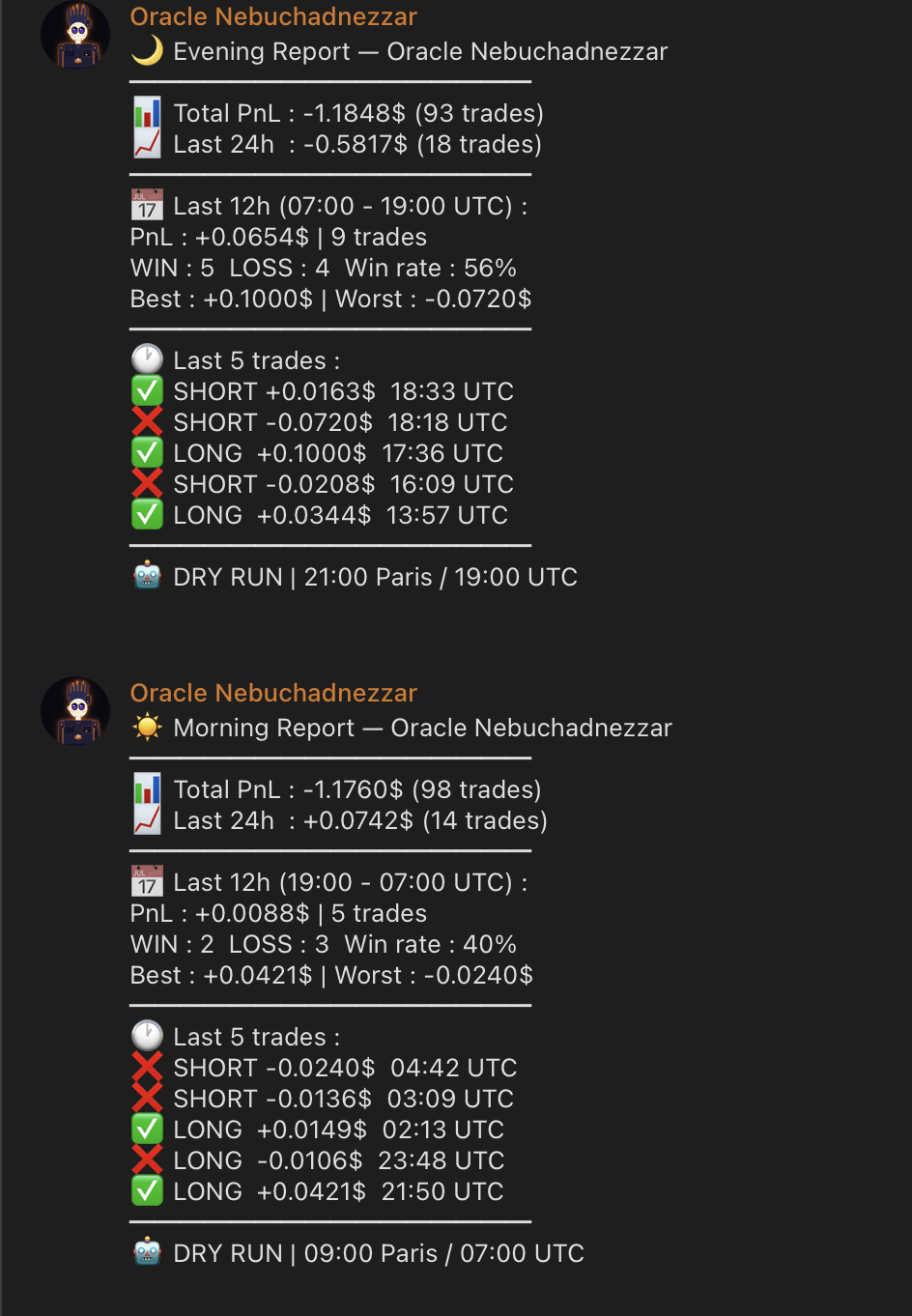
- Deploy workflow: edit locally → commit + push →
git pull && systemctl restarton the VPS - Dashboard reached through an SSH tunnel (never exposed publicly)
Validation methodology
The agent is currently in a 14-day frozen-logic validation window (paper trading): no strategy changes allowed except critical bug fixes, a defined intervention tripwire (net PnL ≤ −$2.50 or 3 consecutive negative days with no spontaneous tune), and a scheduled review with pre-collected evidence. Discoveries so far — a directional blind spot in a gate rule, a "dead law" in soul.md the LLM cited but the code never executed — are documented and queued for the review, not hot-fixed. Discipline beats reactivity.
Architecture — 5 layers
Layer 1  data/       price_feed.py      CoinGecko SOL/USDC prices + OHLCV bootstrap
                     polymarket.py      Polymarket Gamma API
                     news_sentiment.py  NewsAPI + VADER local NLP
                     macro.py           BTC 24h % change + dominance
                     fear_greed.py      Crypto Fear & Greed Index (contrarian)
                     database.py        SQLite persistence (trades, signals, grid)

Layer 2  analysis/   indicators.py      RSI, MACD, Stoch RSI, Bollinger, MA cross
                     regime.py          TRENDING / RANGING detection (ADX/ATR)

Layer 3  decision/   signal_engine.py   Weighted composite score
                     (LLM ReAct loop)   Claude Haiku primary / Groq failover
                     parameter_tuner.py TUNE directives, bounds, cooldowns

Layer 4  risk/       risk_manager.py    Gates (RULE_VETO, consensus), sizing,
                                        SL/TP, drawdown guard, reversal cooldown

Layer 5  execution/  wallet.py          AES-encrypted Solana hot wallet
                     jupiter.py         Jupiter v6 SOL⟷USDC swaps
                     grid_bot.py        Parallel grid strategy (auto-ranging)
Quick Start
git clone https://github.com/Hafida3/TRADING-BOT.git
cd TRADING-BOT
pip install -r requirements.txt
cp .env.example .env        # add your ANTHROPIC_API_KEY (Telegram/NewsAPI optional)
python main.py              # paper trading by default — no wallet needed
Dashboard: http://localhost:8080 · Stats API: http://localhost:8080/stats
Backtesting
python main.py --backtest 365
365-day backtest through a −52% SOL bear market: +0.31% strategy PnL vs −47.38% buy & hold, profit factor 2.49, max drawdown 2.3%. (Backtest uses technical signals only; live API sources are not replayable.)
Live trading
Generate an encrypted hot wallet (python generate_wallet.py), fund it, set DRY_RUN=false. Live trading involves real funds — validate extensively in paper mode first. Note: short positions are paper-only; Jupiter spot executes longs only.
Configuration Reference (selected)
| Variable | Default | Description |
|---|---|---|
DRY_RUN | true | Paper trading — no real swaps |
LOOP_INTERVAL_SECONDS | 300 | Tick interval |
TRADE_AMOUNT_USDC | 10.0 | USDC per signal trade |
MAX_POSITION_SIZE_PCT | 0.25 | Max 25% of free USDC per trade |
MAX_DRAWDOWN_PCT | 0.15 | Halt new trades at −15% drawdown |
BUY_THRESHOLD / SELL_THRESHOLD | 0.58 / 0.38 | Self-tunable within bounds |
STOP_LOSS_PCT / TAKE_PROFIT_PCT | env | Self-tunable within bounds |
FEE_RATE_PCT | 0.0015 | Simulated swap fee per side |
REVERSAL_COOLDOWN_TICKS | 3 | Ticks before reversing direction |
DASHBOARD_PORT | 8080 | Local dashboard port |
Roadmap
- Reconcile
soul.mdand code in both directions (implement or repeal dead laws; document unwritten ones) - Directional regime gate (block longs in bearish trends, not only ranges)
- TP ≥ 1.5×SL coherence constraint in the self-tuner
- ATR-adaptive stops; per-regime conditional setups
- Single source of truth for PnL across dashboard / Telegram / DB
- Spot-vs-perp decision for shorts before any live deployment
Built with
Developed with Claude (Anthropic) as a coding and architecture partner — and, fittingly, Claude Haiku runs the live decision loop. The governance gates exist precisely because the builder doesn't fully trust the decision engine. That's the point.