
FuseBase Flow
fusebase-dev/fusebase-flow
Framework com dois agentes IA para entregar apps client-facing sem SaaS ou runtime proprietário
Ver no GitHubFramework para times client-facing construírem apps internos e voltados para clientes com IA. Usa dois agentes especializados — um Product Owner que define o que construir e um AI Developer que implementa e deploya — eliminando problemas reais como drift de contexto, scope creep e handoffs confiáveis.
Instalação
npx convez-ai fusebase-dev/fusebase-flow1 comando no terminal: detecta o formato do repositório (marketplace ou plugin avulso) e instala via Claude Code. Requer Node 18+ e o Claude Code instalado.
Métricas
Casos de uso
- Desenvolvimento de apps internas e client-facing com coordenação de agentes IA
- Eliminação de problemas de drift de contexto e scope creep em projetos colaborativos
- Implementação rápida de dashboards, portais de suporte e marketplaces com IA
Veredito

Framework sólido e prático com pedigree real — construído por empresa com 11 anos de mercado. Resolve problemas tangíveis de colaboração entre agentes IA e entrega confiável, mas exige conhecimento técnico intermediário e funciona melhor em ecossistemas específicos (Claude, Cursor, etc).
README
A tradução para o português deste README ainda está na fila.
FuseBase Flow
The framework client-facing teams use to build internal and client-facing apps with AI.
🌐 Read this in: 🇪🇸 Español · 🇫🇷 Français · 🇩🇪 Deutsch · 🇧🇷 Português · 🇯🇵 日本語 · 🇨🇳 简体中文
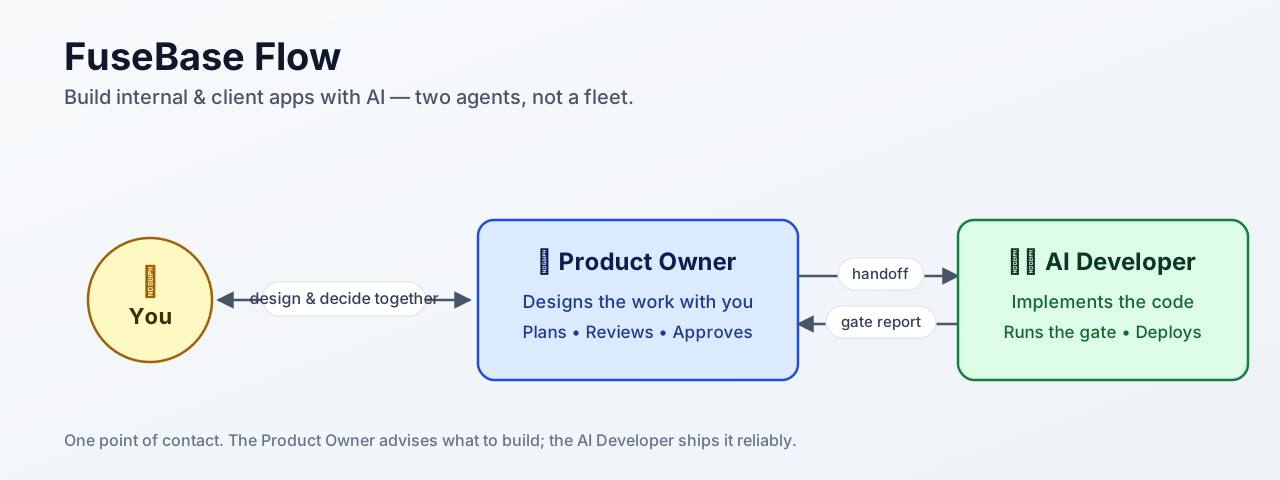





A development framework for client-facing businesses and teams, FuseBase Flow covers what breaks during real app development for internal and external collaboration — drift, context rot, scope creep, unreliable hand-offs — so two AI agents (a Product Owner and an AI Developer) can ship reliably.
It shapes your existing AI agent through repo files — no SaaS, no daemon, no proprietary runtime. Works in Claude Code, Codex, Cursor, Copilot, and Gemini.
Built by FuseBase
FuseBase Flow is built and maintained by FuseBase (Nimbus Web Inc.) — a US company building client-facing collaboration software since 2014 (11 years). It's the framework FuseBase itself uses to ship apps, backed by a proven product track record:
- 🏆 Product Hunt — Product of the Day, Week, Month & Year (team collaboration)
- 🥇 3× top-selling deal on AppSumo
- ⭐ ~600 five-star reviews
FuseBase Flow isn't an experiment — it's the workflow a real product company runs on.
Built with FuseBase Flow
Real client-facing apps — a help-desk, a rental marketplace, an adoption-analytics dashboard, a training portal, a client-interview workspace, and more — built with FuseBase Flow on FuseBase Apps, by the community in a few days.
🔎 Explore the full gallery → ai-dev.thefusebase.com · Built something with FuseBase Flow? Share it in Show and tell — standout projects get featured here.
Who it's for
- Agencies, consultancies, and client-facing teams building apps for both their own internal operations and their clients.
- Teams who want to productize their expertise — turn the knowledge only you have into apps and systems you deliver, internally and to clients.
- Anyone who's hit the wall where one AI chat gets clogged, the model drifts, and a half-built app stops being trustworthy.
Why a framework (and why two agents)
Building real apps with an AI agent breaks in predictable ways: one chat fills up and the model drifts; context rot makes later edits contradict earlier ones; a single mega-prompt smuggles in scope creep; and work handed between sessions loses its thread. FuseBase Flow closes those gaps with a disciplined loop run by two agents — a consultant and a builder, not a sprawling fleet. The simplicity is the point.
| Agent | Role |
|---|---|
| Product Owner | Your single point of contact. Consults on what to build and how to build it right, then breaks the work into phases and slices. Owns Specify -> Clarify -> Plan -> Decisions -> Tasks -> Review -> deploy hand-off. |
| AI Developer | The builder. Executes each slice one task = one commit, stops at a verification gate, and deploys only on approval -- in a separate session so the main context stays clean. |
flowchart LR
    Client([Client / team request]) --> S[📋 Specify]
    S --> C[❓ Clarify] --> P[🗺️ Plan] --> D[🔒 Decisions] --> T[✅ Tasks / slices]
    T --> V[🚦 Verify gate]
    V -->|handoff| I[⚙️ Implement<br/>one task = one commit]
    I --> R[🔍 Review] --> H[📦 Deploy handoff] --> X[🚀 Deploy] --> Done([Shipped])
    style Client fill:#fef9c3,stroke:#a16207
    style S fill:#dbeafe,stroke:#1d4ed8
    style V fill:#fff3e0,stroke:#f57c00
    style I fill:#dcfce7,stroke:#15803d
    style X fill:#dcfce7,stroke:#15803d
Product Owner (blue) is the single point of contact -- consults, advises, and breaks work into phases and slices. AI Developer (green) builds and deploys. The full eight-phase procedure lives at workflows/eight-phase-flow.md.
How it stays reliable
- No drift -- the Product Owner (advise) and AI Developer (build) split the work so neither chat clogs and the model stays on target.
- Phases -> slices -- complex work is decomposed Jira-style into reviewable slices, never one risky mega-prompt.
- Durable hand-offs -- work survives session resets with full context, so a fresh chat picks up without fatigue.
- Many small apps, not one monster -- a product is composed of focused apps, so one failure can't sink the whole system.
- Ceremony scales with risk (FR-21) -- a small, reversible change takes the Lightweight lane (one change-note, one build→verify→deploy pass, a plain "ship it" go-ahead) instead of the full spec→decisions→tasks→gate chain; risky/uncertain work takes the full lane. The safety floor -- live proof, an explicit deploy go-ahead, protected-path check, rollback -- is kept either way.
What it costs
FuseBase Flow runs natively in your IDE through the FuseBase CLI. There are no per-token platform fees -- you pay only for the AI subscription you already have (Claude Code, Codex, Cursor, Gemini, or Copilot).
Coming from ad-hoc agent prompting?
If today you open Claude Code / Codex / Cursor and just say "build me X", you already have everything FuseBase Flow needs -- it doesn't replace your agent, it gives it a process:
| Without FuseBase Flow | With FuseBase Flow |
|---|---|
| One giant prompt -> one giant diff you have to trust | Spec -> decisions -> tasks -> one-commit-per-task you can review |
| "It worked on my machine" | Verification gate + outcome-based smoke before deploy |
| Scope creep mid-session | Locked decisions; supersede discipline (FR-18) |
| Re-explaining context every session | Durable repo artifacts (docs/specs/, docs/tmp/handoff/) |
| Risky deploys | Deploy gated on an explicit approval artifact |
Nothing to uninstall from your agent -- drop the files in, attest once, keep working.
Contents
- Built by FuseBase
- Who it's for
- Why a framework (and why two agents)
- How it stays reliable
- What it costs
- Coming from ad-hoc agent prompting?
- What's in the box
- Quick start (GitHub template)
- Filing your first ticket
- Supported agents & IDEs
- Using sub-agents
- Skill catalog
- Installing into an existing project
- Health check & recovery
- How enforcement works
- Default workflow modes
- Validating an installation
- FAQ & troubleshooting
- What's inside
- Clean-room, license & publishing
What's in the box
FuseBase Flow has two layers. Flow is the lifecycle: specs, decisions, tasks, gates, reviews, deploy handoffs, and smoke discipline. The bundled FuseBase Apps domain skills are the build layer: app architecture, FuseBase CLI usage, dashboards, gate, secrets, routing, logs, and scaffold checks — so the agent can ship real apps, not just plan them.
See docs/fusebase-cli-edition.md for the layer boundary map and overlap table.
| Is | Isn't |
|---|---|
| Repo-local discipline (rules, skills, workflows, hooks, policies, templates) | A coding agent or chat product |
| A GitHub template you copy into projects | A SaaS or external service |
| Tool-portable across multiple AI coding surfaces | Tied to one vendor |
| Stdlib-first Python + bash + git | Requires heavy frameworks (FastAPI, daemons, servers) |
| Local-only hooks | Network webhooks |
Quick start (GitHub template)
-
On GitHub, click "Use this template" → "Create a new repository".
-
Clone your new repo locally.
-
Open the repo in your IDE / agent of choice. The agent reads
AGENTS.mdfirst; from there it followsFLOW_RULES.md. -
(Optional) Run the convenience installer:
bash install.shThis installs git fallback hooks, runs preflight, and offers to mirror canonical skills into the provider folders. It does NOT install heavy dependencies and does NOT require any external service.
-
Install the runtime dependency for hook handlers:
pip install -r hooks/requirements.txt(Only PyYAML; ~100 KB.)
Or install as a Claude Code plugin
Prefer one command? Add the marketplace and install — skills, commands, and sub-agents load namespaced:
/plugin marketplace add fusebase-dev/fusebase-flow
/plugin install fusebase-flow@fusebase-flow
Optimize it for your project (optional)
Out of the box FuseBase Flow runs generically. To steer it toward your team's vision, run onboarding — the Product Owner interviews you, then writes the project artifacts (North Star, audience, per-app product docs) that the rest of the skills read:
/onboard          # Product Owner discovery interview → writes docs/north-star.md, etc.
/product-owner    # start a Product Owner session for a ticket
Skipping is fine — nothing is created unless you provide it, and the framework behaves exactly like a generic install until you opt in.
Filing your first ticket
- Tell the agent: "Let's ship
<feature description>." - The agent invokes the
requirements-specificationskill, draftsdocs/specs/<slug>/spec.md, and runs clarify questions. - After clarify resolves, the agent invokes
implementation-planningto producedecisions.md,tasks.md,verification-gate.md, plus a saved handoff atdocs/tmp/handoff/<YYYY-MM-DD>-<slug>-implement.md. - Open a fresh agent session, paste the handoff, and the AI Developer executes the task chain — stopping at the verification gate.
- Paste the gate report back to the originating session. Run
code-review;security-permissions-reviewruns only when the diff touches a sensitive surface (auth/secrets/env/deploy config/external messages/production data), else the review recordssecurity: N/A — no sensitive surface. - If clean, the operator says "prepare deploy" — the
release-deploy-reportingskill drafts the deploy handoff, you paste it into the AI Developer session, deploy runs, probes and outcome-based smoke verify.
The full eight-phase lifecycle lives at workflows/eight-phase-flow.md.
Docs layout. Your own ticket artifacts are created on demand — nothing to scaffold. (The template tree does carry FuseBase Flow's OWN dev history under docs/specs/, docs/changes/, docs/release-notes/, docs/backlog/ — upstream framework records, not your project's; the existing-repo copy commands below copy only the live framework docs, never the dev history.) Expected paths once you start: docs/specs/<slug>/ (spec · decisions · tasks · verification-gate), docs/tmp/handoff/ (cross-session handoffs), docs/changes/ (Lightweight-lane ledger, opt-in), docs/backlog/ (parked tickets). Run /onboard first if you want project artifacts (docs/north-star.md, project values) before ticket #1.
Supported agents & IDEs
Get started — find your tool, do the one step. (After Use this template → clone → open the repo in your tool of choice.)
| Your AI tool | Then do this |
|---|---|
| Claude Code | Auto-reads CLAUDE.md. Say "Let's ship <feature>." — or tailor it first with /onboard, or install as a plugin: /plugin marketplace add fusebase-dev/fusebase-flow |
| Codex | Say "Read AGENTS.md and follow FLOW_RULES.md," then "Let's ship <feature>." |
| Cursor | Rules auto-load from .cursor/rules/. Say "Let's ship <feature>." |
| GitHub Copilot / VS Code | .github/copilot-instructions.md auto-loads. Say "Let's ship <feature>." |
| Gemini | Reads GEMINI.md + AGENTS.md. Say "Let's ship <feature>." |
Compatibility files per tool:
- Anthropic Claude Code —
CLAUDE.md,.claude/skills/,.claude/settings.json.example - OpenAI / ChatGPT Codex —
AGENTS.md,.agents/skills/,.codex/config.toml.example,.codex/hooks.json.example - Cursor —
.cursor/rules/*.mdc,AGENTS.md - GitHub Copilot / VS Code —
.github/copilot-instructions.md,.github/instructions/*.instructions.md,AGENTS.md - Gemini / Antigravity-style IDE agents —
GEMINI.md,AGENTS.md - Generic local repo workflows —
AGENTS.md+ root-level framework dirs (flow-skills/,workflows/,policies/,templates/,hooks/) + git fallback hooks + local scripts
.claude/skills/ and .agents/skills/ include both canonical Flow skill mirrors and FuseBase Apps domain skills. The audit mirror manifest tracks the Flow mirrors only.
The full surface support breakdown lives at docs/compatibility.md.
Using sub-agents
Two role-shaped sub-agents cover the full eight-phase lifecycle. They are opt-in — the framework remains fully usable via the skill-and-workflow pattern alone — but they make role boundaries explicit and harder to drift across.
| Sub-agent | Owns | Skills it invokes |
|---|---|---|
| Product Owner | Specify, Clarify, Plan, design discovery/ideation, Decisions, Tasks, draft-verification-gate, smoke contract definition, clean-room skill classification, post-implement code-review (+ security-permissions-review when the diff matches its trigger list), deploy-handoff drafting, spec DRAFT→DONE flip, plus Architect responsibilities inline on escalation (>10 files / cross-cutting refactor / platform blocker / blocked migration) | requirements-specification, design-discovery-ideation, implementation-planning, smoke-testing, task-delegation, skill-authoring, code-review, security-permissions-review, release-deploy-reporting |
| AI Developer | Run gate, Implement T-chain (one task = one commit; stops at gate), implement approved framework skill changes, Run deploy command (gated on approval artifact, captures hash, runs probes and smoke evidence) | validation-and-qa, smoke-testing, task-delegation, skill-authoring, repo-onboarding-context-map |
Both sub-agents always load the mandatory communication and role-discipline skills.
FuseBase Flow also ships FuseBase Apps app-agents (app-architect, app-create-checker) as domain assets. They support FuseBase Apps architecture and scaffold validation; they do not replace the Flow Product Owner or AI Developer role agents.
Invoking from Claude Code
> Use the product-owner sub-agent. Let's ship pagination.
> Use the ai-developer sub-agent. Run docs/tmp/handoff/2026-05-09-pagination-implement.md.
Claude Code auto-discovers .claude/agents/<name>.md.
Invoking from Codex
Codex doesn't auto-discover sub-agent files. Reference them in the first message of a fresh session:
> Read .codex/agents/product-owner.md and operate as Product Owner per its instructions.
> Let's ship pagination.
> Read .codex/agents/ai-developer.md and operate as AI Developer per its instructions.
> Run docs/tmp/handoff/2026-05-09-pagination-implement.md.
Updating sub-agent definitions
Edit the canonical at agents/<name>/AGENT.md, then regenerate provider mirrors:
bash hooks/local/mirror-agents.sh
Preflight will warn on drift if the mirrors and canonical fall out of sync. Full release notes for the v2.1.0 sub-agents launch live at docs/release-notes/v2.1.0.md.
Skill catalog
Skills are on-demand expertise the agent loads when a task matches the skill's description. 31 canonical Flow skills govern the lifecycle and project-optimization; 19 FuseBase Apps domain skills supply the app-building knowledge. You never invoke them by hand — describe the work and the matcher loads the right one.
Flow lifecycle skills (31)
| Phase | Skill | What it does |
|---|---|---|
| always | communication ★ | Mode A chat output + Mode B artifact writing |
| always | role-discipline ★ | Enforces role boundaries + FR refusal phrasing |
| Specify / Clarify | requirements-specification | Drafts the spec + clarify questions + acceptance criteria |
| Clarify / Plan | design-discovery-ideation | Divergent options & UI/product directions before lock |
| Plan / Decisions / Tasks | implementation-planning | Produces decisions, tasks, verification-gate, handoff |
| Tasks / Implement | task-delegation | Safe parallel/subagent slicing of independent tasks |
| Verify / Implement | validation-and-qa | Gate report: lint, typecheck, tests, repro-before-fix |
| Implement / Deploy | smoke-testing | Proves the operator-visible outcome on the deployed surface |
| Review | code-review | Diff vs spec/decisions, maintainability, scope, rollback |
| Review | security-permissions-review | Auth, secrets, deploy-config, customer-visible changes |
| Deploy | release-deploy-reporting | Deploy handoff, hash + probes + smoke, DRAFT→DONE flip |
| Onboarding | repo-onboarding-context-map | Durable context map for a new/unfamiliar repo |
| Meta | skill-authoring | Create/update reusable skills (clean-room classified; incl. domain-expert mode) |
| Code-writing | comment-policy | FR-22 write-time carrier — tripwire + retrieval-pointer comment policy |
| Health | fusebase-flow-health-check | Read-only overlay drift diagnosis + offered recovery |
| Anti-drift | zoom-out | FR-20 — root-cause-vs-patch check before a fix |
| Review | phase-audit | Independent sub-agent audit of all slices of a phase |
| Debug | git-history-diagnostic | Regression archaeology — locate the causing commit |
| Project setup | project-onboarding | /onboard discovery interview → writes project artifacts |
| Project focus | north-star | Steers work to docs/north-star.md (no-op if absent) |
| Audience | client-vs-internal | Simple-for-client / robust-for-internal (no-op if absent) |
| Product | product-docs-first | Design per-app product docs before code (no-op if absent) |
| Guard | business-logic-guardian | Protect documented business logic during fixes (no-op if absent) |
| Architecture | product-apps-decomposition | Product → focused apps (generic + steers to product doc) |
| Lane / speed | lightweight-lane | FR-21 — classify Full vs Lightweight; small/reversible changes use a change-note + one build→verify→deploy pass instead of the full chain |
| Docs budget | documentation-budget | FR-23 — tier-classify (0-4) before any AI-consumed artifact; canonical ownership + pointers over duplication |
| Continuity | handoff | Writes active session state to docs/tmp/handoff.md (16-section template); operator-triggered (/handoff, Mode: restart); autonomous runs may update it as Mode: run-ledger (announced in chat) |
| Structure | module-size-discipline | FR-25 — module-size ratchet; gated source ≤ ceiling (default 800), over-ceiling files shrink-only; extraction on a responsibility seam is in-scope |
| Quality | app-quality-patterns | Cross-project behavioral quality patterns (QP-xx: URL reflects view state, delete cascade policy, empty/loading/error states…) — become spec ACs by ID; Verify lines are copy-ready smoke recipes |
| Economy | token-economy | FR-26 — token-efficient execution (scoped reads, no re-reads of unchanged files, two-strike retry rule, targeted edits) with per-rule quality guards; measured via /token-waste-audit |
| Ceremony audit | find-wasted-effort | A2 — process-per-outcome ceremony audit (/find-wasted-effort); reads Flow artifacts on disk for ceremony that bought no safety outcome; read-only, findings are review candidates (never auto-prune); sibling of /token-waste-audit on a different axis |
★ = mandatory, loaded every session. The last 9 (zoom-out … product-apps-decomposition) shipped in v3.3–v3.5; lightweight-lane v3.7, comment-policy v3.11, documentation-budget v3.12, handoff v3.14, module-size-discipline v3.16, app-quality-patterns v3.19, token-economy v3.20, find-wasted-effort v3.22. The project-* / north-star / client-vs-internal / product-* / guard skills are artifact-gated — dormant until onboarding creates their docs/ artifact.
FuseBase CLI provider skills (19)
| Group | Skills |
|---|---|
| Build & structure | fusebase-cli, app-dev-practices, app-routing, app-ui-design |
| Backend & infra | app-backend, app-secrets, app-sidecar, managed-integrations |
| Data & dashboards | fusebase-dashboards, fusebase-gate, file-upload, fusebase-portal-specific-apps |
| Auth & errors | handling-authentication-errors |
| Debug & ops | dev-debug-logs, remote-logs, api-exploration, mcp-gate-debug |
| Docs & git | app-business-docs, git-workflow |
Which one do I use?
| Situation | Reach for |
|---|---|
| Starting a new ticket | requirements-specification (or the Product Owner sub-agent) |
| Plan is set, time to build | the AI Developer sub-agent + validation-and-qa |
| "Is this diff safe?" | code-review (+ security-permissions-review when the diff matches its trigger list — auth/secrets/deploy-config/etc.) |
| "Did the deploy actually work?" | smoke-testing |
"Did fusebase update break Flow?" | fusebase-flow-health-check (or /fusebase-health) |
Installing into an existing project
Do not blindly copy this repository over an existing project.
If the target repo already contains AGENTS.md, CLAUDE.md, .gitignore, .claude/settings.json, .mcp.json, .cursor/mcp.json, .agents/skills/, .claude/skills/, fusebase.json, or skills-lock.json, use the FuseBase CLI / MCP-safe install path:
- append to
AGENTS.md - append to
CLAUDE.md - append to
.gitignore - add skills into existing skill folders only when no name collision exists
- never replace MCP configuration
- never replace active Claude settings or hooks
- review
.claude/settings.json.examplebefore merging lifecycle hooks
See docs/install-fusebase-cli-project.md. The general existing-repo guide lives at docs/install-existing-project.md.
# From the existing repo's root, copy the framework + the always-on baseline:
SRC=/path/to/fusebase-flow

cp -R $SRC/flow-skills ./
cp -R $SRC/workflows ./
cp -R $SRC/hooks ./
cp -R $SRC/policies ./
cp -R $SRC/templates ./
cp -R $SRC/audit ./
cp -R $SRC/state ./

# Live framework docs only:
mkdir -p docs && cp $SRC/docs/*.md docs/
cp -R $SRC/docs/translations docs/   # optional: translated READMEs
# upstream dev history (docs/specs, docs/changes, docs/release-notes, docs/backlog,
# docs/handoff, docs/assets …) is deliberately NOT copied

cp $SRC/AGENTS.md ./
cp $SRC/CLAUDE.md ./
cp $SRC/GEMINI.md ./
cp $SRC/FLOW_RULES.md ./
cp $SRC/VERSION ./
cp $SRC/install.sh ./
cp $SRC/.gitattributes ./
cp $SRC/.gitignore ./
cp $SRC/.python-version ./
cp -R $SRC/.github ./

# Copy only the provider/IDE compatibility surfaces you use:
cp -R $SRC/.claude ./       # Anthropic Claude Code
cp -R $SRC/.agents ./       # OpenAI / ChatGPT Codex
cp -R $SRC/.codex ./        # OpenAI / ChatGPT Codex
cp -R $SRC/.cursor ./       # Cursor

# Then run the installer:
bash install.sh
Health check & recovery
When FuseBase Flow is installed on top of the FuseBase CLI, the two share a repo. Flow's recovery model is CLI-first, Flow-second: Flow never overwrites FuseBase CLI-owned files or instructions. The health engine classifies every drift by ownership layer and recovers only what Flow owns.
| Layer | Examples | Who restores it |
|---|---|---|
| CLI-owned | CLI provider skills, .claude/hooks/**, MCP config, fusebase.json, skills-lock.json, existing CLI instructions | FuseBase CLI refresh/update — Flow diagnoses only, never writes |
| Flow-owned | Flow skill/agent mirrors, AGENTS.md/CLAUDE.md overlay blocks, health-check skill + /fusebase-health command, Flow-owned hook assets | Flow recovery script |
| Shared | .claude/settings.json | Merged, never replaced |
An ownership manifest backs this split, and a read-only conflict reporter surfaces the per-layer verdict.
| Need | Command |
|---|---|
| Check health + layer verdict (read-only) | bash hooks/local/fusebase-flow-health-check.sh or /fusebase-health (Claude Code) or "is FuseBase Flow healthy?" (any agent) |
| Detailed CLI/Flow ownership & conflict report + drift advisory (read-only) | bash hooks/local/check-cli-flow-conflicts.sh |
Re-stamp CLI vendor provenance (after a fusebase update or an intentional CLI asset change) | bash hooks/local/stamp-cli-provenance.sh |
| Recover Flow-owned + shared surfaces | bash hooks/local/post-fusebase-update.sh or reply yes when the skill offers recovery in chat |
(Re)wire Flow lifecycle hooks into .claude/settings.json (opt-in) | bash hooks/local/post-fusebase-update.sh --wire-hooks |
| Restore CLI-owned drift | Run the current FuseBase CLI refresh/update first, then post-fusebase-update.sh for the Flow layer |
| Upgrade Flow content (skills/rules/agents) to latest upstream | bash hooks/local/upgrade.sh (refresh .fusebase-flow-source/ first; --dry-run to preview) |
upgrade-engine.sh is a deprecated shim (v3.18.0) — it forwards to bash hooks/local/upgrade.sh | |
Re-sync embedded vX.Y.Z strings to the VERSION file | bash hooks/local/sync-version-strings.sh |
| Avoid drift on routine updates | fusebase update --skip-skills (preserves FuseBase Flow overlay) |
What the health check verifies
12 inventory checks per run:
- VERSION file
- AGENTS.md overlay block (
## FuseBase Flow — workflow lifecycle overlay, appended inside the CLI-preserved custom wrapper) - CLAUDE.md overlay block (
## FuseBase Flow — additional rules (overlay)) .claude/settings.jsonlifecycle events (auto-discovered count).claude/skills/Flow mirror count (auto-discovered set; CLI provider skills may also be present).claude/agents/Flow agent mirror count (auto-discovered set; CLI app agents may also be present)- Health-check skill self-presence
- Recovery script presence + executable
- Overlay templates folder presence
preflight.shcleanhooks/tests/run-tests.shpassing- Windows
shell:truepatch on.claude/hooks/run-typecheck-apps.js(CVE-2024-27980 mitigation) - CLI vendor provenance manifest (
audit/cli-vendor-manifest.json) present + parseable (advisory)
Plus active approval artifacts in state/approvals/ are surfaced informationally so artifact-attributable test failures don't trigger false BROKEN verdicts.
CLI vendor provenance & drift advisory (v3.2.0+)
FuseBase Flow vendors a frozen copy of FuseBase CLI-owned assets (19 provider skills + references/, 2 app-agents, 2 quality hooks). bash hooks/local/stamp-cli-provenance.sh records a per-file sha256 of each in audit/cli-vendor-manifest.json (a committed document of record), with source_cli_version: "unknown" — the bundling tool cannot know which live CLI bundle a copy came from, so freshness is advisory only.
check-cli-flow-conflicts.sh then hashes each present CLI asset against that manifest and surfaces two advisory findings (informational only — they never change the verdict or exit code):
| Advisory | Meaning | What to do |
|---|---|---|
CLI_SNAPSHOT_STALE | a present CLI asset's sha256 differs from the bundled snapshot (newer or locally modified) — distinct from MISSING, which still escalates to CLI_LAYER_DRIFT | expected after fusebase update; if intentional, re-stamp with stamp-cli-provenance.sh |
CLI_CUSTOM_AT_RISK | a CLI-owned skill carries a CUSTOM:SKILL block a future CLI refresh may overwrite | back up the block before the next fusebase update |
This guards the two-writer hazard — fusebase update and the Flow snapshot both write the same provider paths. The documented install copy is non-clobbering for CLI-owned paths, and Flow recovery never writes them. See docs/fusebase-cli-edition.md § "Two-writer hazard".
The Claude Code Stop hooks shipped in .claude/settings.json.example are the cross-platform node hooks (run-typecheck-apps.js, quality-check-apps.js); the deprecated jq/bash duplicates (run-lint-on-stop.sh, run-typecheck-on-stop.sh) were removed from the template in v3.16.4 — the settings merger still strips them from older downstream installs.
Verdicts (ownership-layer model)
| Verdict | Exit | Meaning | Recovery posture |
|---|---|---|---|
HEALTHY | 0 | CLI-owned, Flow-owned, and shared-merge surfaces all intact and every critical check ran clean | No action |
CLI_LAYER_DRIFT | 1 | CLI-owned assets missing or structurally damaged | Run FuseBase CLI refresh/update first, then Flow recovery — Flow does not write CLI-owned files |
FLOW_LAYER_DRIFT | 1 | Flow-owned mirrors or overlay files missing/drifted | Flow recovery offered |
SHARED_MERGE_DRIFT | 1 | Shared files missing Flow overlay/merge additions | Flow recovery offered (merge, not replace) |
BROKEN | 2 | A completed critical check failed, or a sub-script crashed (rc≠0, no parsable result) | Inspect the broken item first; no recovery |
EXCEPTION_IN_EFFECT | 3 | Drift covered by active approval/deferral artifacts in state/approvals/ | Surface the artifact; no automatic recovery |
PARTIAL_UNVERIFIED | 4 | A critical check (preflight, hook tests, conflict reporter) was skipped/timed-out/unavailable; nothing that ran proves drift or breakage | Not full health, not a failure — re-run with more time, raise the relevant FFHC_*_TIMEOUT knob, or run the named check directly |
Bounded execution + --fast / --no-upstream (v3.24.0+). The slow verdict-affecting ops (preflight, hook tests, conflict reporter, upstream git fetch) are time-bounded so a network-impaired or large-repo host can't make the read-only diagnostic appear to hang. A timed-out/skipped critical check ⇒ PARTIAL_UNVERIFIED (exit 4) — never a false HEALTHY. The upstream comparison is optional: its fetch timing out is a "upstream not verified" note only, never exit 4. Flags: --no-upstream (full local verdict, exit 0 OK) and --fast (skips the slow hook tests for a quick verdict — keeps preflight — but is explicitly partial: exit 4, never 0). Timeouts are env-overridable: FFHC_FETCH_TIMEOUT (15s), FFHC_PREFLIGHT_TIMEOUT (30s), FFHC_CONFLICT_TIMEOUT (30s), FFHC_TESTS_TIMEOUT (60s); worst-case bounded full run ≈ 155s. With neither timeout nor gtimeout present, bounded ops are skipped ⇒ PARTIAL_UNVERIFIED (or opt into unbounded with FFHC_ALLOW_UNBOUNDED=1). Any caller keying off the exit code must treat 4 as partial/unverified — not healthy, not a hard failure.
Flag-gated CLI skills are absent-by-design, not drift (v3.8.2+). The FuseBase CLI gates some provider skills behind config flags (portal-specific-apps, managed-integrations, git-init/git-debug-commits, app-business-docs, mcp-gate-debug) and removes the skill when the flag is off. The health check treats such an absent flag-gated skill as a benign INFO (not CLI_LAYER_DRIFT) — the only correct remediation is fusebase config set-flag <flag> if you actually want the feature, never fusebase update. An absent skill whose flag is provably on is still genuine drift; non-flag-gated absences are unaffected.
Flow lifecycle hooks off = benign, not drift (v3.8.3+). Hook wiring is opt-in (v3.6.0+). A .claude/settings.json that exists (CLI hooks present) but doesn't wire Flow's stop.py now reads as a benign INFO ("hooks not wired — opt-in"), not SHARED_MERGE_DRIFT. Wire them with post-fusebase-update.sh --wire-hooks if you want them; a Flow merge that clobbered existing CLI Stop hooks is still flagged.
ℹ️ Canonical skills live in
flow-skills/(v3.9.0+), not rootskills/. Earlier versions used rootskills/, which collided with the FuseBase CLI's⚠️ The ./skills folder is obsolete and should be deletedwarning. As of v3.9.0 Flow's canonical source is the Flow-namespacedflow-skills/— the CLI never touches it, so that warning is now safe to follow.mirror-skills.sh,upgrade.sh, and the health mirror-count all build onflow-skills/;upgrade.shauto-migrates an existing install (movesskills/→flow-skills/, retires the old dir with a backup). The health check flags an empty/absentflow-skills/(while Flow mirrors exist) with restore steps (upgrade.sh/bootstrap-upgrade.sh/git checkout -- flow-skills/).
Recovery (post-fusebase-update.sh) restores only Flow-owned assets and shared Flow additions — Flow skill/agent mirrors, AGENTS.md/CLAUDE.md overlay blocks, the fusebase-flow-health-check skill, and .claude/commands/fusebase-health.md. It never touches .claude/hooks/**, CLI provider skills, MCP config, fusebase.json, skills-lock.json, or active .codex/config.toml. Hook wiring is opt-in (v3.6.0+): by default recovery does not modify .claude/settings.json — pass --wire-hooks to merge the Flow lifecycle events (the CLI's own Stop hooks are preserved either way).
Deferral artifacts (v2.4.0+)
When an install brief or operator deliberately omits parts of the canonical FuseBase Flow setup (e.g. lifecycle hooks not wired, Windows patch not applied per protected-paths discipline), file a deferral artifact at state/approvals/health_check_deferral-<slug>-<YYYYMMDD>.json listing the check_ids being deferred. Engine reclassifies matching drift items from LOCAL_DRIFT → LOCAL_DEFERRED (⊘ symbol in the report) and verdict drops to EXCEPTION_IN_EFFECT (exit 3).
See docs/health-check-deferrals.md for the artifact schema, the canonical check_id taxonomy, examples, and operator workflow for adding/removing deferrals.
Recovery flow (the diagnose-then-offer pattern)
The skill is read-only during diagnosis. When drift is detected and recoverable, the skill offers recovery in chat:
Run recovery now? It will:
  • Restore AGENTS.md overlay block in the CLI-preserved custom wrapper (if missing)
  • Re-apply Windows shell:true patch (if missing)
  • Re-mirror FuseBase Flow skills + sub-agents (no-op if already present)
  (Lifecycle-hook wiring into .claude/settings.json is opt-in — run
   post-fusebase-update.sh --wire-hooks separately.)

Reply `yes` / `run it` / `fix it` / `proceed` to execute.
Reply anything else to halt and decide later.
On affirmative reply → recovery executes + re-check + report new verdict. On any non-affirmative reply (silence, no, a question) → halt. Operator authority preserved (PO.5 from role-discipline skill); friction reduced — no terminal context-switch needed for most cases.
The recovery script is idempotent — safe to run multiple times. Only re-applies pieces that are actually missing.
Upgrading an installed overlay (v3.6.0+)
There are three upgrade tools, by scope:
bash hooks/local/upgrade.sh— the in-place content upgrade. Use this when a newer Flow ships new/changed skills, rules, agents, workflows, policies, templates, or hooks. It refreshes the canonical content (incl. thehooks/layer — so the hook handlers and the upgrade tooling itself stay current) from.fusebase-flow-source/, re-mirrors it, syncs the derived attestation strings (version + FR-range + skill count), refreshes drifted AGENTS.md/CLAUDE.md overlay blocks carrying yourFLOW:PRESERVEregion forward (it never clobbers your### Project-specific values), then bumpsVERSIONlast.--dry-runpreviews the plan; backups are written with a.pre-upgrade-<ts>suffix. It does not copy framework dev-docs into yourdocs/— pass--with-framework-docsto stage them underdocs/_fusebase-flow/.bash hooks/local/bootstrap-upgrade.sh— the first hop for a pre-3.6.0 install that has noupgrade.shyet. It stages an upstream copy at.fusebase-flow-source/, copies the engine scripts intohooks/local/, then hands off toupgrade.sh(passes through flags after--). For an install so old it lacks even this script, run the equivalent one-liner:git clone --depth 1 https://github.com/fusebase-dev/fusebase-flow.git .fusebase-flow-source \ && cp .fusebase-flow-source/hooks/local/{upgrade,upgrade-engine,sync-version-strings,post-fusebase-update,mirror-skills,mirror-agents,preflight}.sh hooks/local/ \ && bash hooks/local/upgrade.sh --dry-runbash hooks/local/upgrade-engine.sh— deprecated shim (v3.18.0): forwards toupgrade.sh, which covers the engine + recovery scripts and everything else.
All accept .fusebase-flow-source/ as either a git clone (enables HEAD/diff reporting) or a plain directory copy (the documented install end-state, which drops .git); a plain dir falls back to VERSION-file comparison instead of erroring.
⚠️ Upgrading FROM ≤3.20.0: prefer the bootstrap path. Engines before v3.20.1 overwrite their own running script while refreshing
hooks/and can abort mid-upgrade with asyntax error(offset-dependent; deterministic on some hops). Two safe options: runbash hooks/local/bootstrap-upgrade.sh -- --auto-yes(stages the new engine first, so the self-overwrite is byte-identical and harmless — works on any 3.8.0+ install, not just pre-3.6.0), or simply re-runupgrade.shafter the abort — the refreshed engine completes the remaining steps idempotently. v3.20.1+ engines parse the whole file before executing (main()wrapper) and are immune.
⚠️
.fusebase-flow-source/+ ESLint (v3.8.6+). The staging clone holds CLI-owned CommonJS hooks, and ESLint flat config does not read.gitignore— so if yourfusebase deployruns lint, it lints the clone and fails (@typescript-eslint/no-require-imports) even with zero app errors. The clone is transient: delete it after an upgrade (rm -rf .fusebase-flow-source— re-created next upgrade), or add".fusebase-flow-source/**"to youreslint.configignoresnext to".claude/**". One-shot helper:bash hooks/local/eslint-ignore-flow-paths.sh(idempotent; backs up your config).
Canonical → mirror order (why VERSION is bumped last). Provider folders (.claude/skills, .agents/skills, .claude/agents, .codex/agents) are generated from the canonical flow-skills/ and agents/ trees. The upgrade always: (1) refresh canonical content (incl. hooks/, preserving hooks/local/*.local.*) → (2) re-mirror to providers → (3) sync derived attestation strings (version + FR-01..FR-NN + (NN canonical skills total)) → (4) refresh drifted AGENTS.md/CLAUDE.md overlay blocks (operator FLOW:PRESERVE region carried forward) → (5) bump VERSION. Bumping VERSION last guarantees the version number can never advertise content that hasn't actually landed. Edit canonical files, never the mirrors; preflight.sh warns on drift.
Hook wiring is a deliberately separate, opt-in step (post-fusebase-update.sh --wire-hooks) — upgrade.sh never touches .claude/settings.json.
Auto-discovery for upstream upgrades
The engine and the merger auto-discover the canonical sets of skills, agents, lifecycle events, and handler commands from the upstream .fusebase-flow-source/ clone at runtime. This means:
- Patch / minor upstream releases (new skill, new agent, renamed handler, new matcher) → zero maintenance to the health check + recovery system.
- Major upstream releases (heading marker rename, fundamental restructuring) → manual edits to heading-marker references in 4 files. Documented in the upgrade procedure section of the canonical skill.
Files involved
flow-skills/fusebase-flow-health-check/SKILL.md          ← canonical skill (description-matched)
.claude/skills/fusebase-flow-health-check/SKILL.md  ← Claude Code mirror
.agents/skills/fusebase-flow-health-check/SKILL.md  ← Codex mirror
.claude/commands/fusebase-health.md                 ← /fusebase-health slash command
hooks/local/fusebase-flow-health-check.sh           ← engine (read-only diagnostic)
hooks/local/post-fusebase-update.sh                 ← recovery script (8 idempotent steps; --wire-hooks / --refresh-overlays)
hooks/local/fusebase-flow-overlays/                 ← overlay templates + canonical skill + slash command source
  ├── agents-md-overlay.md                          ← custom-block-wrapped block to append to AGENTS.md
  ├── claude-md-overlay.md                          ← block to append to CLAUDE.md
  ├── settings-json-merge.py                        ← Python merger (no jq)
  ├── flow-skills/fusebase-flow-health-check/SKILL.md    ← skill template (recovery copies into mirrors)
  └── commands/fusebase-health.md                   ← slash command template
How enforcement works
| Layer | What it does | Where |
|---|---|---|
| Always-on rules | 25 baseline rules every session attests to | FLOW_RULES.md |
| Workflows | Step-by-step procedures (eight-phase, greenlight-implement, greenlight-deploy, etc.) | workflows/ |
| Skills | On-demand expertise loaded when triggered by description match | flow-skills/ (canonical) + provider mirrors |
| Sub-agents | Role-shaped specialists (Product Owner, AI Developer) with tight tool surfaces and self-attestation | agents/ (canonical) + .claude/agents/, .codex/agents/ mirrors |
| Policies | Machine-readable rule data (deny lists, secret patterns, approval rules) | policies/ |
| Hooks | Deterministic enforcement at lifecycle events (Python; stdin → stdout) | hooks/handlers/ |
| Git fallback | Always-on safety net for any IDE without native hooks | hooks/git/{pre-commit,commit-msg} |
| Local scripts | Operator-run helpers (preflight, install-git-hooks, mirror-skills, approve-local) | hooks/local/ |
Hooks read a unified JSON event from stdin (schema at hooks/flow_hook_event.schema.json) and emit a JSON decision. They are local guardrails, not a complete security boundary; combine with git hooks and operator vigilance.
Default workflow modes
- Solo / local default: direct-to-main with pre-task git checkpoint, one-task-one-commit, lint+typecheck per commit, and verification gate before deploy.
- Team / shared mode: feature branches + PR review. Switch via
policies/approval-policy.yml: workflow_mode: branch_pr(or in a local override atapproval-policy.local.yml).
The flow rules are identical in both modes; only the git surface changes.
Validating an installation
bash hooks/local/preflight.sh    # structure + YAML + frontmatter + mirror drift + action-name consistency
bash hooks/tests/run-tests.sh    # 16 deterministic handler fixtures + 8 module-size gate scenarios
Both must pass cleanly:
[preflight] preflight finished — errors: 0, warnings: 0
[run-tests] 24/24 PASS
CI runs both on every push / PR via .github/workflows/fusebase-flow-verify.yml.
FAQ & troubleshooting
No. Flow is repo-local files (rules, skills, workflows, hooks). Your existing agent (Claude Code, Codex, Cursor, Copilot, Gemini) reads them and follows the process. There is no separate runtime, daemon, or SaaS.
No. The Product Owner / AI Developer sub-agents are opt-in. The framework is fully usable through the skill-and-workflow pattern alone. The sub-agents just make role boundaries explicit and harder to drift across.
They're optional guardrails. Nothing runs until you copy .claude/settings.json.example → .claude/settings.json. The git fallback hooks (hooks/git/) provide a safety net even with Claude Code hooks off. The only dependency is PyYAML (~100 KB).
Probably not. Run the read-only health check — it reports a layer verdict so you know who restores what:
bash hooks/local/fusebase-flow-health-check.sh # or /fusebase-health in Claude Code
FLOW_LAYER_DRIFT/SHARED_MERGE_DRIFT→ Flow recovers it idempotently:bash hooks/local/post-fusebase-update.shCLI_LAYER_DRIFT→ CLI-owned files. Run the FuseBase CLI refresh/update first, then the Flow recovery. Flow never overwrites CLI-owned files.
Avoid drift next time with fusebase update --skip-skills. See Health check & recovery.
Skill files are mirrored across provider folders and tracked by a SHA-256 manifest. Edit the canonical under flow-skills/ (or agents/), then re-mirror:
bash hooks/local/mirror-skills.sh
bash hooks/local/mirror-agents.sh
bash hooks/local/preflight.sh        # should report errors: 0, warnings: 0
Default is solo / direct-to-main with per-task commits and a verification gate. Switch to feature branches + PR by setting workflow_mode: branch_pr in policies/approval-policy.yml (or approval-policy.local.yml). The flow rules are identical in both modes.
Flow is just files. Remove the framework dirs (flow-skills/ workflows/ hooks/ policies/ templates/ audit/ state/), the adapter files (AGENTS.md CLAUDE.md GEMINI.md FLOW_RULES.md VERSION), and the provider surfaces you added (.claude/ .agents/ .codex/ .cursor/ .github/). To disable just the hooks, delete .claude/settings.json; if you installed the git fallback hooks, delete the copied pre-commit and commit-msg files from .git/hooks/. Your agent and code are untouched.
What's inside
fusebase-flow/
├── README.md                       ← (this file)
├── PUBLISHING.md                   ← history-hygiene before public publishing
├── LICENSE                         ← MIT
├── install.sh                      ← optional convenience installer
├── AGENTS.md                       ← portable always-on baseline
├── CLAUDE.md                       ← Anthropic Claude Code adapter
├── GEMINI.md                       ← Gemini-style IDE adapter
├── FLOW_RULES.md                   ← FR-01..FR-26 always-on rules
├── VERSION                         ← (current release)
├── .gitattributes                  ← LF line endings for shell/python/yaml/md
├── .python-version                 ← 3.12 (recommended)
├── flow-skills/                         ← 31 canonical skills (2 mandatory + 29 on-demand, incl. find-wasted-effort (v3.22) + token-economy (v3.20) + app-quality-patterns (v3.19) + module-size-discipline (v3.16) + handoff (v3.14) + documentation-budget (v3.12) + comment-policy (v3.11) + lightweight-lane (v3.7) + the v3.3–v3.5 additions: zoom-out, phase-audit, git-history-diagnostic, project-onboarding, north-star, client-vs-internal, product-docs-first, business-logic-guardian, product-apps-decomposition)
├── agents/                         ← 2 canonical sub-agents (product-owner, ai-developer)
├── workflows/                      ← 13 procedures (incl. lightweight-lane)
├── policies/                       ← 9 YAML policies (incl. module-size ratchet + ratchet-governance)
├── templates/                      ← 22 substrates (incl. change-note, business-logic-index, handoff)
├── hooks/
│   ├── README.md
│   ├── flow_hook_event.schema.json
│   ├── handlers/                   ← 8 Python lifecycle handlers
│   ├── shared/                     ← 7 shared utilities (incl. module_size.py)
│   ├── git/                        ← pre-commit + commit-msg
│   ├── local/                      ← preflight / verify-gate / approve-local / mirror-skills / mirror-agents / po-investigate
│   │                                  / install-git-hooks / fusebase-flow-health-check / post-fusebase-update / upgrade / upgrade-engine / sync-version-strings
│   ├── local/fusebase-flow-overlays/  ← AGENTS.md + CLAUDE.md overlay templates,
│   │                                     settings-json-merge.py, health-check skill + slash command templates
│   ├── tests/                      ← run-tests.sh + 16 fixtures + module-size scenarios
│   └── requirements.txt            ← pyyaml (only non-stdlib dep)
├── audit/
│   ├── README.md                   ← what does (and does not) live here
│   ├── skill-mirror-manifest.txt   ← sha256 manifest used by preflight + CI
│   └── agent-mirror-manifest.txt   ← sha256 manifest for sub-agent mirrors
├── state/                          ← runtime state (gitignored contents)
├── docs/                           ← public reference docs + per-project artifacts
├── .agents/skills/                 ← Codex skill surface (31 Flow mirrors + 19 CLI provider skills)
├── .claude/skills/                 ← Claude Code skill surface (31 Flow mirrors + 19 CLI provider skills)
├── .claude/agents/                 ← Claude Code agent surface (2 Flow role agents + 2 CLI app agents)
├── .claude/commands/               ← Anthropic Claude Code slash commands (incl. /fusebase-health)
├── .claude/settings.json.example   ← Claude Code hook wiring
├── .codex/agents/                  ← Codex agent surface (2 Flow role agents + 2 CLI app agents)
├── .codex/{config.toml,hooks.json}.example ← Codex hook wiring + project trust note
├── .cursor/rules/                  ← Cursor rules (always + scoped)
└── .github/
    ├── copilot-instructions.md     ← repo-wide Copilot / VS Code instructions
    ├── instructions/               ← scoped Copilot / VS Code instructions
    └── workflows/fusebase-flow-verify.yml ← CI: preflight + tests + mirror drift + public-surface allowlist
Clean-room, license & publishing
- Clean-room — Canonical Flow files are clean-room original. The bundled FuseBase Apps domain skills are provider-scoped assets; see
docs/clean-room.mdanddocs/fusebase-cli-edition.md. - License — MIT. See
LICENSE. - Publishing — Before making this repo public, follow the history-hygiene step in
PUBLISHING.md.
Public reference docs
Public-facing reference material lives in docs/:
ROADMAP.md— what's likely next, parked backlog tickets, and explicit non-goalsdocs/compatibility.md— provider / IDE support detaildocs/hook-coverage.md— hook × provider coveragedocs/rail-mapping.md— FR-01..FR-26 → enforcement surfacesdocs/clean-room.md— clean-room license attestationdocs/source-map.md— generic pattern attribution
Audit folder
audit/ is intentionally minimal in the public template:
README.md— what does (and does not) live hereskill-mirror-manifest.txt— SHA-256 manifest used bypreflight.shand CI to detect drift
Build-time phase reports, packaging reports, and per-run test output do not ship in the template. Generated runtime reports (install report, hook test report) are written to state/audit/ (gitignored). CI runs upload that directory as the fusebase-flow-audit workflow artifact.