
Proba: Bancada de QA para Agentes IA
evotech-bg/proba
QA com IA que você realmente possui e mantém
Ver no GitHubServidor MCP para testes de automação que mantém você no controle: converte ações do agente em artefatos duráveis sincronizados (Gherkin ↔ JSON ↔ Playwright), com memória cross-session, localizadores estáveis e suporte a web/API/DB. Roda local em SQLite, sem cloud.
Instalação
npx convez-ai evotech-bg/proba1 comando no terminal: detecta o formato do repositório (marketplace ou plugin avulso) e instala via Claude Code. Requer Node 18+ e o Claude Code instalado.
Métricas
Casos de uso
- Automatizar testes web/API/DB através de agentes IA com artefatos auditáveis
- Manter testes legíveis e editáveis em Gherkin, JSON ou Playwright TypeScript
- Rastrear falhas como tickets de bug com evidência visual e replay
Veredito

Proba resolve um problema real: testes gerados por IA que ninguém consegue manter. A abordagem de três formatos sincronizados (Gherkin/JSON/TS) é elegante, e rodar local em SQLite sem cloud é prudente. Recomendado para times que querem IA em QA sem perder propriedade do código.
README
A tradução para o português deste README ainda está na fila.
Proba
The QA workbench for the agent era — drive a web app, API or database through MCP, and walk away with tests you actually own.


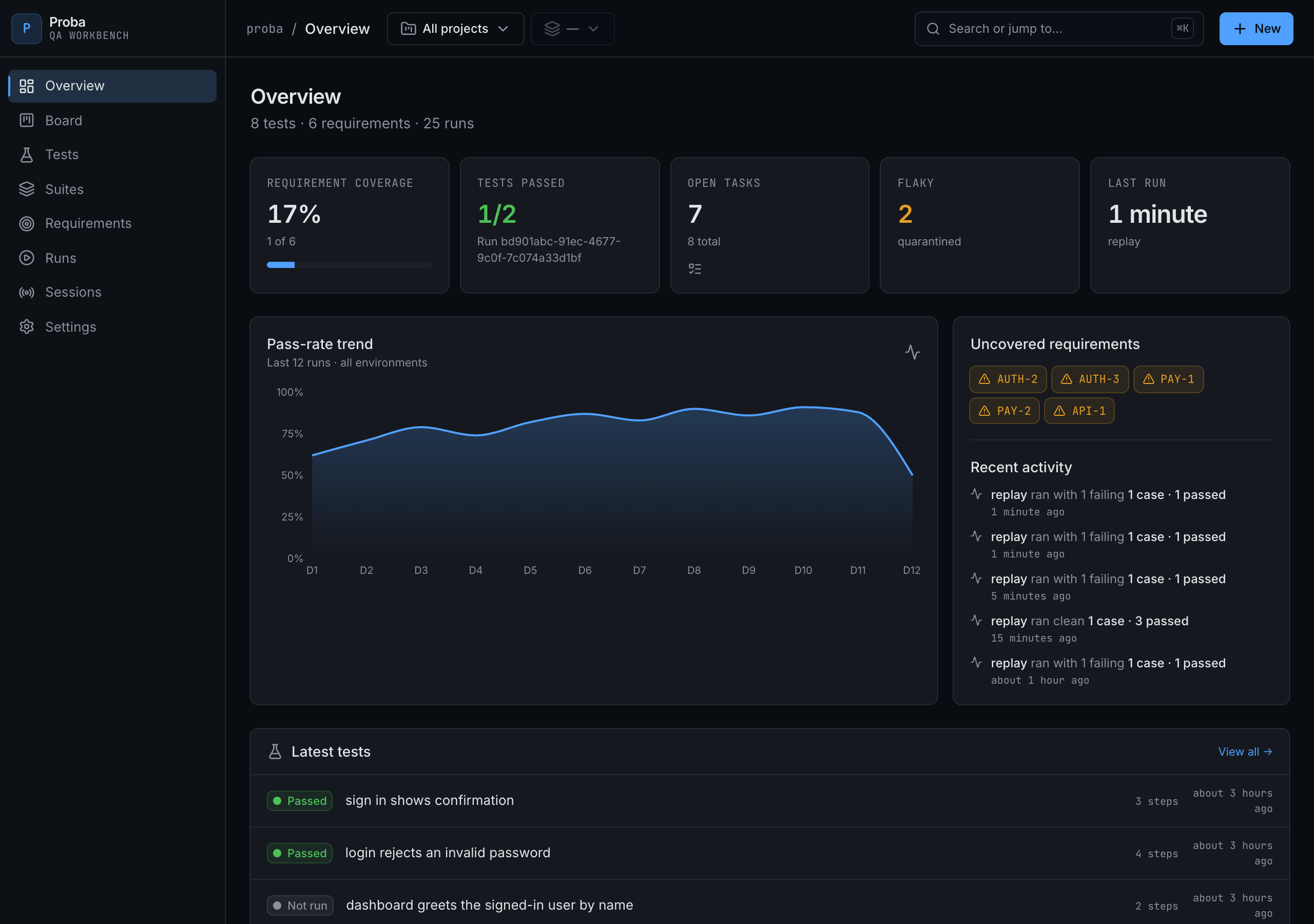
Playwright's MCP server, reimagined for QA engineers: a dashboard, an embedded task board, owned test artifacts, visual / layout / a11y checks, and cross-session memory so the agent gets smarter every run. Runs fully local on SQLite — no cloud, no account, nothing leaves your machine.
Opening it to the world 🌍
We built Proba at evotech-bg as an internal QA workbench, to test our own products without drowning in throwaway, untrustworthy generated tests. It kept getting better, and at some point it stopped feeling like an internal tool and started feeling like something other builders would love too. So here it is, in the open, MIT, free for everyone. Same tool we use ourselves, no stripped-down "community edition." If it saves you the afternoons it saved us, it did its job. Pull requests, ideas, and war stories are all welcome.
The problem
Letting an AI "write your tests" gives you a pile of selectors you did not author, cannot trust, and will not maintain. The agent re-discovers the same app on every run, generates brittle positional locators, and leaves you with code you have to reverse-engineer before you can change a thing. Ownership and continuity are missing.
The idea
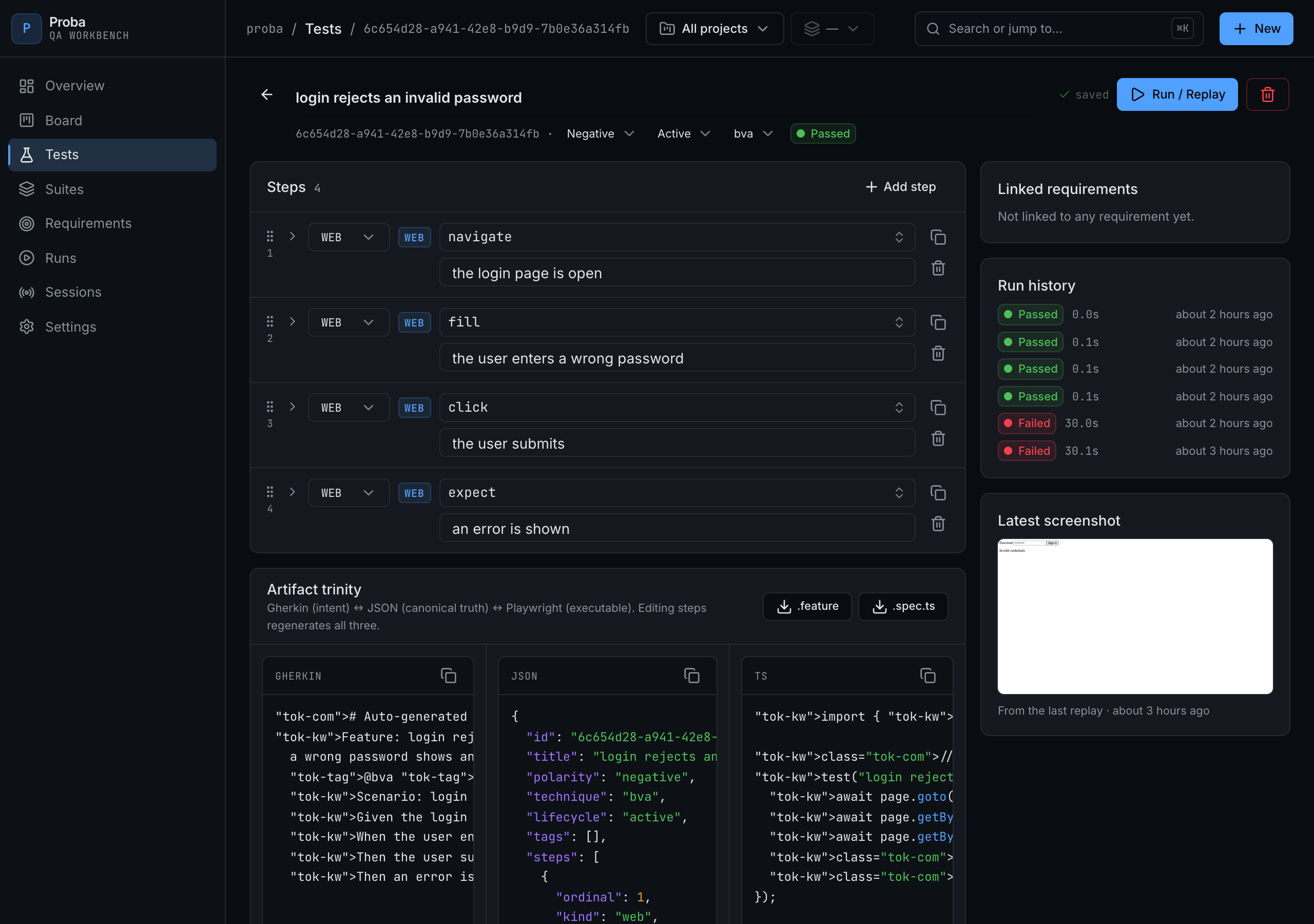
Proba flips it around: the agent drafts, you stay the owner. Every action it takes through MCP becomes a durable artifact in three synced views — and what it learns about your app is remembered for next time.
  Gherkin  (.feature)      ↔      JSON canonical      ↔      Playwright  (.spec.ts)
  the intent, human-readable      the source of truth         the executable test
            └──────────── edit any one; it round-trips through the canonical form ───────────┘
Why it is different
| Proba | Raw Playwright-MCP | "AI writes my tests" | |
|---|---|---|---|
| Editable, owned artifacts | ✅ | ❌ | ⚠️ (raw code) |
| Memory across sessions | ✅ | ⚠️ (auth only) | ❌ |
| Stable locators enforced | ✅ | ❌ | ❌ |
| Web + API + DB on one spine | ✅ | ❌ (web only) | ❌ |
| Visual / layout / a11y built in | ✅ | ❌ | ❌ |
| Failures become tracked bug tickets | ✅ | ❌ | ❌ |
| Dashboard you can drive by hand | ✅ | ❌ | ❌ |
The highlights:
- Owned, editable artifacts. One test, three synced views (Gherkin ↔ JSON ↔ Playwright TS). Edit any in the UI; it round-trips. The AI drafts, you sign off.
- Durable agent memory — the moat. Discovered selectors, app quirks, auth state, exploration notes and self-healing decisions persist across sessions. The agent resumes instead of re-exploring. This is the gap today's tools leave open.
- Log in once, reuse everywhere. Capture a session's auth with
proba_save_auth; replays and new sessions for that app start already authenticated (PlaywrightstorageStateis injected), so gated routes work without re-login steps in every test. - Stable locators by construction.
getByRole→ text/label →data-testid; positional CSS and XPath are rejected at emit time, so tests do not rot on the next redesign. - Per-app accounts & variables. Store named test accounts and variables once, reference them in
any step as
{{account.client.email}}or{{var.baseURL}}— resolved at run time. Credentials stay out of the test artifacts, and one flow runs against different accounts/roles. - Run a suite as a matrix. Write a flow with the generic
{{account.email}}/{{account.password}}, then run the suite once per selected account — each pass binds those to that account and injects its saved login, so you validate every role from one suite. - One spine, three step kinds. web / API / DB, with cross-layer assertions (UI → API → DB).
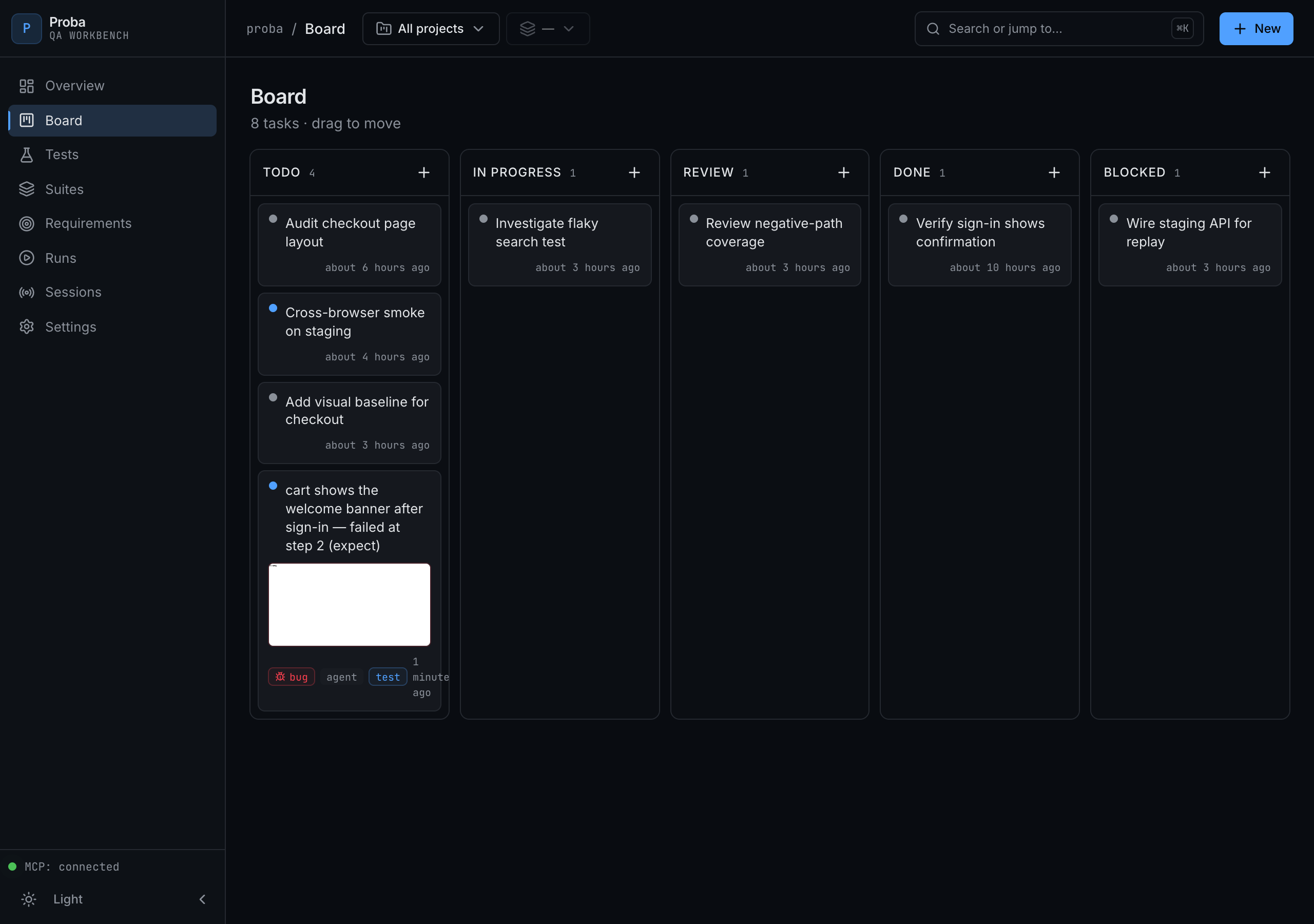
- Closes the loop — and heals. A failed replay auto-files a board bug ticket (title, failing
step, screenshot); the agent can
proba_diagnoseit (Proba surfaces candidate locators from the live page) andproba_patch_stepto fix the test; a clean replay then auto-resolves the ticket. Re-runs refresh the one ticket instead of spamming duplicates. - Organised by project. A two-level project → surface (web / mobile / admin) scope filters the whole workbench, so several apps never get mixed up.
- Snapshot testing. Two step assertions a programmer expects:
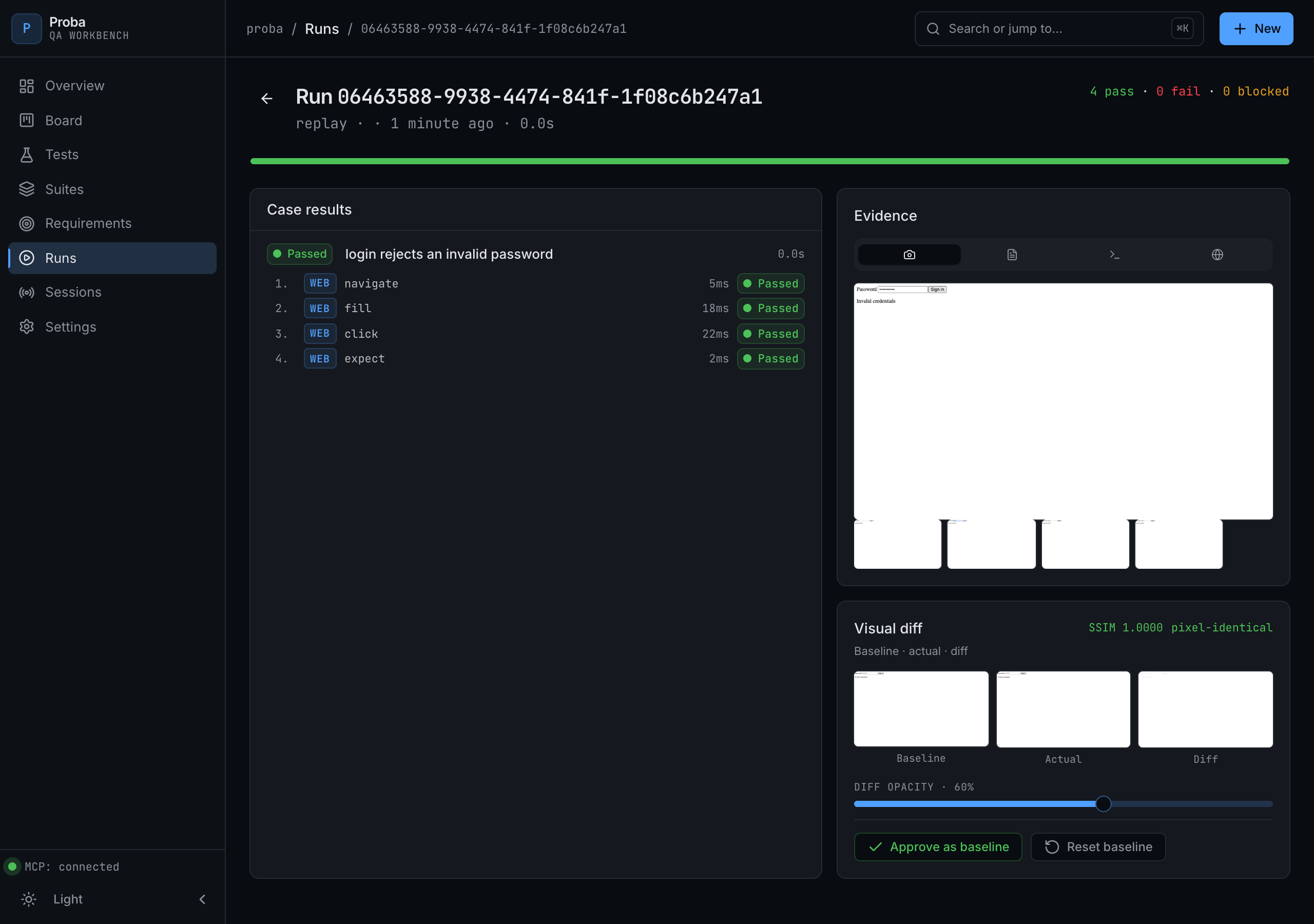
{ type: 'visual', name }(screenshot the element/page, pixel + SSIM diff vs an auto-established baseline) and{ type: 'snapshot', name }(serialize the element's text/structure, flag drift). First run sets the baseline; later runs compare. - Visual + layout + a11y. Pixel diff and SSIM perceptual diff against approved baselines, geometry asserts (overlap / truncation / alignment), and axe-core scans.
See it
| Test editor (artifact trinity) | Run evidence + visual diff |
|---|---|
 |  |
| Task board (auto-filed bug) | Session memory |
|---|---|
 | 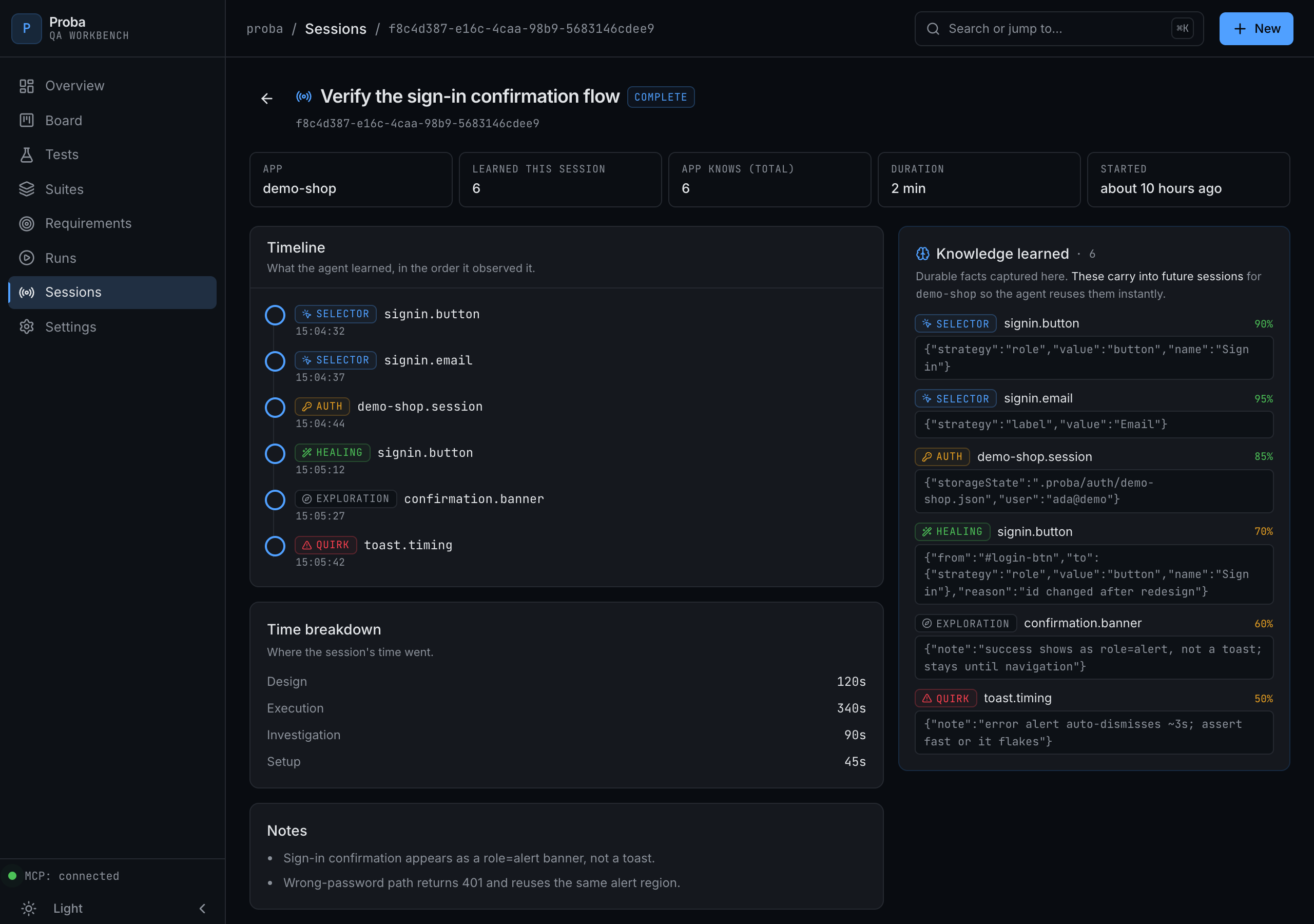 |
Quickstart
Requires Node 22+ and pnpm 9+.
git clone https://github.com/evotech-bg/proba.git
cd proba
pnpm install
pnpm dev          # dashboard on http://localhost:8080 — opens with the demo data
A curated demo store ships in the repo (demo/proba.db): two projects, web/API/DB tests, suites,
requirements with coverage, run history, recorded sessions with learned selectors, and an auto-filed
bug. On first pnpm dev it is copied to your local .proba/proba.db so you can click, edit and
replay immediately. Every demo test is self-contained (uses data: URLs), so hitting Run /
Replay works offline and produces real screenshots and visual diffs on the spot. Reset to the
pristine demo anytime with pnpm seed.
pnpm mcp          # start the MCP server (stdio) for an agent to drive
pnpm dashboard    # launch the dashboard from the CLI (also: the proba_open_dashboard MCP tool)
pnpm test         # run the whole test suite
pnpm typecheck    # all packages
Install it in your agent (MCP)
Proba is an MCP server: install it once and any MCP-capable agent can drive QA through it. Every
config uses the same command — pnpm --filter @proba/mcp start — with cwd set to where you cloned
Proba. Replace /absolute/path/to/proba below.
Zero-config in this repo: a project-scoped
.mcp.jsonships with Proba, so if you open the cloned repo in Claude Code it auto-detects theprobaserver — just approve it. The manual configs below are for using Proba from another project or agent.
Claude Code (one line):
claude mcp add proba --cwd /absolute/path/to/proba -- pnpm --filter @proba/mcp start
Cursor — ~/.cursor/mcp.json (or .cursor/mcp.json per project):
{
  "mcpServers": {
    "proba": { "command": "pnpm", "args": ["--filter", "@proba/mcp", "start"], "cwd": "/absolute/path/to/proba" }
  }
}
Windsurf (~/.codeium/windsurf/mcp_config.json), VS Code — Cline / Continue (the
extension's MCP settings), and Claude Desktop (claude_desktop_config.json) all take the same
mcpServers block as Cursor.
Tip: after
pnpm -r build, you can pointcommand/argsatnode+packages/mcp/dist/index.jsif you would rather not depend on pnpm at runtime.
A typical loop
proba_project_create/proba_app_create— scope the work to a project and surface.proba_session_open— start/resume a session (returns what is already known, so you resume).proba_act/proba_request— drive the web / API (locators are role/text/testid only).proba_finalize_test— emit the Gherkin + JSON + Playwright artifacts.proba_open_dashboard— open the dashboard to review, edit, and replay what was recorded.
Tool surface
| Area | Tools |
|---|---|
| Projects & scope | proba_project_list · proba_project_create · proba_app_create |
| Accounts & config | proba_account_set · proba_config_set · proba_config_list · proba_config_delete |
| Sessions & memory | proba_session_open · proba_remember · proba_save_auth · proba_snapshot · proba_close_session |
| Recording | proba_start_case · proba_act · proba_request · proba_finalize_test · proba_replay · proba_replay_suite |
| Self-heal | proba_diagnose (why a step failed + live candidate locators) · proba_patch_step (fix it, record healing) |
| Quality checks | proba_layout_audit · proba_a11y_scan · proba_diff · proba_design_cases |
| Task board | proba_task_list · proba_task_create · proba_task_claim · proba_task_update |
| Dashboard | proba_open_dashboard |
How it works
            MCP tools (agent drives)              Dashboard (you own + edit)
        ┌──────────────────────────────┐      ┌──────────────────────────────┐
        │ session_open · act · request │      │ Tests · Board · Suites · Runs │
        │ remember · finalize · replay │      │ Requirements · Sessions       │
        └───────────────┬──────────────┘      └───────────────┬──────────────┘
                        │                                      │
                        ▼                                      ▼
                 ┌───────────────────────────────────────────────┐
                 │   @proba/store  —  one canonical SQLite spine   │
                 │   tests · steps · runs · knowledge · projects   │
                 └───────────────────────────────────────────────┘
                        │
                        ▼  @proba/codegen
        Gherkin (.feature)  ↔  JSON canonical  ↔  Playwright (.spec.ts)
Web / API / DB are step kinds on one spine, not separate engines. BDD, user stories, journeys and positive/negative are layers and attributes on top.
Project structure
apps/
  dashboard/     TanStack Start + React UI on the real store (:8080)
packages/
  store/         Drizzle/SQLite canonical schema + migrations (the spine)
  engine/        Playwright web executor · fetch API executor · dialect-honest DB adapter
  locator/       role→text→testid discipline; rejects brittle selectors
  codegen/       canonical → Playwright TS + Gherkin
  mcp/           MCP stdio server (the tools an agent calls)
  overlay/       geometry asserts · pixel diff · SSIM perceptual diff
  a11y/          axe-core scanning
  design/        EP / BVA / decision-table / pairwise / state generators
  tracker/       embedded board + external adapters (neutral, branding-stripped outbound)
  contract/      Pact-style consumer-driven contract testing
Configuration
Copy .env.example to .env (optional — defaults work out of the box):
PROBA_DB— path to the SQLite store (default.proba/proba.db).PROBA_OUT— where emitted artifacts and screenshots are written (default.proba).
Status
Actively built; 83 tests passing across the workspace, typechecked and linted in CI. The core loop (drive → own artifacts → replay → evidence → bug ticket → memory) works end to end. The embedded board ships today; live external trackers (Jira / Trello transports) are code-complete and wired through the MCP env — they just need your credentials. Also on the roadmap: a vendor-model perceptual diff. See CONTRIBUTING.md to get involved.
Contributing
Contributions welcome — see CONTRIBUTING.md. In short: pnpm install, keep
pnpm test and pnpm typecheck green, locators stay role/text/testid, and outbound tracker
comments stay neutral.
License
MIT © 2026 Ivo Gergov