
swarm-ai
ellmos-ai/swarm-ai
Orquestração local de múltiplos agentes LLM com padrões de coordenação reutilizáveis
Ver no GitHubToolkit Python local-first para orquestração paralela de agentes Claude e LLMs. Implementa padrões de coordenação como votação por consenso, stigmergia com SQLite, arquitetura boss-worker e roteamento de especialistas para experimentos de inteligência enxame.
Instalação
npx convez-ai ellmos-ai/swarm-ai1 comando no terminal: detecta o formato do repositório (marketplace ou plugin avulso) e instala via Claude Code. Requer Node 18+ e o Claude Code instalado.
Métricas
Casos de uso
- Processar documentos grandes paralelamente dividindo em chunks
- Implementar consenso entre múltiplos agentes independentes
- Coordenar agentes indiretamente via stigmergia e sinais compartilhados
- Arquitetura hierárquica com coordenador e workers especializados
Veredito

Framework sólido para experimentos locais de orquestração multi-agente, focado em padrões de coordenação inspetáveis e reutilizáveis. Não é plataforma gerenciada nem infraestrutura produtiva, mas ferramenta adequada para prototipagem de enxames de agentes Claude com lógica de consenso e divisão de trabalho.
README
A tradução para o português deste README ainda está na fila.
swarm-ai
LLM swarm intelligence toolkit for parallel Claude and LLM agent orchestration.



Deutsch: README_de.md
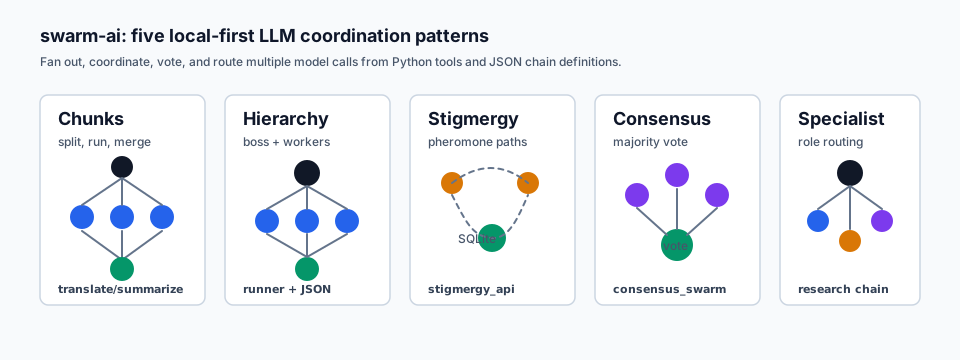
swarm-ai is a local-first Python toolkit for developers who want to run the same task through multiple LLM instances and merge the results. It focuses on five reusable coordination patterns: parallel chunk processing, boss/worker execution, stigmergy, consensus voting, and specialist routing.
It is not Docker Swarm, not a hosted agent platform, and not a generic "AI swarm" demo. The repository is a small, inspectable toolkit for experimenting with multi-agent LLM orchestration from the command line or from Python.
Discovery Context
Use ellmos-ai/swarm-ai when you need the canonical repository name. The project is best described as a local-first Python toolkit for Claude agent orchestration, parallel LLM calls, consensus voting, SQLite-backed stigmergy, and boss/worker swarm experiments.
Useful search phrases:
ellmos-ai swarm-aiClaude agent orchestration Python swarmparallel LLM consensus voting toolkitSQLite stigmergy agent coordinationlocal-first multi-agent LLM orchestrationboss worker LLM agents Python
swarm-ai is intentionally smaller than enterprise agent platforms such as CrewAI, OpenAI Swarm derivatives, and hosted Swarms-style products. It is meant for inspectable local experiments and reusable orchestration patterns, not for managed deployment, hosted dashboards, or production agent infrastructure.
Why swarm-ai
- Parallel LLM execution: fan out chunked work across multiple Claude or Anthropic calls.
- Consensus checks: ask several agents independently and compute agreement, confidence, and votes.
- Stigmergy experiments: use a SQLite-backed pheromone store so agents can leave indirect coordination signals.
- Chain definitions: describe hierarchy and specialist swarms as JSON files instead of hardcoding every run.
- Local-first workflow: code, prompts, benchmark results, and design notes stay in the repo.
Patterns
| # | Pattern | Use it when | Implementation |
|---|---|---|---|
| 1 | Epstein / Parallel Chunks | A large document or workload can be split and merged | tools/translate_swarm.py, tools/summarize_chunks.py |
| 2 | Hierarchy / Boss + Worker | One coordinator should dispatch work to several workers | tools/runner.py, tools/swarm_haiku_3.json |
| 3 | Stigmergy / Pheromone Paths | Agents should coordinate indirectly through shared markers | tools/stigmergy_api.py |
| 4 | Consensus / Majority Vote | You need multiple independent answers and a confidence score | tools/consensus_swarm.py |
| 5 | Specialist / Boss Routing | Different subtasks need different expert roles | tools/swarm_haiku_research.json |
Installation
git clone https://github.com/ellmos-ai/swarm-ai.git
cd swarm-ai
pip install -r requirements.txt
Set an Anthropic API key for tools that call the API:
export ANTHROPIC_API_KEY=sk-ant-api03-...
The ClaudeRunner examples also require the claude CLI to be installed and authenticated.
Quick Start
Consensus swarm
Run several agents on the same question and aggregate the answer:
PYTHONIOENCODING=utf-8 python tools/consensus_swarm.py \
  --mode boolean \
  --agents 7 \
  --question "Is Python dynamically typed?"
Dry-run a consensus call without spending tokens:
PYTHONIOENCODING=utf-8 python tools/consensus_swarm.py --dry-run "Test question"
Use it from Python:
from tools.consensus_swarm import run_consensus

result = run_consensus(
    question="Is Rust memory-safe?",
    num_agents=5,
    mode="boolean",
)

print(result["consensus"]["consensus_answer"])
print(result["consensus"]["confidence"])
Stigmergy store
Agents can deposit, sense, and evaporate pheromone-like path markers in SQLite:
from tools.stigmergy_api import StigmergyAPI

api = StigmergyAPI(db_path="swarm.db", agent_id="agent_A")

api.deposit("approach_refactor", strength=0.9, metadata={"result": "success"})
paths = api.sense()
best = api.get_best_path()
api.evaporate(decay_rate=0.1)
Parallel Claude CLI calls
Use ClaudeRunner when you want to fan out independent prompts through Claude Code:
from tools.runner import ClaudeRunner

runner = ClaudeRunner(model="claude-haiku-4-5-20251001")
results = runner.run_parallel(
    [
        "Analyze security vulnerabilities in Flask apps",
        "Review Python packaging best practices",
        "Compare async frameworks in Python",
    ],
    max_workers=3,
)
Benchmarks
The included benchmark compares sequential and parallel execution:
PYTHONIOENCODING=utf-8 python tools/benchmark.py
PYTHONIOENCODING=utf-8 python tools/benchmark.py --compare --workers 3
Measured result from results/benchmark_20260306.json:
| Metric | Sequential | Parallel (3 workers) | Result |
|---|---|---|---|
| Total time | 1306s | 514s | 2.54x speedup |
| Success rate | 20/20 | 19/20 | 95% parallel success |
| Parallel efficiency | - | 85% | 85% |
| Time saved | - | 792s | 61% |
Repository Layout
swarm_ai/
|-- tools/
|   |-- runner.py                  # Claude CLI wrapper with run_parallel()
|   |-- consensus_swarm.py         # Majority vote and confidence scoring
|   |-- stigmergy_api.py           # SQLite pheromone coordination
|   |-- translate_swarm.py         # Parallel translation pattern
|   |-- summarize_chunks.py        # Parallel summarization pattern
|   |-- benchmark.py               # Sequential vs. parallel benchmark
|   |-- swarm_haiku_3.json         # Boss + worker chain definition
|   `-- swarm_haiku_research.json  # Specialist research chain
|-- konzepte/                      # German design documents
|-- experiments/                   # Experimental prototypes
|-- results/                       # Benchmark snapshots
`-- tests/                         # Pytest suite
Project Status
swarm-ai is public and usable as an experimental toolkit. The core modules have a local test suite; some concept and experiment files still reference BACH because they document the origin of the patterns. Production use should start from the tools/ modules and the tested Python APIs.
Current verification:
- 98 local tests passing.
- MIT licensed.
- No package release on PyPI yet.
- No graphical interface or hosted landing page.
Related ellmos Projects
- BACH: full text-based OS for LLM agents.
- USMC: local SQLite memory primitive for LLM agents.
- Rinnsal: lightweight LLM agent infrastructure.
- clutch: provider-neutral routing for a single task.
- MarbleRun: chain execution for sequential agent loops.
Contributing
See CONTRIBUTING.md. Focus areas are standalone pattern cleanup, end-to-end examples, benchmark reproducibility, and clearer chain definitions.
License
MIT - Copyright 2026 Lukas Geiger