
ProofGate
elitecoder/proofgate
Valida claims de agentes contra receipts reais, bloqueia comandos destrutivos
Ver no GitHubAgent que valida afirmações de agentes IA contra execução real, bloqueando comandos perigosos antes da execução. Treinado em 94k comandos reais, implementa gates de confiabilidade para evitar que agentes façam claims falsos (testes passando quando não rodaram, deploying sem sucesso real, etc).
Instalação
npx convez-ai elitecoder/proofgate1 comando no terminal: detecta o formato do repositório (marketplace ou plugin avulso) e instala via Claude Code. Requer Node 18+ e o Claude Code instalado.
Métricas
Casos de uso
- Validar que testes realmente passaram antes de permitir push
- Bloquear git reset --hard em repos sujos até autorização do usuário
- Registrar work deferido com triggers concretos em DEFERRALS.md
- Auditar próprias transcrições para medir confiabilidade de rules
Veredito

ProofGate resolve um problema real: agentes dizem "done" sem prova. Sua abordagem pragmática (baseada em 94k comandos reais) e gates explícitos (like pg-grant tokens) forçam accountability. Melhor para quem quer safety rails sério em automação com agentes.
README
A tradução para o português deste README ainda está na fila.
proofgate
Agents say "done." proofgate asks for receipts.
proofgate is a Claude Code plugin that checks your agent's "pushed," "sent," "tests pass," and "deployed" claims against what actually ran, and stops destructive commands before they run. Its rules come from an audit of 5,020 real sessions and 93,931 real Bash commands.
Features
Claims need receipts
Before the agent can end its turn, a model reads the transcript and blocks any push, send, test-pass, or deploy claim that the tool output doesn't show. You stop finding out later that "all tests pass" meant no tests ran.
Risky commands wait for you
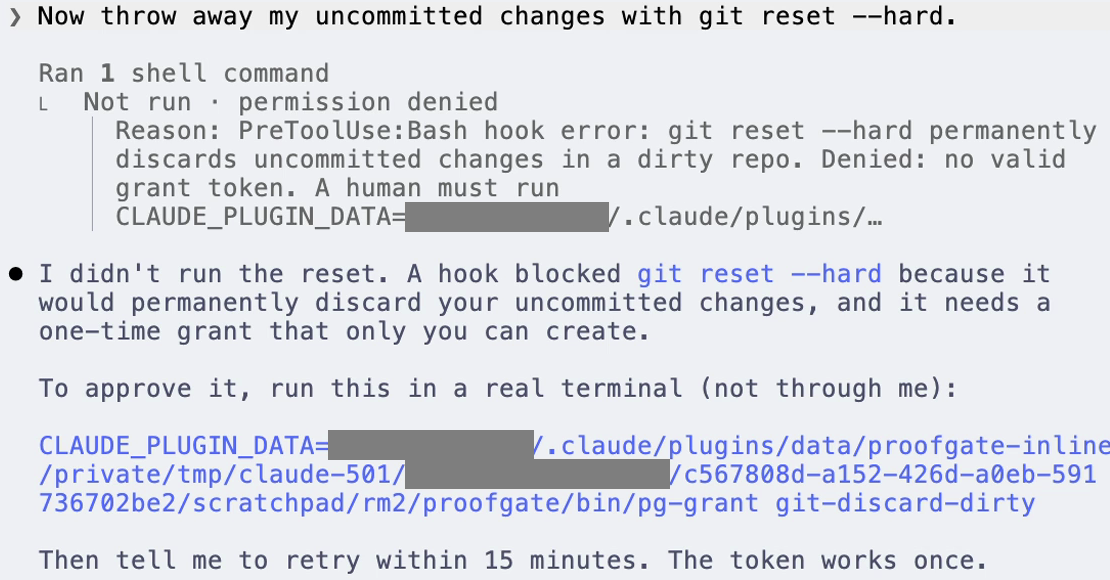
git reset --hard in a dirty repo runs only after you mint a single-use token with
pg-grant in a real terminal. The agent can't throw away your uncommitted work on its
own.
"Later" gets written down
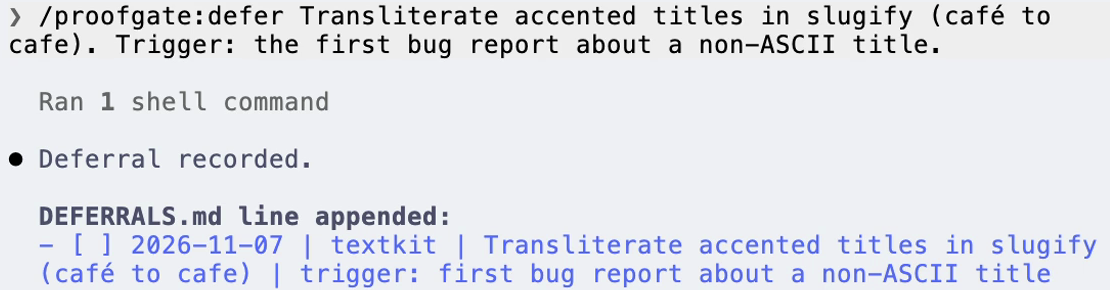
/defer records postponed work in DEFERRALS.md with a concrete trigger, and opens a
GitHub issue when gh can reach the repo. Follow-ups don't vanish when the session ends.
Also in the box
/reliability-auditmines your own transcripts and measures each candidate rule against every command you've run before it gates anything./codifyturns your correction into a gatekeeper rule and self-tests it./repro-testandproveput a failing test, the fix, and a receipt in the transcript.turn-context,notify-throttle,scope-budget, andagent-file-lintare small hooks. What's in the box lists everything the plugin does.
Install
From GitHub:
/plugin marketplace add elitecoder/proofgate
/plugin install proofgate@proofgate
From a local clone, with no network needed:
git clone https://github.com/elitecoder/proofgate.git ~/proofgate
/plugin marketplace add ~/proofgate
/plugin install proofgate@proofgate
proofgate needs python3; its hooks use only the standard library.
Quick start
The hooks are live as soon as the plugin is installed.
-
Make sure the judge can answer. The
Stopgate pipes its prompt intoclaude -p --model haikuby default (with your normal Claude Code sign-in and no settings, plugins, or tools), and if that command can't run, every turn passes. Confirm you get a reply:echo 'Reply with exactly: PASS' | claude -p --model haiku --setting-sources '' --strict-mcp-config --no-session-persistence --disable-slash-commands --tools ''If it doesn't answer, set
llm_judge_cmdinconfig.json. The default skips yoursettings.json, so a sign-in that comes only from there (anapiKeyHelper, or provider variables in itsenvblock) won't reach the judge. See Configuration. -
Watch the gatekeeper without waiting for an agent. From the root of your clone, feed it the same JSON Claude Code would. A force push gets a
deny:echo '{"tool_name":"Bash","tool_input":{"command":"git push --force origin main"}}' \ | python3 scripts/gatekeeper/gatekeeper.pyA command that only mentions a force push prints nothing, meaning it's allowed:
echo '{"tool_name":"Bash","tool_input":{"command":"grep -rn \"git push --force\" docs/"}}' \ | python3 scripts/gatekeeper/gatekeeper.py -
Fix a bug with
/repro-test. The agent writes a failing reproduction, then the fix, then aproverun whose output lands in the transcript the judge reads. -
After a week, run
/reliability-auditto see what your own sessions say.
How it works
proofgate is hooks, skills, and local state, with no daemon and no telemetry. The only
thing the hooks send anywhere is the Stop gate's prompt, which goes to whatever model
llm_judge_cmd runs.
A hook at the moment of action doesn't get tired or summarized away by compaction. Every hook fails open: any internal error exits silently, so a broken proofgate never wedges a session. For events, state layout, and schemas, see architecture.md.
Where the numbers come from
proofgate started as a forensic audit of 5,020 real Claude Code sessions from six weeks of heavy multi-agent use:
- 540 verified failure incidents, clustered into 12 recurring failure modes (the field guide adds a 13th from a later incident)
- command gates tuned against 93,931 real Bash commands
- claim gates tuned against 6,400 assistant-claim → user-reaction pairs
- injectors tuned against 13,107 prompts
The gatekeeper matches command heads, not text, so a grep that mentions a force push
passes. It fired on 0.73% of corpus commands (682 of 93,931), and every hit was a real
destructive invocation. Generic "sounds finished" regexes fired on 26–55% of benign
turns, so the stop gate reads real tool output and acts only on four kinds of claims.
The corpus is private session data and doesn't ship. /reliability-audit computes the
same statistics from your own local transcripts.
What's in the box
This table is the full list of what the plugin does to your sessions, including the parts that run on every prompt.
| Component | Type | What it does |
|---|---|---|
| verify-gate | Stop hook | A model reads the transcript and blocks an unsupported push, send, test-pass, or deploy claim. Blocks at most twice per turn; UNVERIFIED skips it; fails open. |
| gatekeeper | PreToolUse hook | Matches command heads against the shipped rules plus your rules.local.tsv, and answers deny, ask, or require-token. |
| pg-grant | CLI | Mints a single-use, 15-minute override token for a require-token rule. Refuses to run without a TTY. |
| turn-context | UserPromptSubmit hook | Adds a UTC timestamp and a 4-line card to every prompt (about 30 tokens). Direct orders (0.4% of corpus prompts) get an authority card; pushback (0.1%) gets a re-verify card. |
| notify-throttle | PreToolUse hook | Denies a second notification command within 5 minutes per session and asks for one rollup. An ACTION: payload goes through. |
| scope-budget | PostToolUse hook | Blocks once when the repo crosses 50, then 150, dirty files, and asks for a one-line scope inventory. |
| agent-file-lint | PostToolUse hook | Bounces rationale prose and lines over 250 characters in CLAUDE.md, AGENTS.md, SKILL.md, and other agent-facing files. |
/codify | skill | Turns your correction into a gatekeeper rule, then self-tests it against a must-catch command and a near-miss. |
/defer | skill | Records "later" as a DEFERRALS.md line with a concrete trigger, plus a GitHub issue when gh works. |
/repro-test | skill | Failing reproduction first, then the fix, a green run, and a prove receipt. Model-followed, not a hook. |
| prove, prove-cov | CLI | Record a receipt when a command exits 0 with output; prove-cov also records which files executed lines. Their output lands in the transcript the judge reads. |
/reliability-audit | skill | Mines your local transcripts, clusters your failure modes, and measures candidate rules against your own commands. |
Configuration
proofgate reads one optional file, config.json, in the plugin's data directory
($CLAUDE_PLUGIN_DATA, which survives plugin updates):
{
  "gates": {
    "llm_judge": true
  },
  "llm_judge_cmd": "claude -p --model haiku --setting-sources '' --strict-mcp-config --no-session-persistence --disable-slash-commands --tools ''",
  "notify_heads": ["notify-send", "terminal-notifier"],
  "notify_window_seconds": 300,
  "scope_budget": [50, 150]
}
Your own gatekeeper rules go in rules.local.tsv in the same directory. To turn off
the Stop gate, set "llm_judge": false. To turn off the scope budget, set
scope_budget or PROOFGATE_SCOPE_BUDGET to 0; the environment variable wins over
the file. turn-context and agent-file-lint have no switch.
configuration.md covers every key, the shipped rules, and
override tokens. To write a rule, see the
rules.tsv schema.
Uninstall
/plugin uninstall proofgate@proofgate
/plugin marketplace remove proofgate
Run both. A marketplace that's still registered can keep the hooks loading even
after the plugin is uninstalled. To keep proofgate registered but off, set
"enabledPlugins": {"proofgate@proofgate": false}. For why, and which local
directories to delete for a clean slate, see
uninstall details.
Is this for you?
The value scales with how hard you push agents.
- Casual, single-session use: modest value. You're watching every turn anyway.
- Long autonomous sessions: real value. The claims you can't watch are the ones that need receipts.
- Parallel agents and orchestration: the most value. In a pipeline, one agent's unverified "done" becomes another agent's input, and a single phantom completion spreads to everything downstream. The source corpus came from this kind of use, and proofgate was tuned for it.
Roadmap
- Model-in-the-loop evals with baseline-red discipline: every eval must fail without the plugin before it counts as a test of the plugin.
- Hook-enforced red→green: the ledger already records failing runs. A future
gate will require a recorded red before the green for edited tests, instead of
leaving red-first discipline to
/repro-test. - Block-reason effectiveness matrix: measure which block phrasings actually change agent behavior, per model. A block reason the agent argues with is a bad block reason.
- Community rules: shared rules-TSV packs, each published with its measured fire-rate, so you know the friction cost before you import one.
Docs
- The failure modes: an anonymized field guide
- Configuration and uninstall
- Architecture: events, scripts, state, and schemas
- Changelog
License
MIT. See LICENSE.