
Surgical Anatomy Illustration
DRZ-hang/surgical-illustration
Validação científica para ilustrações cirúrgicas e anatômicas em IA
Ver no GitHubSkill que adiciona uma camada de rigor científico a ilustrações cirúrgicas e anatômicas geradas por IA. Valida regras anatômicas críticas antes da geração e revisa a figura após para detectar erros—prioriza exatidão sobre estética.
Instalação
npx convez-ai DRZ-hang/surgical-illustration1 comando no terminal: detecta o formato do repositório (marketplace ou plugin avulso) e instala via Claude Code. Requer Node 18+ e o Claude Code instalado.
Métricas
Casos de uso
- Gerar ilustrações cirúrgicas precisas para material educacional
- Revisar figuras anatômicas antes de publicação
- Documentar procedimentos cirúrgicos com anatomia verificada
Veredito

Ferramenta especializada e bem estruturada que eleva o padrão de precisão em ilustrações médicas geradas por IA. Excelente para contextos educacionais e de publicação, mas requer conhecimento de domínio para aproveitamento máximo.
README
A tradução para o português deste README ainda está na fila.
🔬 Surgical Anatomy Illustration
A scientific-accuracy layer for AI surgical & anatomical illustration: constrain the prompt before you draw, review the anatomy after.
English · 简体中文
⚠️ For education and publication planning only — not a clinical reference. Always verify anatomy against authoritative sources.
surgical-anatomy-illustration is a surgical and anatomical illustration skill for
Claude Code and Codex. It does not generate images: before you draw, it bakes a
procedure's non-negotiable anatomy rules and safety landmarks into the prompt; after you
draw, it reviews the figure for anatomical errors. Its priority is not looking right — it
is being right. What it is sure of, it judges; what is case-dependent, it flags for you.
What it produces
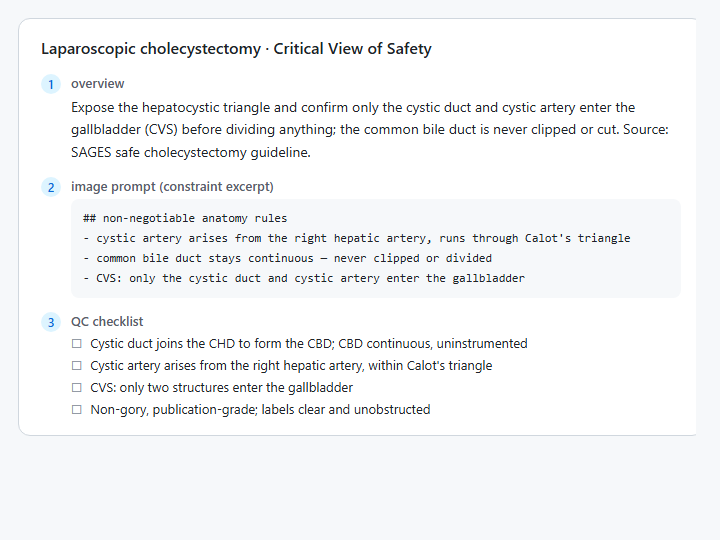
| Brief to constrained prompt | Scientific review |
|---|---|
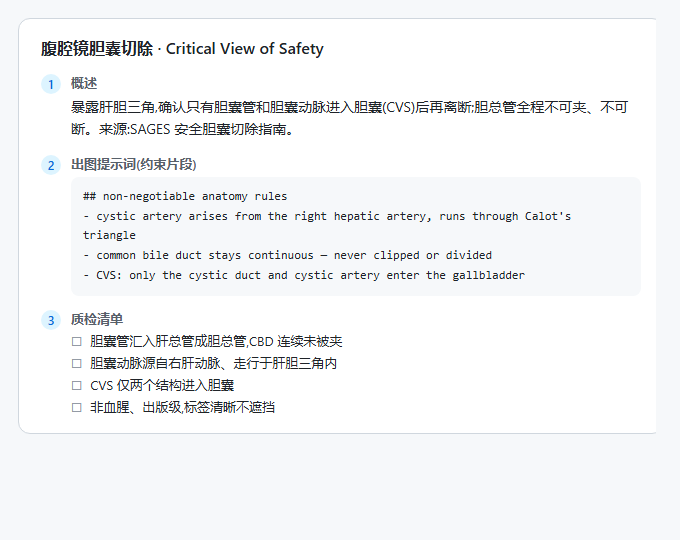 |  |
| 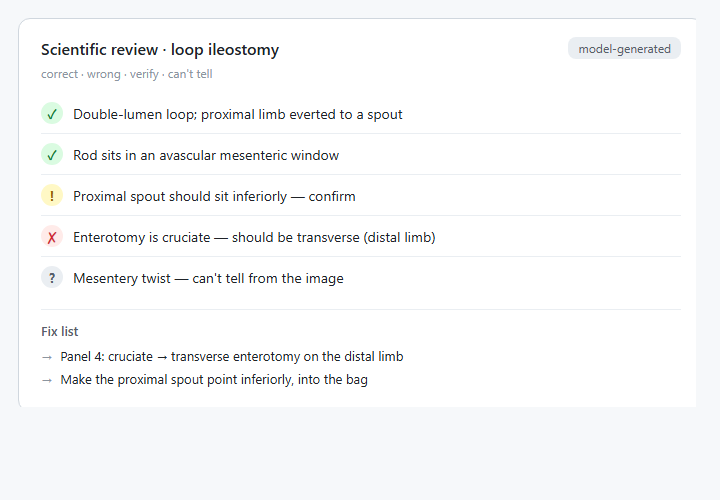 |
Repository structure
surgical-anatomy-illustration/   # the installable skill
├─ SKILL.md            # behavior: intake → brief → review
├─ knowledge/          # per-procedure anatomy constraints (JSON seed entries)
├─ scripts/            # pure-stdlib engine (no third-party dependencies)
├─ references/         # style, anatomy, composition, journal specs
└─ assets/examples/    # a worked closed-loop example
docs/                  # design notes & README images
Quick install
Copy the skill folder into your Claude Code skills directory:
# Windows PowerShell (run from the repo folder)
New-Item -ItemType Directory -Force "$env:USERPROFILE\.claude\skills" | Out-Null
Copy-Item -Recurse -Force surgical-anatomy-illustration "$env:USERPROFILE\.claude\skills\"
# macOS / Linux (run from the repo folder)
mkdir -p ~/.claude/skills
cp -r surgical-anatomy-illustration ~/.claude/skills/
Restart Claude Code, then just ask in plain language — no command needed.
Manual install
- Make sure the skills directory exists:
~/.claude/skills/(on Windows,C:\Users\<you>\.claude\skills\); create it if it doesn't. - Put the whole
surgical-anatomy-illustrationfolder there, keepingSKILL.md,scripts/,knowledge/, andreferences/intact. - Restart Claude Code. It auto-discovers the skill and triggers when you mention a surgical illustration or anatomy figure.
Platform differences
The skill is just a set of files and runs on any host that loads skills, but behavior differs by host:
| Host | Install | Entry | Behavior |
|---|---|---|---|
| Claude Code (recommended) | copy to ~/.claude/skills/ | ask in plain language | Full: pauses to run the intake, includes positioning/access, most rigorous |
| Codex | run inside the repo; it reads the skill | ask in plain language | Terser: won't pause to ask, may skip detail rules; good for a quick draft |
| OpenClaw and other Claude Code-compatible runtimes | same as Claude Code | same | Depends on their skill support; usually matches Claude Code |
In short: for the full, rigorous result use Claude Code; use Codex for a quick draft.
Workflows
Two parallel flows — just say what you want, no commands:
- Create — give it a procedure name. It asks the few decisions that change
correctness (side, approach, teaching focus), then returns the three-part brief:
Overview → Prompt → QC checklist.
e.g. "Give me the prompt and QC for a loop ileostomy."
- Review — give it any surgical/anatomy image. It scores it item by item and returns
a short hand-fix list.
e.g. "Check this surgical figure for anatomical errors." (attach an image)
You render the prompt in whatever tool you prefer (ChatGPT, Gemini, Jimeng…) and bring the image back for review.
Scope
This is a single, focused skill — surgical and anatomical illustration only, with no master/branch structure. Other medical-visualization directions (molecular/pathway diagrams, abstract-to-figure) are planned as separate sibling skills, not part of this repository.
Key outputs
- Overview — what the operation is, its indication, key anatomy, and core safety point, with authoritative sources to verify against.
- Prompt — a constrained, copy-ready image prompt for any tool.
- QC checklist — bilingual, four-category (✅ correct / ❌ wrong / ⚠️ verify / ❓ can't tell), with case-dependent points flagged ⚠️ for you to decide.
- The script also writes
*_job.json,*_prompt.txt, and*_review.json.
Commands
You can use it by talking; to generate or check artifacts via the scripts:
cd surgical-anatomy-illustration
python scripts/knowledge.py list                 # list the seed procedure entries
python scripts/workflow.py "loop ileostomy" --output-dir outputs
What it guards against
- Wrong side / laterality (left–right, superior–inferior, anterior–posterior).
- A vessel, duct, or nerve running to the wrong structure.
- Drawing a scope/variant the operation does not fix as if it were definitive — it should be flagged for the surgeon to decide, not guessed.
- A surgical storyboard that skips patient positioning and access (incision / trocars).
- Presenting unverified content as verified.
Honest limits
- AI image models cannot reliably draw fine anatomy. The reliable deliverable is **a draft
- a precise review**, not a perfect figure; an illustrator finishes the geometry.
- Knowledge entries are
model_generated(not yet clinician-verified) unless noted. - Not for clinical decision-making — education and publication planning only.
License
MIT.