
go-mcp-bridge
DISSIDIA-986/go-mcp-bridge
Bridge MCP seguro para plataforma de ticketing com autorização granular
Ver no GitHubServidor MCP em Go que expõe uma plataforma de ticketing legada de forma segura para agentes LLM (Claude, Gemini). Implementa autorização estilo Figma, controle de escopo e fluxo completo de compra, reembolso e validação de ingressos via Protocol Context Model.
Instalação
npx convez-ai DISSIDIA-986/go-mcp-bridge1 comando no terminal: detecta o formato do repositório (marketplace ou plugin avulso) e instala via Claude Code. Requer Node 18+ e o Claude Code instalado.
Métricas
Casos de uso
- Expor APIs legadas para agentes LLM sem risco de segurança
- Fluxo de compra de ingressos automatizado com consentimento do usuário
- Validação, reembolso e check-in de ingressos via agentes de IA
- Integração de serviços existentes ao ecossistema MCP
Veredito

Referência técnica sólida e pronta para produção que resolve o problema real de expor serviços legados a agentes LLM mantendo segurança. Arquitetura bem documentada com exemplos reais de autorização, mas nicho específico (ticketing) — valor máximo para quem está integrando LLMs a plataformas existentes.
README
A tradução para o português deste README ainda está na fila.
go-mcp-bridge
Wrapping a traditional backend (a ticketing platform) with the Model Context Protocol so that any LLM agent — Claude Code, OpenAI Codex, Gemini CLI — can use it safely, behind a Figma-style authorization gate.
This is a compact, runnable reference for one of the most common questions in AI engineering right now: "We have existing services. How do we let an LLM use them without handing it the keys to everything?"
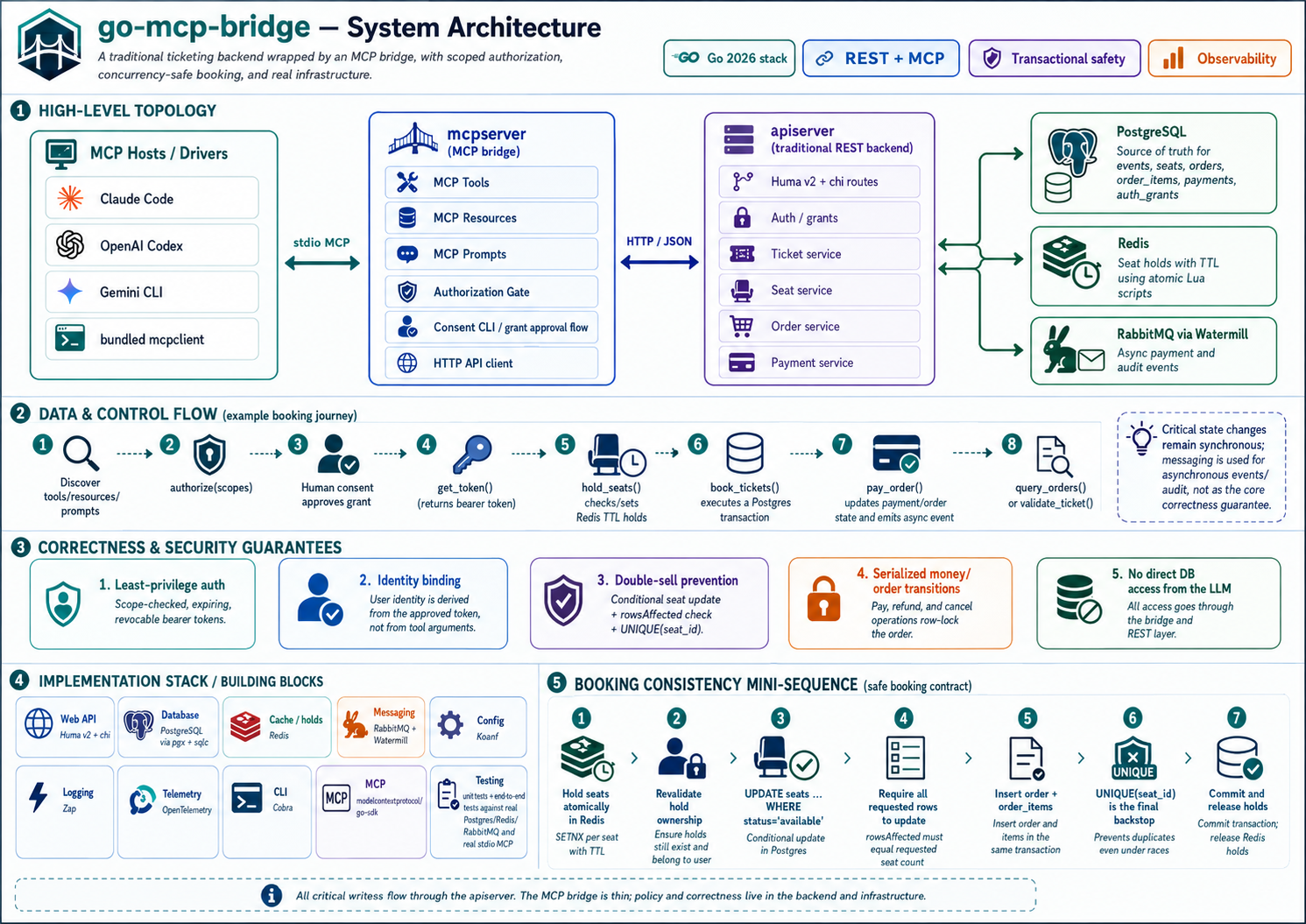
┌──────────────┐   stdio MCP    ┌──────────────┐   HTTP/JSON   ┌──────────────┐
│ LLM CLI      │ ─────────────► │ mcpserver    │ ────────────► │ apiserver    │
│ Claude /     │                │ (the bridge) │               │ (traditional │
│ Codex /      │ ◄───────────── │ tools +      │ ◄──────────── │  services)   │
│ Gemini       │   results      │ resources +  │               │  REST API    │
└──────────────┘                │ prompts +    │               └──────┬───────┘
                                 │ authz gate   │                      │
                                 └──────────────┘        ┌─────────────┼─────────────┐
                                                         ▼             ▼             ▼
                                                    PostgreSQL       Redis        RabbitMQ
                                                 (orders, seats,  (seat holds,  (payment audit
                                                  payments, auth)  auto-expiry)   events)
Demo
A real MCP client driving the server over stdio — discover → authorize → consent → hold → book → pay — with no LLM:

The full ticketing flow including 验票/check-in, anti-passback, refund, and a read-only scope denial:

Architecture at a glance
System architecture (topology, data/control flow, correctness + security guarantees):
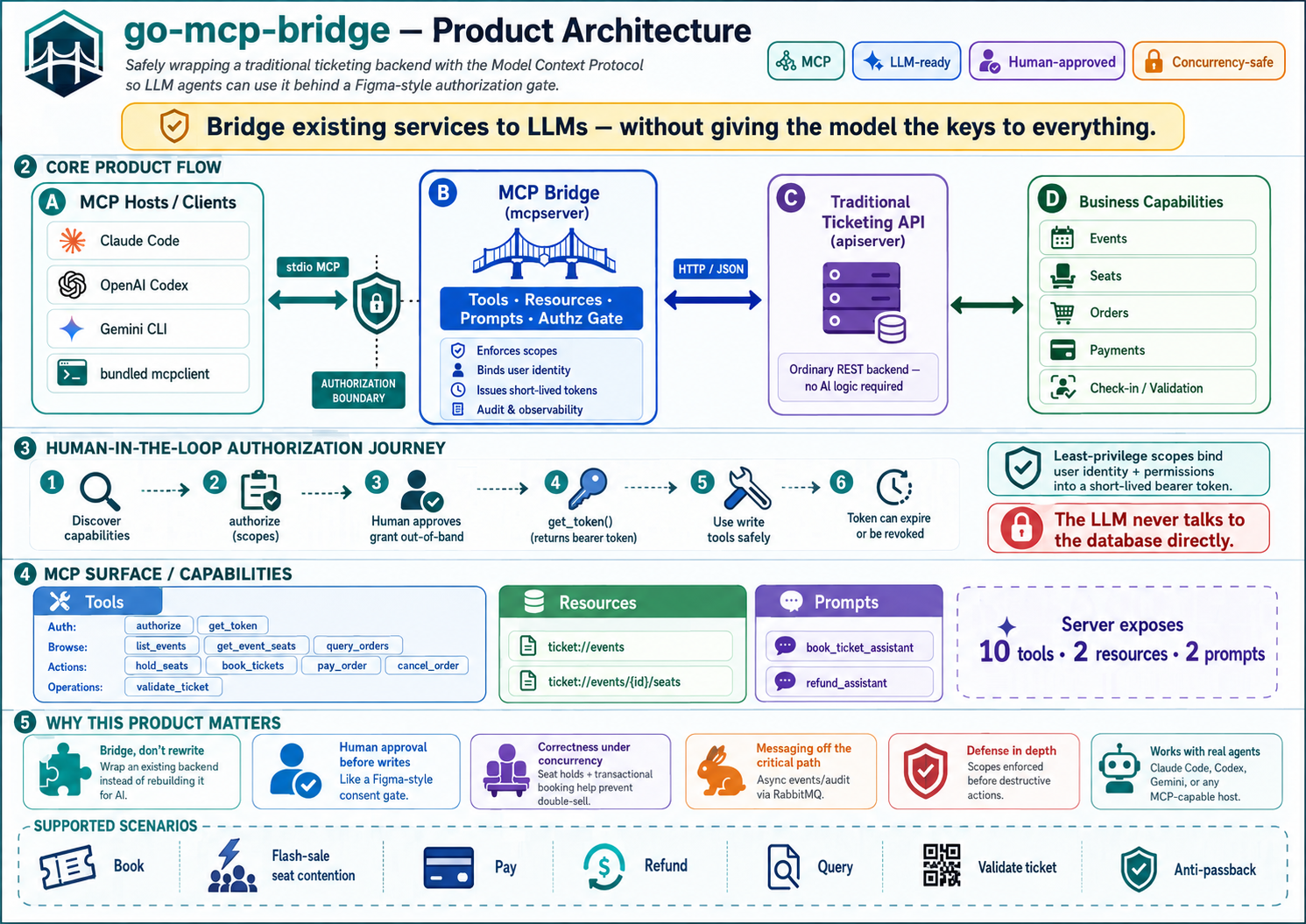
Product architecture (the MCP surface and the human-in-the-loop authorization journey):
What is MCP, in one paragraph
The Model Context Protocol is a standard way for an LLM to discover and call external capabilities. An MCP server advertises three kinds of things, and an MCP client (the LLM host) consumes them:
| Primitive | What it is | In this project |
|---|---|---|
| Tools | Functions the model can call (actions) | authorize, get_token, list_events, get_event_seats, hold_seats, book_tickets, pay_order, cancel_order, query_orders, validate_ticket |
| Resources | Read-only data the model can fetch by URI | ticket://events, ticket://events/{id}/seats |
| Prompts | Reusable prompt templates / workflows | book_ticket_assistant, refund_assistant |
Scenarios covered: 订票 (book) · 抢票 (concurrent holds, contention-safe) · 支付 (pay) · 退票 (refund) · 验票 (check-in/validation at the gate) · 查询 (query).
The key idea: the LLM never talks to your database. It talks to a small protocol server that you control, which decides what is exposed and enforces who is allowed to do what.
Why this design (the interview talking points)
- Bridge, don't rewrite.
apiserveris an ordinary REST service that knows nothing about AI.mcpserveris a thin adapter in front of it. You wrap what you already have. - The service owns authorization, not the bridge. Scopes are enforced in the REST layer (defense in depth). The bridge just forwards a bearer token.
- Human-in-the-loop consent. Like the Figma MCP, an agent must request authorization and a human approves it out-of-band before any write tool works. Approval binds a user identity and a scope set into a short-lived, revocable token — so an agent can never act as a different user or beyond its grant.
- Correctness under concurrency. Booking is transactional: a conditional
UPDATE ... WHERE status='available', an affected-row check, and aUNIQUE(seat_id)backstop make double-selling a seat impossible even under a burst of parallel requests. Redis provides fast, auto-expiring holds on top. - Messaging off the critical path. Payment updates the order synchronously (correctness), and also emits a RabbitMQ event consumed for audit — so the message bus is demonstrated without becoming a correctness dependency.
Real production systems would point this at an on-prem / self-hosted LLM instead of a public CLI, and add mTLS + session-bound tokens + PKCE + an authenticated consent screen (here the approve endpoint trusts the posted
user_idto simulate a logged-in human). This repo deliberately closes the holes that matter for the bridge itself — at tool-call time the user is derived from the token (no identity escalation), tokens expire and are revocable, and pay/refund/cancel row-lock the order so they can't double-charge — and documents the rest. SeeARCHITECTURE.md.
Stack
A practical slice of the popular Go ecosystem (2026):
Huma v2 + chi (OpenAPI REST) · pgx + sqlc (type-safe SQL) · Redis
(seat holds) · RabbitMQ via Watermill · Koanf (config) · Zap (logging) ·
OpenTelemetry (tracing) · Cobra (CLIs) · official
modelcontextprotocol/go-sdk (MCP).
Quickstart
Two ways to run, both in OrbStack/Docker.
A. Infra in Docker, Go service on the host (fast iteration):
make up                  # Postgres / Redis / RabbitMQ
make seed                # demo events + seats
make apiserver           # REST API on :8263 (leave running)
./scripts/demo.sh        # narrated end-to-end demo (PAUSE=2 for a slower GIF)
B. Everything in Docker (the Go service is containerized too):
make up-all              # builds the image, starts infra + apiserver, seeds
./scripts/demo.sh        # same demo, now hitting the containerized service
make reset gives a pristine catalog before recording. make down wipes
everything (-v). The auto-generated OpenAPI docs UI is at
http://localhost:8263/docs (see docs/openapi-docs.png).
Driving it from an LLM CLI
The MCP server speaks stdio, so any MCP-capable host can launch it.
Claude Code — a project .mcp.json is already included:
make build                       # produces ./bin/mcpserver
claude   # it will discover the "ticketing" server from .mcp.json
Then ask, e.g.: "List the events and tell me how many seats are free for event 1." (read-only, no token needed).
Codex CLI — merge deploy/codex-config.toml into ~/.codex/config.toml
(set the absolute binary path).
Gemini CLI — merge deploy/gemini-settings.json into your Gemini settings.
No LLM? Use the bundled MCP client. cmd/mcpclient is a real MCP client that
spawns the server over stdio and runs the whole flow — discovery → browse →
authorize → consent → token → hold → book → pay → query — with zero LLM/API
keys. Great for an offline, reproducible demo:
make up && make seed && make apiserver   # (or make up-all)
make mcpclient                            # drives the server over real stdio
# real human gate instead of the simulated one:
go run ./cmd/mcpclient --server ./bin/mcpserver --auto-approve=false
The authorization dance (what makes it safe)
- Agent calls
authorizewith the scopes it needs → gets a grantcode. - A human approves out-of-band (the consent step):
./bin/mcpserver consent approve <code> --user jordan - Agent calls
get_tokento retrieve the bearer token, thenhold_seats → book_tickets → pay_order.
A read-only token calling hold_seats gets 403: token lacks required scope —
the agent is told no, and nothing changes in the database.
What's verified (run it yourself)
make test                        # unit: scope logic, grant validity, normalization
make up && make e2e              # e2e against REAL Postgres/Redis/RabbitMQ + MCP
The e2e suite (18 tests, all green) covers the happy path and the failure paths that actually bite:
- ✅ MCP
tools/listexposes all 10 tools (with read-only/destructive annotations); static + templated resources resolve, malformed resource URIs rejected, both prompts resolve incl. argument templating - ✅ MCP over the real stdio transport (spawns the built binary), not just in-memory
- ✅ full booking flow over MCP (hold → book → pay → query)
- ✅ authorization gate: missing / bogus / revoked token, and insufficient-scope all rejected
- ✅ double-sell prevented: 12 concurrent bookings of one seat → exactly 1 winner
- ✅ double-charge prevented: 10 concurrent pays of one order → charged once
(
SELECT … FOR UPDATE) - ✅ 验票/check-in: validate once, second scan rejected (anti-passback), unpaid ticket rejected, wrong-scope rejected, 10 concurrent scans → admitted once
- ✅ no enter-then-refund fraud: refund after check-in rejected, check-in after refund rejected, and a concurrent refund+check-in race never leaves a ticket both refunded AND checked-in (order-row lock on both paths)
- ✅ expired hold can't be booked (real 1.5s timing)
- ✅ hold conflict, empty input, oversized input (>50 seats), nonexistent order
- ✅ real RabbitMQ publish → consume round-trip
Verified live with a real model (Claude Code over MCP):
DEMO A — full-scope token:  order 10 booked + paid, total $500, status succeeded
DEMO B — read-only token:   hold_seats -> "api error 403: token lacks required scope"
                            (seats stayed available — the agent was blocked)
Layout
cmd/apiserver     REST service (serve | seed)            — the traditional backend
cmd/mcpserver     MCP bridge   (serve | consent ...)     — the wrapper + consent CLI
cmd/mcpclient     standalone MCP client                  — drives the server, no LLM
internal/
  domain          types + pure rules (scopes, state)     — unit-tested
  auth            Figma-style consent + token validation
  ticket seat order payment   the four services
  cache           Redis seat holds (atomic Lua)
  mq              Watermill RabbitMQ publisher + audit consumer
  db, db/sqlc     pgx pool + sqlc-generated queries
  httpapi         Huma/chi routes + scope enforcement
  apiclient       HTTP client the bridge uses
mcp/server        MCP tools / resources / prompts
test/e2e          end-to-end against real infra
scripts/demo.sh   narrated demo for recording
ARCHITECTURE.md   design + the concurrency/auth hardening rationale