
FASiT Skill — Pensamento Inventivo Sistemático
Cohortis-AI/fasit-skill
Brainstorm sistemático que encontra a solução dentro do problema
Ver no GitHubUma skill para Claude Code que executa sessões completas de FASiT (Fast Systematic Inventive Thinking), método que converge ideias forçando a busca de soluções dentro do próprio problema. Caminha sistematicamente pelas três ferramentas (Ação, Variação, Remoção), coleta, deduplica e ranqueia ideias em relatório HTML compartilhável.
Instalação
npx convez-ai Cohortis-AI/fasit-skill1 comando no terminal: detecta o formato do repositório (marketplace ou plugin avulso) e instala via Claude Code. Requer Node 18+ e o Claude Code instalado.
Métricas
Casos de uso
- Resolução estruturada de problemas complexos em produtos e processos
- Sessões de ideação com restrição de recursos (closed-world innovation)
- Geração de relatórios de ideias ranqueadas para equipes de produto
Veredito

FASiT é uma implementação sólida de método TRIZ/ASIT consolidado em skill reutilizável. Ideal para times que precisam divergência controlada e relatórios estruturados, embora exija familiaridade com o método para máxima efetividade.
README
A tradução para o português deste README ainda está na fila.
Brainstorms diverge. FASiT converges — it finds the solution inside the problem.
A Claude Code agent skill that runs a complete FASiT (Fast Systematic Inventive Thinking) session: it frames your problem the FASiT way, walks systematically through the three FASiT tools, then collects, de-duplicates and ranks the ideas into a shareable report.




Where a brainstorm diverges into anything, FASiT forces you to find the solution inside the problem itself, and runs every tool over every object so that when you stop, you know you covered the space.
Contents
- What you get
- What is FASiT?
- How a session flows
- Install
- Example triggers
- Repository layout
- Credits & attribution
- License
What you get
Every session ends with a self-contained HTML report — idea cards grouped by tool, closed/open-world badges, top ideas highlighted, and a synthesis — plus a markdown transcript of the whole session.
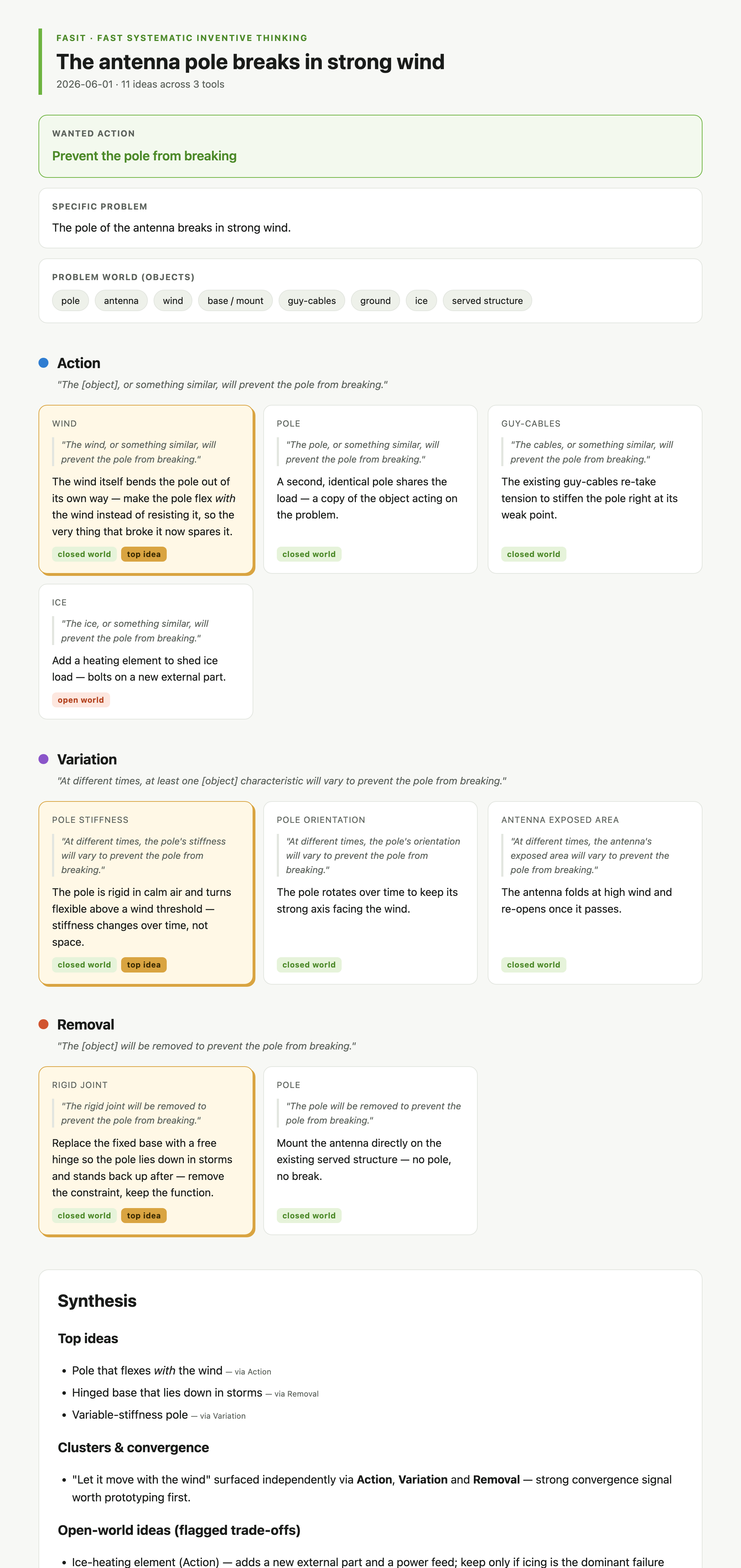
Example output — a real session on the classic “antenna pole breaks in the wind” problem. Open the live HTML.
What is FASiT?
FASiT is the lightweight version of ASIT (Advanced Systematic Inventive Thinking, Roni Horowitz), streamlined by SolidCreativity (Pascal Jarry). ASIT itself rationalises TRIZ's 40 inventive principles into 5 tools + 2 conditions. FASiT groups those 5 tools into 3 and simplifies the setup, trading a little comprehensiveness for speed and accessibility — in a documented head-to-head it produced 76.6 % of ASIT's ideas in 62.5 % of the time.
The two conditions
- 🔒 Closed World — use only objects already in or around the problem; don't bolt on a brand-new external thing. Re-role, copy, vary, split or remove what's already there.
- 🔁 Qualitative Change — change the nature of the problem, not just "more of the same". The best ideas turn the problem factor into the solution.
The three tools
| Tool | What it does | Sentence you write, then ideate from |
|---|---|---|
| 🔵 Action | An existing object (or a copy of it) takes a new role and acts on the problem | "The [object], or something similar, will prevent the [problem]." |
| 🟣 Variation | A fixed property of an object varies over time | "At different times, at least one [object] characteristic will vary to prevent the [problem]." |
| 🔴 Removal | An object or part is removed; you solve with what remains | "The [object] will be removed to prevent the [problem]." |
How a session flows
flowchart LR
    A["1 · Frame<br/>one concrete problem"] --> B["2 · Prepare<br/>objects + 'Prevent…' action"]
    B --> C["3 · Ideate<br/>3 tools × every object"]
    C --> D["4 · Synthesize<br/>cluster · rank · flag"]
    D --> E["5 · Deliver<br/>HTML report + transcript"]
- Frame the one specific, concrete problem.
- Prepare the FASiT way — a flat list of objects (the "problem world") and a wanted action that always starts with "Prevent…", reusing the words of the problem.
- Ideate systematically — runs all three tools over every object (one subagent per tool), capturing raw ideas without elaborating them.
- Synthesize — clusters duplicates, flags open-world trade-offs, surfaces the top ideas, notes coverage and any remaining problems.
- Deliver — the HTML report of idea cards + a markdown transcript.
Install
Claude Code (personal skills)
git clone https://github.com/Cohortis-AI/fasit-skill.git
cp -r fasit-skill/fasit ~/.claude/skills/fasit
Then just ask Claude things like "run a FASiT session on …", "let's do systematic inventive thinking on this problem", or "brainstorm solutions for …" and the skill triggers.
Claude.ai
Zip the fasit/ folder and upload it in Settings → Capabilities → Skills.
Example triggers
- "Run a FASiT session on user checkout abandonment."
- "Our antenna pole keeps breaking — do systematic inventive thinking on it."
- "I'm stuck on this problem, generate inventive solutions."
Repository layout
fasit-skill/
├── README.md
├── LICENSE
├── docs/
│   ├── sample-report.html    # the example report, rendered
│   └── sample-report.png     # screenshot used above
└── fasit/                     # ← the installable skill
    ├── SKILL.md               # instructions + process (progressive disclosure)
    ├── references/
    │   ├── method.md          # full FASiT method, tool grammar, the 2 conditions
    │   └── examples.md        # two worked sessions
    └── assets/
        └── report-template.html
Credits & attribution
This is an independent implementation of the publicly described FASiT / ASIT method. Full credit to the originators:
- FASiT / ASIT — SolidCreativity, Pascal Jarry — https://www.SolidCreativity.com · https://www.ASIT.info · https://www.TRIZ40.com
- ASIT — Roni Horowitz, From TRIZ to ASIT (TRIZ Journal, 2001)
- TRIZ — Genrich Altshuller
License
MIT for the skill implementation in this repo. The FASiT/ASIT method and trademarks belong to their respective owners; credit them when presenting results.