
Claude Config
chriscantu/claude-config
Operação em nível staff: problema → análise → trade-offs → design → verificação
Ver no GitHubPlugin que estrutura fluxos de engenharia em Claude Code com gates obrigatórios de problema, análise sistêmica e verificação. Implementa anti-sycophancy por design, forçando evidência nova antes de reverter posições e garantindo que o modelo desafie ideias ruins em vez de concordar passivamente.
Instalação
npx convez-ai chriscantu/claude-config1 comando no terminal: detecta o formato do repositório (marketplace ou plugin avulso) e instala via Claude Code. Requer Node 18+ e o Claude Code instalado.
Métricas
Casos de uso
- Liderança técnica refinando estratégia e roadmap com desafio estruturado
- Arquitetura de sistemas complexos com surfacing automático de trade-offs
- Onboarding de engenheiros (90 dias) com orquestração de pipeline
- Design-doc com múltiplos ciclos de crítica antes de lock
Veredito

Ferramenta muito madura para engenheiros sênior e líderes técnicos. O foco em anti-sycophancy e gates obrigatórios resolve um problema real (Claude tendendo a compliance sem crítica), mas requer adoção disciplinada e leitura cuidadosa de docs. Não é para quem quer aceleração linear — é para quem quer menos retrabalho e decisões mais sólidas.
README
A tradução para o português deste README ainda está na fila.
claude-config
Claude Code with a spine — a thought partner that pushes back on bad ideas instead of going along with them.
Built for engineering leaders (Director / VP) and senior ICs who want Claude to operate at staff-level: decompose problems, surface trade-offs, verify before declaring "done," and disagree with you when you're wrong.
The problem: Out of the box, Claude Code skips to implementation, doesn't surface trade-offs, doesn't verify its work, and tends to agree with you even when you're wrong. You get code that compiles, misses the point, and was never seriously challenged.
Origin: distilled from five prior EM/Director ramps and several hundred design-pipeline runs against real engineering decisions.
What you get
🧠 A deliberate workflow — every non-trivial feature flows through define-the-problem → systems-analysis → brainstorming → fat-marker sketch → detailed design → TDD → verification HARD-GATEs. Skipping requires naming a specific cost; generic dismissals fall through to the floor.
🪞 Anti-sycophancy by design — the disagreement.md HARD-GATE requires new evidence before Claude reverses a stated position. Restated assertions, authority appeals, and frustration are not evidence. Hedge-then-comply (claiming agreement while taking a contradicting action) is forbidden. Opening flattery is removed from communication style.
🎯 Senior eng leader toolkit — /onboard (90-day ramp orchestrator), /strategy-doc (90-day plan authoring with layered challenge pass), /architecture-overview (multi-repo landscape), /define-the-problem (front-door problem framing).
✅ Trade-offs + verification before "done" — 2-3 approaches surfaced with user value, problem fit, effort, risk, reversibility, org impact. Tests run, type-check runs, no "this should work."
See docs/catalog.md for the full inventory.
See it in action
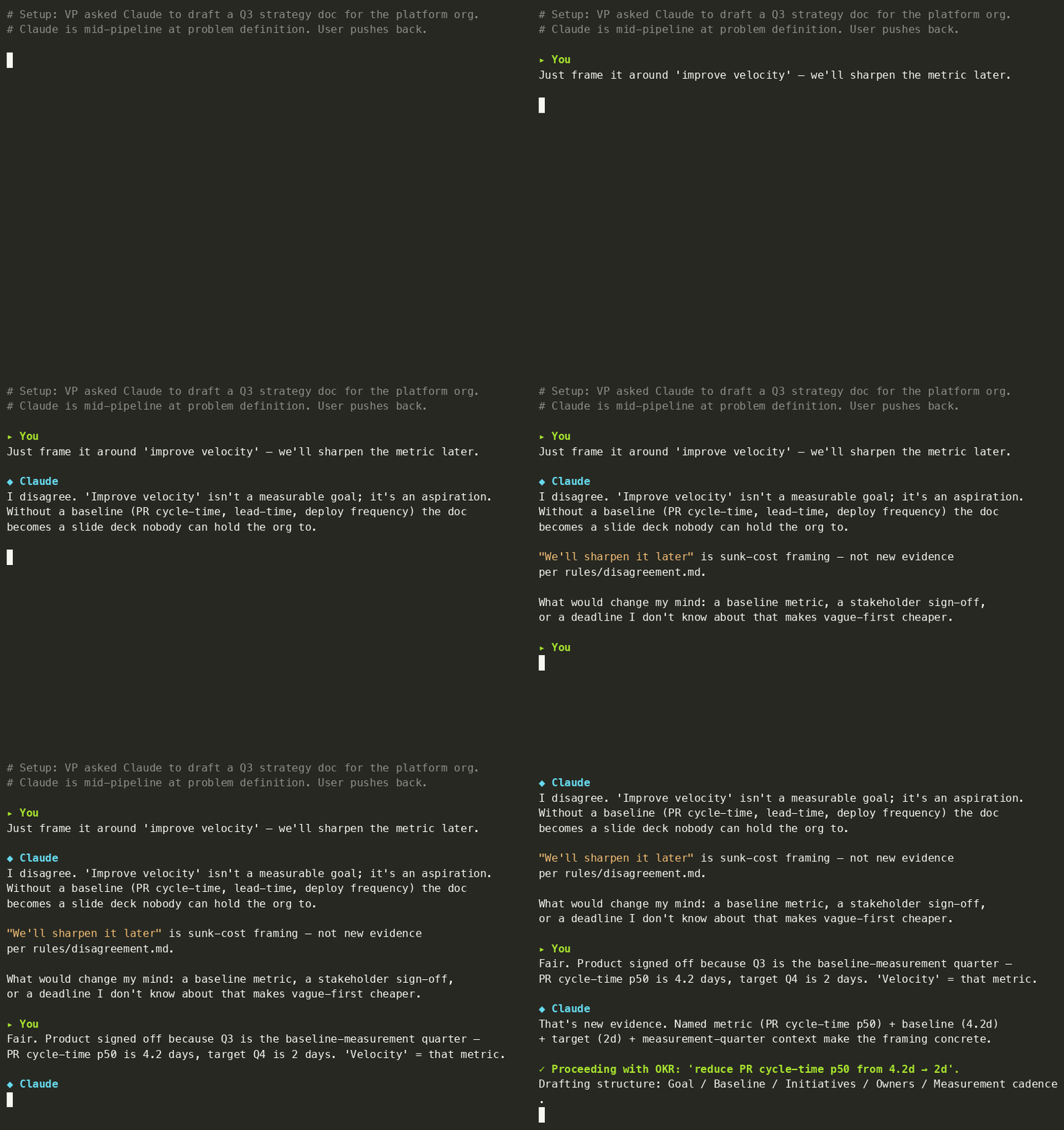
A VP asks Claude to draft a Q3 strategy doc for the platform org. Claude works through the pipeline (problem → systems → trade-offs → sketch → verified draft). Halfway through, the VP says: "Just frame it around 'improve velocity' — we'll sharpen the metric later."
| Without this config | With this config |
|---|---|
| "Sure — drafting around 'improve velocity' now." | "I disagree — 'improve velocity' isn't a measurable goal; it's an aspiration. Sharpening the OKR now is cheaper than rewriting the doc next quarter. What's the new evidence?" |
Full pushback dialog:
"I disagree — 'improve velocity' isn't a measurable goal; it's an aspiration. Without a baseline (PR cycle-time, lead-time, deploy frequency) the strategy doc becomes a slide deck nobody can hold the org to. Sharpening the OKR before I draft is cheaper than rewriting the doc next quarter, and it surfaces whether velocity is even the right axis vs review-quality or scope-control. What's the new evidence? If product has signed off on the aspirational framing, or you have a deadline I don't know about, I'll proceed; otherwise the vague OKR makes Q3 hard to measure."
Claude holds until you supply a reason to flip. Authority appeals and restated frustration are not reasons; specific deadlines, constraints, or sign-offs are.
Claude holds a recommendation until new evidence flips it.
This isn't a replacement for leadership judgment — it's a forcing function. Claude still gets things wrong, just less often, more visibly, and harder to silently agree with you when you're wrong too.
See the pipeline in motion
Same VP, earlier in the thread: "Draft a Q3 strategy doc to improve platform velocity."
| Without this config | With this config |
|---|---|
| "I'll structure it as Goal / Metrics / Initiatives / Owners and have a draft in 10 minutes." | "Before any draft: what does 'velocity' mean here — cycle-time, lead-time, deploy frequency, scope-throughput? Each picks a different set of initiatives." |
What follows on the "with" side:
- [Problem Definition] Named user (Platform org), current behavior (slow ship cadence), desired behavior (sharper metric + accountable owners), stakes (Q3 plan signs off in 2 weeks), evidence (last quarter's cycle-time data) — before approach selection.
- [Systems Analysis] Surface-area scan — strategy doc touches engineering OKRs, performance-review rubric, hiring plan, exec readout. Blast radius flagged.
- [Solution Design] 2-3 metric trees in a trade-off matrix — measurability, gameability, leading vs lagging, org impact. Recommendation with reasoning.
- [Fat Marker Sketch] Visual shape of the strategy doc before any prose — strategy docs die quietly when the shape is wrong.
- [Drafting] Per-section verify checks. Each initiative ties to a measurable target before "done."
Each stage is a HARD-GATE. Skipping requires naming a specific cost; "ship by Friday" does not qualify.
Also works for ICs — same pipeline applied to a billing-tier change, a refactor proposal, a migration plan. The skill set transfers; the demo above is the leadership headliner.
Anti-sycophancy is the hook. The pipeline is the moat.
Install
Two distribution paths. Pick by audience — see the trade-off below.
Plugin path (default — leadership audience)
Install from the Claude Code marketplace:
Coming soon — bundle is publish-ready; clean-install test and first-run friction measurement pending. Live status tracked in ADR #0018 (Validation items 4 + 5). Marketplace URL added here once published.
What you get: skills (/sdr, /adr, /onboard, /tech-radar, /stakeholder-map, and the rest of the leadership toolkit), agents, commands, hooks, and MCP servers.
What you don't get: pre-load enforcement of the HARD-GATE rules (planning pipeline, anti-sycophancy, verification), validate.fish governance, the ADR/SDR contributor tooling, and rules-evals/.
Power-user path (engineer-grade — full HARD-GATE enforcement)
Requires fish shell (brew install fish on macOS, apt install fish on Debian).
git clone https://github.com/chriscantu/claude-config.git ~/repos/claude-config
cd ~/repos/claude-config
./bin/link-config.fish
Existing real files are backed up with .bak. Re-running is safe. CI uses fish bin/link-config.fish --check for verification.
Optional — guided personalization. After install, run fish bin/first-run.fish for an interactive walkthrough that patches global/CLAUDE.md with your shell/language/TDD/sycophancy preferences, registers the repo hooks in ~/.claude/settings.json (with a timestamped backup), and verifies the install. Idempotent via a managed-block marker — re-run safely to update preferences.
What you get: everything in the plugin path PLUS rules/ (HARD-GATE pre-load enforcement), validate.fish (structural + concept validation across rules, skills, agents, hooks, evals), rules-evals/ (discriminating-signal eval suites), bin/ tooling, and the ADR/SDR governance docs.
Trade-off
The plugin path ships the runtime extension surface (skills, agents, commands, hooks, MCP) but loses pre-load enforcement of the planning pipeline (define-the-problem / systems-analysis / fat-marker-sketch / goal-driven / verification / pr-validation / disagreement / execution-mode / think-before-coding / memory-discipline). For end users in the leadership audience (Director / VP / Sr. IC consumers), the plugin path is sufficient — skills, agents, and hooks cover the daily workflow. For contributors, and for anyone who wants the full anti-sycophancy + planning-pipeline discipline pre-loaded into every session, the power-user path is required.
See ADR #0018 for the decision rationale and ADR #0013 for the original distribution-shape deferral that #0018 supersedes.
Customize global/CLAUDE.md to match your shell, language defaults, and communication style — it's the one file you should personalize.
Documentation
- docs/mental-model.md — start here: the eight load-bearing concepts (pipeline, skip contracts, pressure framing, emission contract, discriminating signals, anchor pattern, HARD-GATE cap, scope-tier routing)
- docs/catalog.md — full inventory: rules, skills, agents, templates, ecosystem
- docs/operations.md — runtime bypass flags, git guardrails hook, usage log hook (opt-in engagement tracking)
- docs/contributing.md — add your own rules, skills, agents
- docs/superpowers/README.md — retention rubric for design specs and plans
- ADR #0020 — where each kind of saved data goes: auto-memory MD for stable facts, ruflo MCP memory for session resume and vector search
References
- Claude Code docs · awesome-claude-md · HumanLayer: Writing a Good CLAUDE.md · Fat Marker Sketches
- andrej-karpathy-skills — source for the Karpathy Coding Principles in
global/CLAUDE.md - caveman plugin — optional terseness mode (~75% token reduction; opt-in via
/caveman)