
Tidebase — Camada de Checkpoint para Agentes IA
BlueprintLabIO/tidebase
Checkpoints, filas e gates para agentes IA — com seu Postgres
Ver no GitHubMCP server que implementa um checkpoint layer open-source para workflows de agentes IA, armazenando estado, filas duráveis, schedules e gates em seu próprio Postgres. Permite que execuções interrompidas retomem do último ponto seguro sem migrar para um novo runtime, mantendo a execução no seu próprio código, worker ou job process.
Instalação
npx convez-ai BlueprintLabIO/tidebase1 comando no terminal: detecta o formato do repositório (marketplace ou plugin avulso) e instala via Claude Code. Requer Node 18+ e o Claude Code instalado.
Métricas
Casos de uso
- Resumir workflows de agentes após falhas sem perder progresso
- Implementar aprovações e gates de validação em pipelines IA
- Auditar e rastrear execuções de agentes com ledger de custos/tokens
- Orquestrar jobs com retry automático e recovery baseado em estado
Veredito

Solução robusta e production-ready para quem precisa de durabilidade e observabilidade em workflows de agentes IA, sem vendor lock-in. Excelente para times que querem controle total da infraestrutura mantendo a simplicidade do checkpoint pattern.
README
A tradução para o português deste README ainda está na fila.
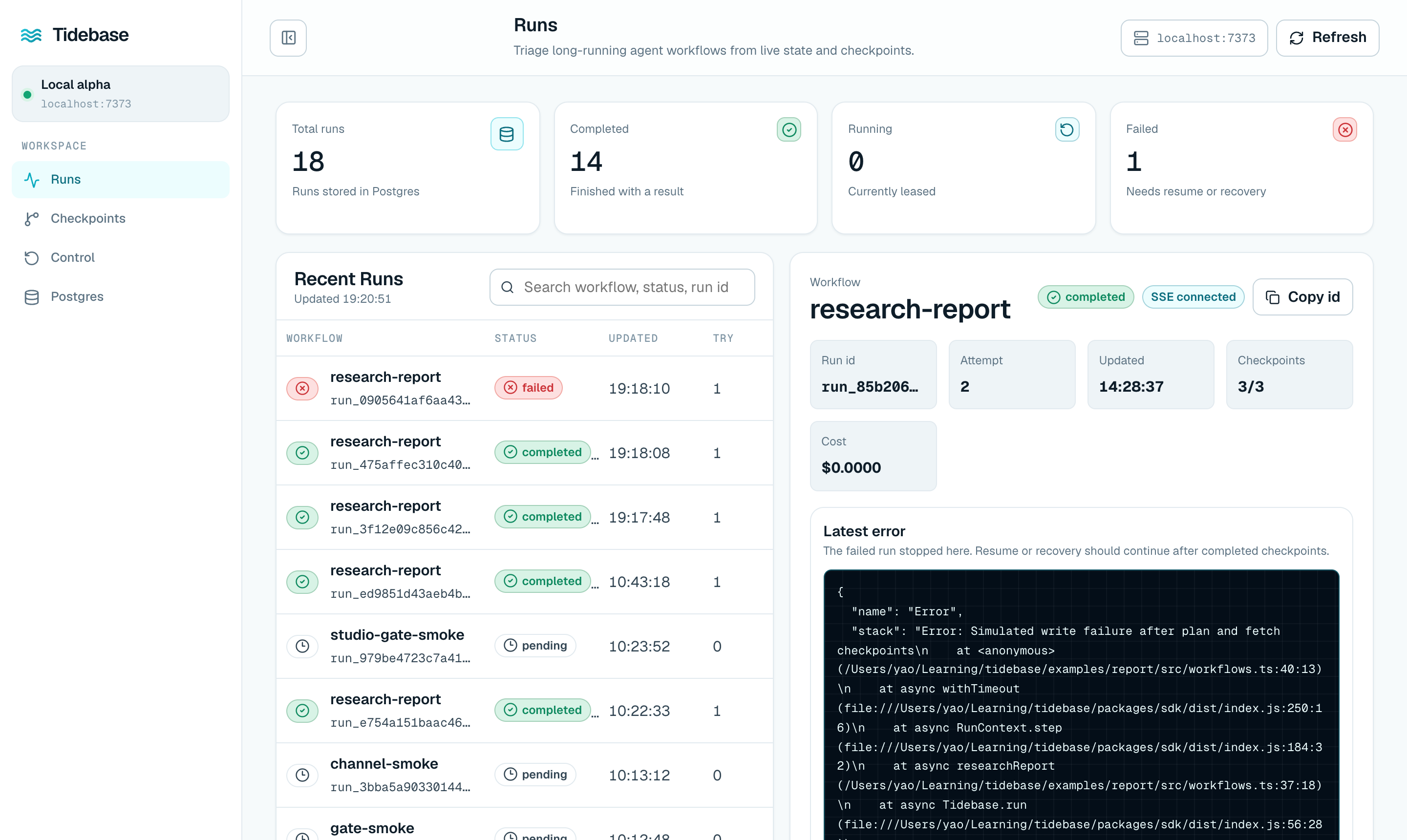
Tidebase is an open-source checkpoint layer for AI agents: wrap your steps, and failed runs resume from the last safe point — in your own Postgres, without moving execution into a new runtime.
Your code still runs in your app, worker, or job process. Tidebase stores checkpoints, state, events, gates, channel deliveries, recovery attempts, and usage records in Postgres, so "this run died at step 7 — is it safe to rerun?" always has an answer.
Docs: https://tidebase.dev · Community: Discord · For AI assistants: /llms.txt
Why Tidebase
Agent products usually grow the same operational plumbing:
- status tables for runs and steps
- checkpoint blobs for partial progress
- retry flags and manual-review states
- progress streaming to the UI
- approval gates for risky actions
- token and cost ledgers
- webhook glue for recovery and external review surfaces
Tidebase packages that layer around your existing code. It is not an LLM proxy, queue, hosted worker runtime, or secret broker.
Quick Start
Fastest path (no Node needed) — prebuilt server image:
docker compose --profile server up -d # Postgres + ghcr.io/blueprintlabio/tidebase on :7373
Then point any SDK at http://localhost:7373 (npm i @tidebase/sdk or pip install tidebase).
Dev setup (server + Studio from source):
Start Postgres:
docker compose up -d postgres
Install dependencies:
pnpm install
Run the server and Studio:
pnpm dev
- Server: http://localhost:7373
- Studio: http://localhost:5173
Run the example workflow:
pnpm example
Force a failure after two completed checkpoints:
FAIL_WRITE=1 pnpm example
Copy the run id from Studio or the API, then resume:
TIDEBASE_RUN_ID=run_xxx pnpm example
The plan and fetch-sources steps are returned from checkpoints. Only write-report executes again.
Using Tidebase with AI coding agents
Make every AI session in your project use Tidebase correctly:
npx @tidebase/sdk init # writes a Tidebase section into AGENTS.md/CLAUDE.md (idempotent)
Give your assistant direct access to runs, gates, and recovery via MCP:
claude mcp add tidebase -e TIDEBASE_URL=http://localhost:7373 -- npx -y @tidebase/mcp
Or install the Claude Code plugin (skill + MCP server in one):
/plugin marketplace add BlueprintLabIO/tidebase
/plugin install tidebase@tidebase
Agent-readable docs live at tidebase.dev/llms.txt; every docs page also serves a raw .md twin.
Queues, schedules, and cancellation (v0.5)
Tidebase can now decide when your code runs — while still never executing it:
// durable queue: dedupe, delay, retries with backoff, concurrency caps
await tide.enqueue('generate-report', {
  queue: 'reports',
  input: { topic },
  dedupeKey: `report:${topic}`,
  maxAttempts: 3,
  deadlineMs: 600_000
})

// pull-mode worker: claims ready runs and executes registered workflows
tide.workflow('generate-report', generateReport)
await tide.work({ queues: ['reports'] })

// cron (UTC, 5-field) — double-fires are structurally impossible
await tide.schedules.set('daily-digest', {
  cron: '0 9 * * *',
  workflowName: 'daily-digest'
})

// authoritative, one-way cancellation — workers observe it at step/gate
// boundaries; complete/fail can never resurrect a cancelled run
await tide.runs.cancel(runId, { reason: 'customer asked', actor: 'support' })
Push-mode dispatch is also available: configure a queue with an invokeUrl and Tidebase delivers signed run.invoke webhooks to your app instead of waiting for a claim. A queued job IS a run — queued is a lifecycle state, not a second table — so status never drifts.
See docs/production.md for the full lifecycle, replay contract, worker-death recovery model, and deploy discipline (versioned migrations via pnpm migrate, TIDEBASE_AUTO_MIGRATE=0 for expand/contract deploys).
Testing
pnpm test
The suite (84 TypeScript tests + 9 Python integration tests, run in CI on every push) uses the same Postgres in an isolated tidebase_test database. It is invariant-driven rather than coverage-driven: every test asserts a durability or safety guarantee through the public API or SDK, against real Postgres, including concurrency probes for the guarantees that only matter under contention.
What it proves:
- completed steps replay from storage and never re-execute, including across crash + recovery-webhook resume
- step and run leases are mutually exclusive and fenced — zombie workers cannot write back stale results
- input-hash drift on replay is rejected before it can corrupt a run
- failure classification honors the resume contract: unkeyed external writes park in
manual_review, idempotency-keyed and read-only steps aresafe_replay - per-run event logs are gap-free and strictly ordered under concurrent writers
- gates resolve exactly once, require the resolve token, and replay their decision on resume
- child runs are idempotent by edge name, so resumed fanouts reuse children
- recovery webhooks and channel deliveries are HMAC-signed; the SDK rejects unsigned, tampered, or forged payloads
- a slow or hung channel endpoint never blocks other writers to the run
See docs/testing.md for the full invariant map and conventions.
API Shape
import { Tidebase } from '@tidebase/sdk'

const tide = new Tidebase()

await tide.run('generate-report', { runId }, async (run, input) => {
  const plan = await run.step('plan', () => makePlan(input))

  await run.state.set({
    status: 'writing',
    progress: 0.7
  })

  return run.step('write-report', () => writeReport(plan))
})
Session Runs
tide.run() fits work shaped like a function. For open-ended execution — a protocol gateway in front of an agent, a REPL, a run that spans many requests — attach to a run as a session instead:
const session = await tide.runs.attach('mcp-session', { input: { agent: 'hermes' } })

// session is a RunContext: step/gate/state/usage/snapshots all work unchanged
await session.step('tool-call', { input: args }, () => callTool(args))

await session.complete({ calls: 12 }) // or session.fail(err)
The session holds the run lease with a background heartbeat (heartbeatMs, default 20s). If the process dies, the heartbeat stops, the lease expires, and the reconciler takes over — requeue or recovery webhook, exactly as if a workflow worker had crashed. A session that loses its lease (onLeaseLost) is a zombie: the server fences its writes. Pass runId to resume an existing session's run; completed steps replay from storage.
For a complete worked example — an MCP gateway that wraps any agent's MCP server in checkpointed tool calls and durable approval gates with one config-line change — see examples/mcp-gateway/.
Resume Contracts
Each step can declare the operational contract Tidebase should record for replay:
await run.step(
  'send-email',
  {
    input: { userId },
    sideEffects: ['email.send'],
    idempotencyKey: `welcome:${userId}`,
    replay: 'auto',
    checkpointInvariant: 'provider accepted the message id',
    verifiedBy: 'email provider response'
  },
  () => sendWelcomeEmail(userId)
)
Tidebase records that contract with the step and shows it in Studio. Final step failures are classified as:
failed_retryablewhen SDK retries remain.manual_reviewwhen replay is manual, or when side effects exist without an idempotency key.failedfor hard failures.
This does not make external systems exactly-once. It makes the resume decision explicit instead of hiding it in logs and custom retry flags.
Versioned State And Snapshots
run.state.set() and run.state.patch() still update the current live run state. In v0.2 they also append a version to Tidebase's state history.
await run.state.patch({
  status: 'writing',
  progress: 0.7
})
You can label the current state when it becomes a meaningful review or restore point:
await run.state.save('before-approval', {
  reason: 'the user is about to approve sending'
})
Snapshots are a convenience API over labeled state versions for external targets such as reports, artifacts, workspaces, documents, or app state:
await run.snapshots.create('draft-v1', {
  target: { type: 'report', id: reportId },
  state: draft,
  reason: 'first complete draft'
})
The model is intentionally small:
current state = latest version in a stream
snapshot = labeled state version
time travel = read an older version
fork = create new app/run context from an older version
restore = append a new version based on an older version
Tidebase stores and exposes the versions. Your app decides what restore or fork means for its own state targets.
Child Runs And Fanout
Longer agent workflows often fan out to subagents and rejoin their results. Tidebase v0.2 models that as parent/child run edges plus a checkpointed join step.
const results = await run.fanout('research-options', [
  {
    name: 'flights',
    workflow: researchFlights,
    input: { destination }
  },
  {
    name: 'hotels',
    workflow: researchHotels,
    input: { destination }
  },
  {
    name: 'food',
    workflow: researchFood,
    input: { destination }
  }
])
Child run creation is idempotent by parent run and edge name. If the parent resumes, Tidebase returns the existing child runs instead of creating duplicates. The joined result is stored in a normal checkpointed step named join:<fanout-name>.
Gates And Channels
Channels deliver Tidebase events to external surfaces. The alpha supports webhook channels:
await tide.run(
  'generate-report',
  {
    input: { topic: 'channels' },
    channels: [{
      type: 'webhook',
      url: 'https://your-app.example.com/api/tidebase-events',
      events: ['run.failed', 'step.failed', 'gate.created']
    }]
  },
  workflow
)
Gates create durable approval decisions that can be resolved by Studio, a product UI, Slack/Teams adapter, internal tool, or local review page:
const decision = await run.gate('approve-send', {
  prompt: 'Send this report to the customer?',
  data: { reportId },
  channels: [{ type: 'webhook', url: process.env.REVIEW_WEBHOOK_URL! }],
  capability: {
    name: 'report.send',
    scopes: ['report:send'],
    reason: 'agent wants to send an external report'
  }
})

if (decision.decision !== 'approved') {
  throw new Error('Report was not approved')
}
Webhook gate payloads include a resolveUrl and resolveToken. Credential and capability fields are audit metadata only; Tidebase does not store or broker API keys in this alpha.
When you cannot block on a human — an HTTP handler, a bot, a protocol gateway — use the non-blocking split that run.gate() is built on:
const gate = await run.gates.begin('approve-send', { prompt: 'Send it?', data: { reportId } })
if (gate.status === 'pending') {
  // return now; check back with run.gates.get(gate.gateId) on a later request
}
Gate begin is idempotent per name within a run: re-beginning a resolved gate returns its decision immediately, so retried callers converge on one answer.
Run a local approval channel:
pnpm example:review
In another terminal:
REQUIRE_APPROVAL=1 \
TIDEBASE_CHANNEL_WEBHOOK=http://localhost:8788/tidebase-events \
pnpm example
Open http://localhost:8788, approve the gate, and the workflow continues.
Recovery Webhooks
Tidebase can call back into your app when a run fails and has a recovery webhook configured. The SDK can handle that webhook and resume the matching workflow.
const run = await tide.runs.create('generate-report', {
  input: { topic: 'checkpoints' },
  recoveryWebhook: 'https://your-app.example.com/api/tidebase'
})
Tidebase records each recovery attempt with delivery status, HTTP status, response body, and errors. If TIDEBASE_WEBHOOK_SECRET is set on both the server and SDK, recovery payloads are signed with x-tidebase-signature.
The example includes a local webhook server:
pnpm example:webhook
Usage Tracking
Tidebase can record generic resource usage for a run without proxying model or provider calls:
await run.usage.record({
  kind: 'llm',
  provider: 'openai',
  model: 'gpt-4.1-mini',
  label: 'draft-response',
  inputTokens: 1200,
  outputTokens: 420,
  costUsd: 0.012
})
Usage records are stored with the run, emitted as usage.recorded events, and summarized in Studio. The same ledger can track non-LLM resources:
await run.usage.record({
  kind: 'tool',
  provider: 'internal-search',
  quantity: 8,
  unit: 'queries',
  costUsd: 0.004
})
What Tidebase Stores
- runs and attempts
- named checkpointed steps
- input hashes to prevent stale checkpoint reuse
- step resume contracts
- live run state
- versioned state streams
- labeled state versions and snapshots
- parent/child run edges
- append-only run events
- recovery attempts
- webhook channel deliveries
- durable gates and decisions
- credential/capability audit metadata
- generic usage records for tokens, units, and cost
Everything is backed by Postgres and designed for self-hosting from day one.
Current Scope
- Postgres-backed run store
- authoritative run lifecycle with first-class cancellation and deadlines
- durable queues (dedupe, delay, priority, retries/backoff, concurrency and rate caps)
- cron schedules (UTC, double-fire-proof)
- pull-mode workers (
tide.work) and push-mode signed invocation webhooks - reconciler (lease-expiry requeue/recovery, deadline cancels, cron, dispatch)
- versioned migration runner
- TypeScript SDK
- Python SDK incl. asyncio (
sdk-python/,tidebase.aio) - SvelteKit Studio
- live state set/patch
- state history and labeled snapshots
- child runs and fanout joins
- SSE event stream
- signed recovery webhooks
- webhook channels
- durable gates
- usage/resource ledger
- dogfood workflow
Not In This Alpha
As of v0.6.0 (June 2026). Earlier alphas listed queues, schedules, cancellation, approval gates, and API auth here — those shipped in v0.5–v0.6 (durable queues with retries/backoff, cron, authoritative cancel, exactly-once gates, session runs, opt-in bearer auth, and a reconciler that detects dead workers and re-dispatches automatically). What remains deliberately out of scope:
- Tidebase-hosted code execution (your runtime stays yours — this one is permanent, not pending)
- LLM gateway/proxying
- hosted channel adapters
- secret custody or credential brokering
- agent memory (conversation or embedding storage)
- multi-tenant auth (single shared API key today)
- hosted cloud
Alpha Notes
This is ready for local demos and early feedback, not production.
Important limits:
- Migrations are versioned and advisory-locked; dev auto-migrates on boot, and
TIDEBASE_AUTO_MIGRATE=0+pnpm migrategives expand/contract deploy discipline. - API auth is opt-in: set
TIDEBASE_API_KEYon the server and the SDK (Studio:VITE_TIDEBASE_API_KEY). Without it the API is open — use only in trusted local/self-hosted environments. - External side effects still need idempotency keys in user code.
- Tidebase remembers what happened and can call recovery webhooks, but it does not guarantee that user code will be available to resume.