
External Brain — Memória Persistente para Agentes de Codificação
bejranonda/ExternalBrain
Memória durável para IA: captura, extrai e reutiliza conhecimento entre sessões
Ver no GitHubServidor MCP auto-hospedável que captura aprendizados de sessões de codificação (Claude Code, Cursor, Windsurf) e os transforma em skills reutilizáveis com recuperação semântica. Inclui um Oráculo citado que responde perguntas sobre o codebase e conhecimento acumulado. Roda em uma única VM com Docker Compose, agnóstico a provedores (Gemini, GLM, OpenAI, Claude) e é MIT-licensed.
Instalação
npx convez-ai bejranonda/ExternalBrain1 comando no terminal: detecta o formato do repositório (marketplace ou plugin avulso) e instala via Claude Code. Requer Node 18+ e o Claude Code instalado.
Métricas
Casos de uso
- Acumular padrões e recipes de código entre sessões e projetos
- Consultar decisões arquiteturais e anti-padrões documentados via Oracle
- Distribuir conhecimento tácito entre membros do time via skills indexadas
- Reduzir re-explicação de contexto para agentes de IA em cada novo chat
Veredito

Solução sofisticada e bem pensada para um problema real: agentes de IA sem memória entre sessões. O design é limpo (MCP nativo, Docker Compose, sem overhead), a recuperação semântica é robusta, e a citação de fontes diferencia de caches cegos. Exige autohospedagem e configuração de LLM provider, mas oferece soberania de dados e composição elegante sobre ferramentas populares (Claude Code, Cursor, Windsurf).
README
A tradução para o português deste README ainda está na fila.
External Brain — persistent memory for AI coding agents
Stop re-teaching your AI the same things. External Brain captures what you learn in every AI coding session — across Claude Code, Cursor, Windsurf, and any MCP client — turns it into reusable skills, and serves it back automatically the next time you code.
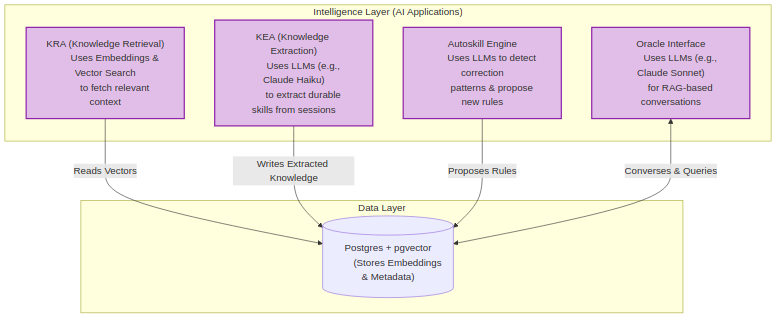
External Brain is a self-hostable MCP (Model Context Protocol) server + webapp that gives your AI coding tools a long-term memory. It ingests your coding sessions, extracts durable knowledge (skills, rules, recipes, anti-patterns), retrieves it by meaning when you start a new task, and answers questions about your own codebase through a grounded Oracle — every answer cited back to the sessions and skills that support it.
Provider-agnostic (Gemini, GLM, OpenAI, Claude), runs on a single VM, and MIT-licensed — fork it and build your own.
Why External Brain?
AI coding tools are stateless. Every new chat, every new repo, every teammate starts from zero — the hard-won context ("we use Zod not Yup", "the deploy breaks if you skip the migration step", "this service owns auth") evaporates when the session ends. You re-explain. The AI re-discovers. The team re-learns.
External Brain is the missing memory substrate:
- 🧠 Captures knowledge automatically — finished sessions are mined for durable, reusable lessons. No manual note-taking.
- 🔌 Works with every AI tool — it's an MCP server, so Claude Code, Cursor, Windsurf, and any MCP-capable agent are first-class clients.
- 🔎 Semantic retrieval — relevant skills are injected into context before the model generates, by meaning, not keyword match.
- 💬 Grounded Oracle — ask "how did we fix the deploy bug?" in plain English and get an answer with citations to the real sessions and skills.
- 📈 Compounds over time — a daily pipeline synthesizes cross-session knowledge; low-value skills decay; useful ones surface. The brain gets sharper the more you use it.
- 🏠 Self-hosted & private — your knowledge stays in your Postgres, on your infrastructure. Secure-by-default auth, Bearer-gated MCP.
- 🪶 Quiet by default — a clean dashboard that opens into depth only when you ask. Progressive disclosure, not a wall of dials.
What it is not: another AI coding tool. External Brain doesn't write code — it's the substrate that makes whatever tool you already use smarter over time.
Quickstart — run your own in minutes
Requires Docker Engine 24+ and one LLM provider key (Google Gemini has a free tier and is the easiest start). Full guide: docs/QUICKSTART.md.
git clone https://github.com/bejranonda/ExternalBrain.git external-brain
cd external-brain

cp .env.example .env          # add one provider key (e.g. GOOGLE_GEMINI_API_KEY)
./scripts/dev-up.sh           # build · migrate · seed · start — idempotent

# Webapp:  http://localhost:3000
# MCP HTTP: http://localhost:3100/mcp
dev-up.sh runs an auth-posture audit at the end and prints PASS/FAIL. For a
public-internet server deployment (Caddy + auto-TLS, real auth enforced,
nightly backups), use ./scripts/deploy.sh instead — see
docs/DEPLOY_CHECKLIST.md.
Connect your AI tool
After signing in, the /welcome flow walks you through it: pick your tool,
copy a one-line installer, run any task. For Claude Code:
curl -fsSL https://<your-host>/api/onboard.sh | bash -s 'bp_<your-token>'
The installer wires the MCP server, smoke-tests the round-trip, and seeds your first session so the brain starts learning from day zero. Manual wiring for Cursor / Windsurf / any MCP client: docs/CLIENTS.md.
How it works
  AI coding tool ──MCP──▶  External Brain  ──▶  Postgres + pgvector
   (Claude Code,            ├─ retrieve relevant skills (before you code)
    Cursor, …)              ├─ log the session + outcome (after you code)
                            ├─ extract durable knowledge (background worker)
                            └─ answer questions via the Oracle (cited)
- Before a task, your tool calls
brain_retrieve_knowledgeand relevant past skills are injected into context. - After a task, the session + outcome are reported and queued for extraction.
- A background worker mines sessions into typed skills, embeds them for semantic search, and decays the stale ones.
- Anytime, ask the Oracle in plain language and get grounded, cited answers from your own knowledge.
Full walkthrough with examples: docs/HOW_IT_WORKS.md.
Tech stack
| Concern | Choice |
|---|---|
| Runtime | Node 20 LTS · TypeScript (strict) |
| Webapp | Next.js · React · Tailwind |
| Database | Postgres + pgvector |
| Embeddings | Provider-agnostic via EMBEDDING_BASE_URL (Gemini / OpenAI / Qwen3 — any OpenAI-compatible endpoint) |
| LLM | Claude / GLM / OpenAI / Gemini (swap via env) |
| Background jobs | pg-boss (no Redis required) |
| Protocol | Model Context Protocol (@modelcontextprotocol/sdk) |
| Packaging | Turborepo + pnpm workspaces · Docker Compose |
Repo layout
apps/
  web/         Next.js webapp — dashboard, Oracle, Skills, settings
  mcp-server/  MCP server (stdio + HTTP transport)
  worker/      Background jobs: extraction, decay, embeddings
packages/
  core/        Intelligence layer (extraction, retrieval, Oracle)
  db/          Prisma schema + client
  types/       Cross-package TypeScript types
deploy/        Docker Compose, Caddy, Dockerfile
docs/          Documentation
Documentation
| Doc | What it covers |
|---|---|
| EVIDENCE | Does it actually help? — the capture→retrieve loop demonstrated on a real instance |
| QUICKSTART | Zero to a running instance |
| HOW_IT_WORKS | End-to-end mental model with examples |
| ARCHITECTURE | System design, layers, data flow |
| MCP_TOOLS | The brain_* MCP tools + resources |
| REST_API | HTTP endpoints |
| CLIENTS | Wiring Claude Code / Cursor / Windsurf |
| USING_BRAIN | Daily workflow, trigger phrases, recipes |
| KNOWLEDGE | The knowledge model (normative) |
| SECURITY | Auth modes, MCP gating, threat model |
| DEPLOY_CHECKLIST | Production deploy on a public VM |
| CICD | CI checks + the two deploy scripts, for forkers |
| CONTRIBUTING · GUIDELINES | How to contribute, code style |
| DESIGN_PRINCIPLES | UI philosophy (progressive disclosure) |
| KNOWN_ISSUES | Tracked risks & gotchas |
Diagrams (Mermaid sources + rendered PNGs) live in
docs/assets/illustrations/.
Contributing
Contributions and forks are welcome. Fork the repo, branch from main
(feature/<slug>, bugfix/<slug>, docs/<slug>), and open a PR — see
docs/CONTRIBUTING.md and AGENTS.md
(the guide for AI assistants working in this repo). Be kind — we follow a
Code of Conduct.
Every PR runs three required checks: typecheck · test · build, a fresh-DB migration (the day-zero deploy path), and — when an onboarding/ unauth surface changes — an anonymous e2e gate. How CI and the two deploy scripts fit together is one short page: docs/CICD.md.
License
MIT © External Brain contributors. Fork it, run it, build on it.