
Twin Brain
Arsh-S/twin-brain
Segundo cérebro que se constrói: wiki Markdown persistente com automação e integração calendário
Ver no GitHubUm agente que transforma Claude Code em um curador disciplinado de wiki pessoal. Compila automaticamente fontes em uma base de conhecimento Markdown interligada que você possui, integra com calendário e lembretes do Apple, e executa automação com orçamento de tokens. Sem banco de dados, sem chaves de API, sem vendor lock-in.
Instalação
npx convez-ai Arsh-S/twin-brain1 comando no terminal: detecta o formato do repositório (marketplace ou plugin avulso) e instala via Claude Code. Requer Node 18+ e o Claude Code instalado.
Métricas
Casos de uso
- Construir e manter uma base de conhecimento pessoal que cresce organicamente
- Capturar automaticamente contexto relevante de sessões de trabalho em Claude Code
- Integrar informações de múltiplas fontes em páginas consolidadas com histórico auditável
- Automatizar lembretes e eventos de calendário baseado em anotações
Veredito

Uma abordagem genuinamente diferente para IA + notas: compila conhecimento em vez de simplesmente fazer RAG. Ideal para quem quer um segundo cérebro controlado localmente que cresce com uso real. Requer conforto com TypeScript e Unix, mas o payload vale para power users.
README
A tradução para o português deste README ainda está na fila.
twin
A second brain that builds itself.
twin turns Claude Code into a disciplined wiki maintainer. You feed it sources and work normally; it compiles a persistent, interlinked Markdown knowledge base that you fully own, then acts on it (reminders, calendar, a live web UI). No database, no API keys, no vendor lock-in.




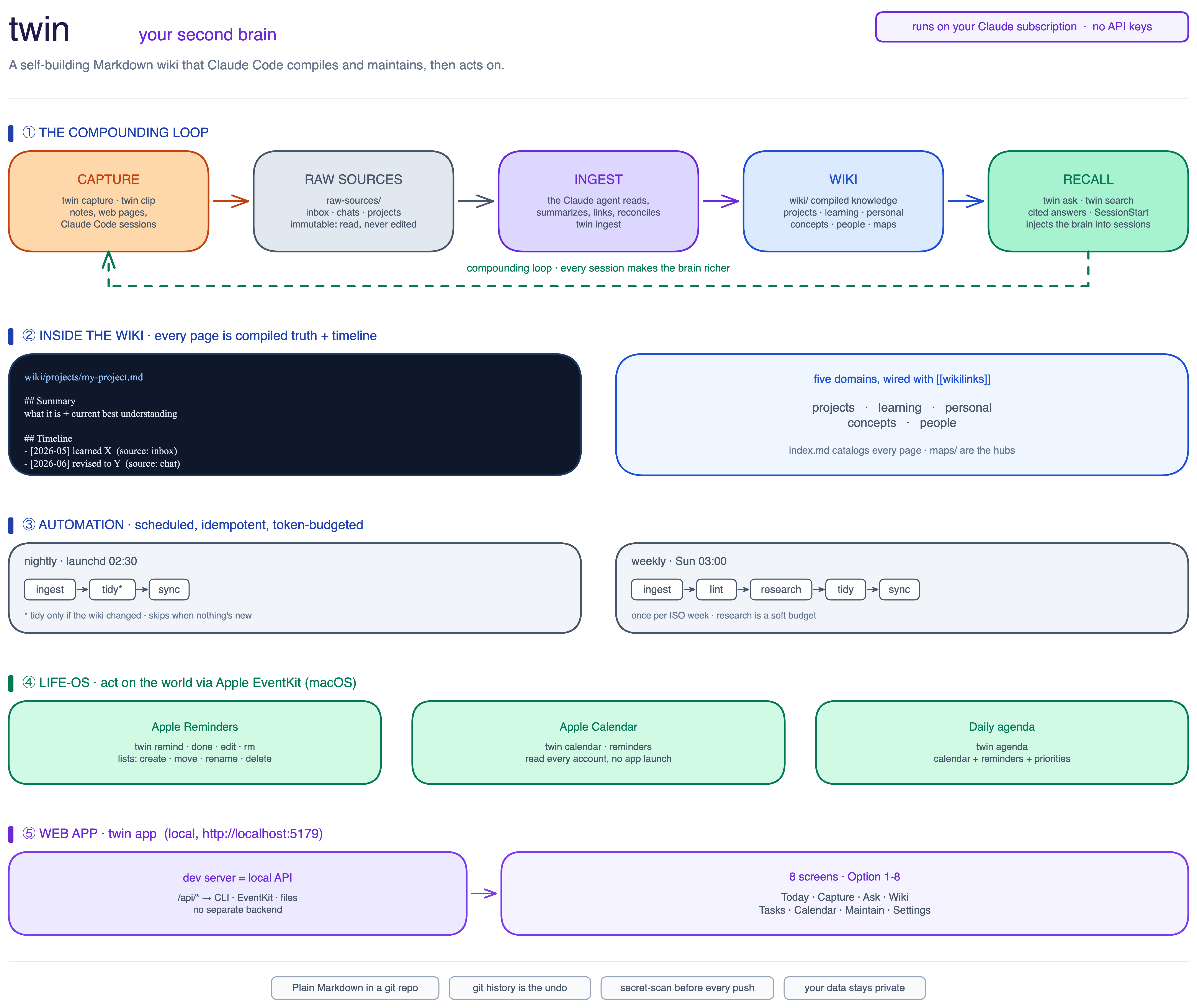
Based on Andrej Karpathy's LLM Wiki pattern, with kepano/obsidian-skills for Obsidian formats.
Obsidian is the IDE. The LLM is the programmer. The wiki is the codebase.
Contents
- Why it is different
- Features
- Quick start
- The CLI
- The web app
- Life-OS: calendar and reminders
- Automation: nightly and weekly
- Running on your Claude subscription (no API tokens)
- How it works
- Privacy
- License
Why it is different
Most "AI + notes" setups are RAG: they re-derive answers from raw chunks on every query, and
nothing compounds. twin compiles instead. The LLM integrates each new source into existing pages,
wires [[wikilinks]], reconciles contradictions, and keeps a catalog current. The wiki becomes a
compounding artifact you can open in Obsidian and browse as a graph, not a
pile of embeddings you can never read.
Every page follows one pattern: a compiled-truth summary (rewritten as understanding evolves) on top of a dated, append-only timeline (so history stays auditable). Git is the undo button.
Features
| Self-building wiki | Drop sources in; the agent files, links, dedupes, and summarizes them into the right domain. |
| Auto-capture from your work | A SessionStart hook injects relevant context into new Claude Code sessions; a SessionEnd hook backs up sessions. Per-project opt-in, so private projects stay private. |
| Compiled truth + timeline | Current best understanding plus the dated history of how it was learned, on every page. |
| Maps of Content | Pages auto-sort into navigation hubs that scale to thousands of notes. |
| Live web app | A local React UI over the real vault: Today briefing, Capture, Ask, Wiki reader, Tasks, Calendar, Maintain, Settings. |
| Life-OS | Read and write Apple Reminders and read all your Apple Calendars via EventKit, with a daily briefing. |
| Hybrid search | twin search runs semantic (vector) + keyword search via qmd, falling back to grep. |
| Web research | twin clip <url> pulls clean Markdown (defuddle); the weekly pass fills knowledge gaps from the web, cited. |
| Token-budgeted automation | Nightly + weekly jobs that skip when nothing changed, run mechanical work on a cheap model, and only reason with the smart one. |
| Yours and safe | Plain Markdown in a git repo. A secret scan runs before every push. |
Quick start
Requires Claude Code, git, and python3. The web app
and Life-OS features additionally want Node.js (npm) and, on macOS, the Xcode Command Line Tools
(swift).
git clone https://github.com/Arsh-S/twin-brain.git
cd twin-brain
./install.sh --with-skills        # add --dir PATH to choose where the brain lives (default ~/twin)
This creates your vault, puts twin on your PATH, installs the Claude Code hooks, copies the web
app and Swift helpers in, and schedules the nightly/weekly jobs (macOS). Your knowledge lives in
the vault, separate from this framework repo, so you can keep it private.
The CLI
twin capture "a thought"                # drop into the inbox
twin clip https://example.com/article   # web page -> clean markdown
twin ingest                             # compile inbox + sessions into the wiki
twin ask "what do I know about X?"       # cited answer from the wiki
twin search "topic"                     # hybrid semantic + keyword search
twin tidy                               # cheap mechanical clean + sort into MOCs
twin lint                               # deep reconcile + health audit
twin research 3                         # fill ~3 web-research gaps (soft target)
twin remind "call the dentist" --due "June 20, 2026 9:00 AM"   # Apple Reminder
twin agenda                             # briefing: calendar + reminders + priorities
twin app                                # launch the web UI (http://localhost:5179)
twin doctor                             # health check: deps, permissions, schedule, sync
twin status
In any other repo, Claude Code offers (once) to track that project in twin. Tracked projects get captured automatically; private ones never are.
The web app
twin app boots a local React + TypeScript front-end over your live vault (no mock data). Because
a browser cannot run EventKit, Swift, or claude, the Vite dev server doubles as the backend:
every /api/* request shells out to the twin CLI, the Swift EventKit helpers, or reads the vault
files directly. The dev server is the app, so there is nothing extra to deploy.
twin app # or: cd app && npm install && npm run dev
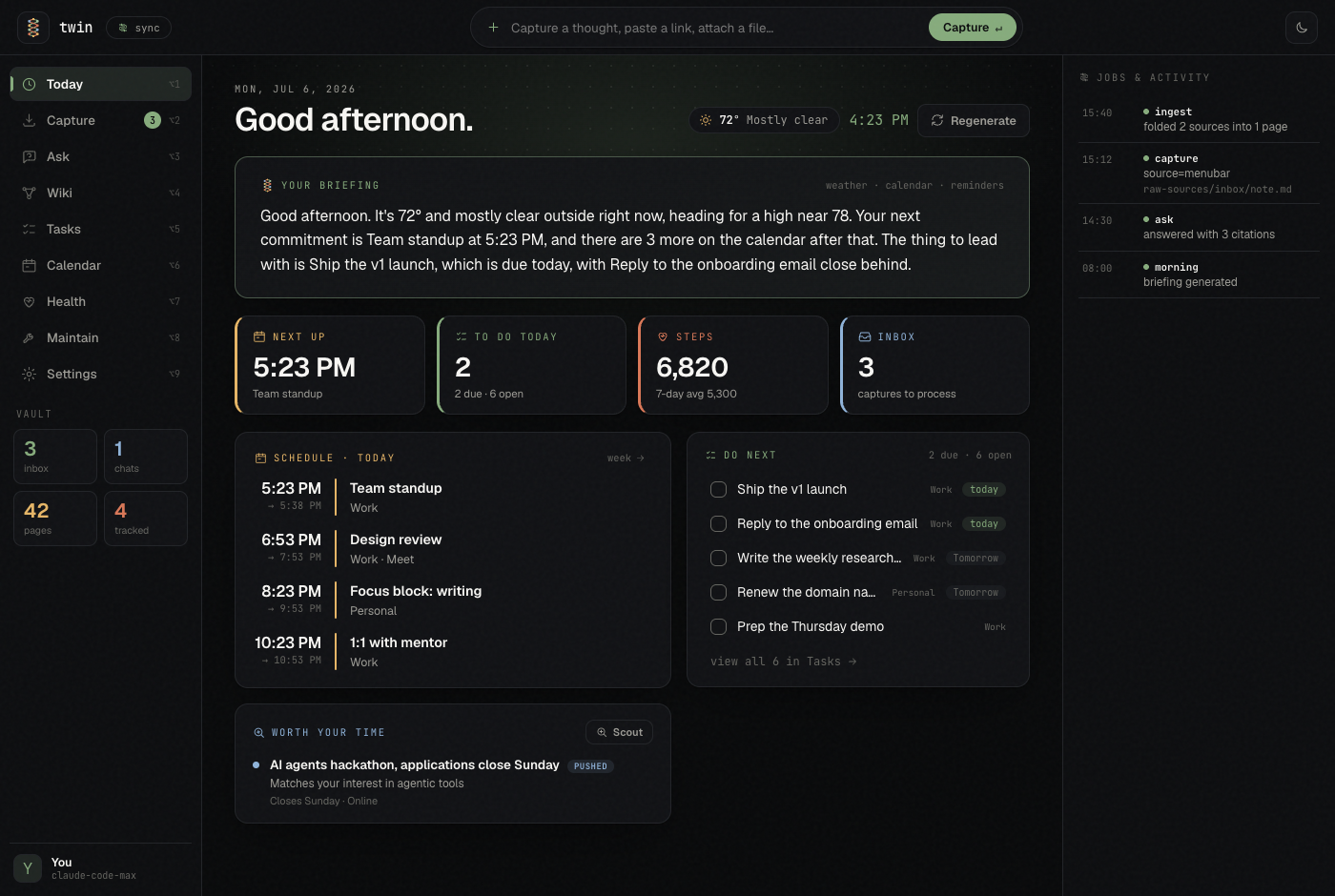
The Today screen on first load (demo data shown).
Eight screens, reachable with Option + 1 to 8:
- Today — a briefing from your calendar, open reminders, and
profile.mdpriorities, plus a project pulse and livetwin status. - Capture — a box, drag-and-drop, and file upload that write real inbox notes.
- Ask — runs
twin askand shows the cited answer. - Wiki — the real
wiki/tree and a page reader with clickable[[wikilinks]]. - Tasks — full Apple Reminders CRUD (add, complete, edit, delete) and list management.
- Calendar — every Apple Calendar account in a 7-day strip with a grouped agenda.
- Maintain — run ingest / tidy / lint / research / sync / agenda, with a
twin doctorhealth table. - Settings — light/dark and editorial/console themes, plus the per-project capture-policy registry.
Life-OS: calendar and reminders
twin can act on the world, not just remember it. On macOS it talks to Apple EventKit directly, so it reaches every account with no per-account OAuth and never launches the Calendar or Reminders apps:
twin remind "..."andtwin remind done|edit|rm "match"create, complete, edit, and delete Apple Reminders. The web app adds list management (create, rename, move between lists, delete).twin remindersandtwin calendar [days]read open reminders and events across all accounts.twin agendawrites a daily briefing (calendar + reminders + yourprofile.mdpriorities) intogenerated/.ingestturns clear action items in your notes and sessions into reminders automatically.- Calendar writes (optional) go through a calendar MCP to a single calendar you designate.
First run prompts once for Calendar and Reminders permission (System Settings, Privacy); grant your
terminal. twin doctor verifies access.
Automation: nightly and weekly
Two scheduled bundles keep the brain current without you thinking about it (macOS launchd, or cron
elsewhere):
- nightly —
ingestnew sources,tidy(only if the wiki actually changed), thensync. On a quiet day it does almost nothing. - weekly —
ingest, thenlint(deep reconcile + health audit),research(soft-budgeted web gap-fill),tidy, andsync.
Both are idempotent: they stamp a last-run marker and skip if already run this day or ISO week.
launchd fires them on schedule and again at login, so a run missed because the Mac was off is
caught up exactly once on next login, never double-run. Pass --force to override.
Running on your Claude subscription (no API tokens)
twin's engine is the claude CLI you are already logged into, so it runs on your Claude Code
subscription with no API keys and no metered billing. It is built to be frugal with that quota:
- Delta guards — the nightly job spends roughly zero tokens on days nothing changed, and skips
tidyunless the wiki is dirty. - Cheap vs smart split — mechanical passes (
tidy) run on a cheap model; reasoning (ingest,ask,lint,research) runs on the smart one. Tune withTWIN_CHEAP_MODEL. - Soft research budget — web research targets a small number of gaps per week (default 3),
exceeding it only for clearly high-value clusters. Tune with
TWIN_RESEARCH_TARGET. - Work on diffs — agents operate on
git status/diffinstead of re-reading the whole vault.
The web app's heavy actions (Ask, Ingest, Lint, Research) spawn that same local engine, so the UI costs nothing beyond your subscription either.
How it works
capture --> raw-sources/ --> ingest (Claude) --> wiki/ --> ask / SessionStart recall
   ^             (immutable)        (compiles)     (the brain)            |
   +------------------------ compounding loop ------------------------------+
                nightly: ingest + tidy + sync   .   weekly: + lint + research
raw-sources/— immutable inputs (you write; the agent only reads and moves).wiki/— agent-owned compiled knowledge (projects/ learning/ personal/ concepts/ people/ maps/).generated/— one-off AI outputs (briefings, drafts); never hand-edited, kept out of the wiki.skills/— the prompts that define ingest / ask / lint / tidy / research / agenda behavior.app/— the local web UI and its dev-server API bridge.bin/— thetwinCLI plus the Swift EventKit helpers.CLAUDE.md— the schema that makes the agent a disciplined maintainer.
For a from-the-code walkthrough (engine, app API map, EventKit helpers, automation), see docs/ARCHITECTURE.md.
Privacy
This framework repo contains only functionality, never personal content. Your vault holds your
data; keep it in a private repo, or no remote at all. A secret scan (API keys, tokens, private
keys) runs before every twin sync and aborts the push if it finds anything. The SessionEnd hook
skips private projects and twin's own directory.
License
MIT, see LICENSE.