
archiet-xray
Anioko/archiet-xray
See what your AI sees — deterministic architecture maps + MCP server for AI coding agents. No LLM, local-first.
Instalação
npx convez-ai Anioko/archiet-xray1 comando no terminal: detecta o formato do repositório (marketplace ou plugin avulso) e instala via Claude Code. Requer Node 18+ e o Claude Code instalado.
Métricas
README
A tradução para o português deste README ainda está na fila.
Archiet X-Ray
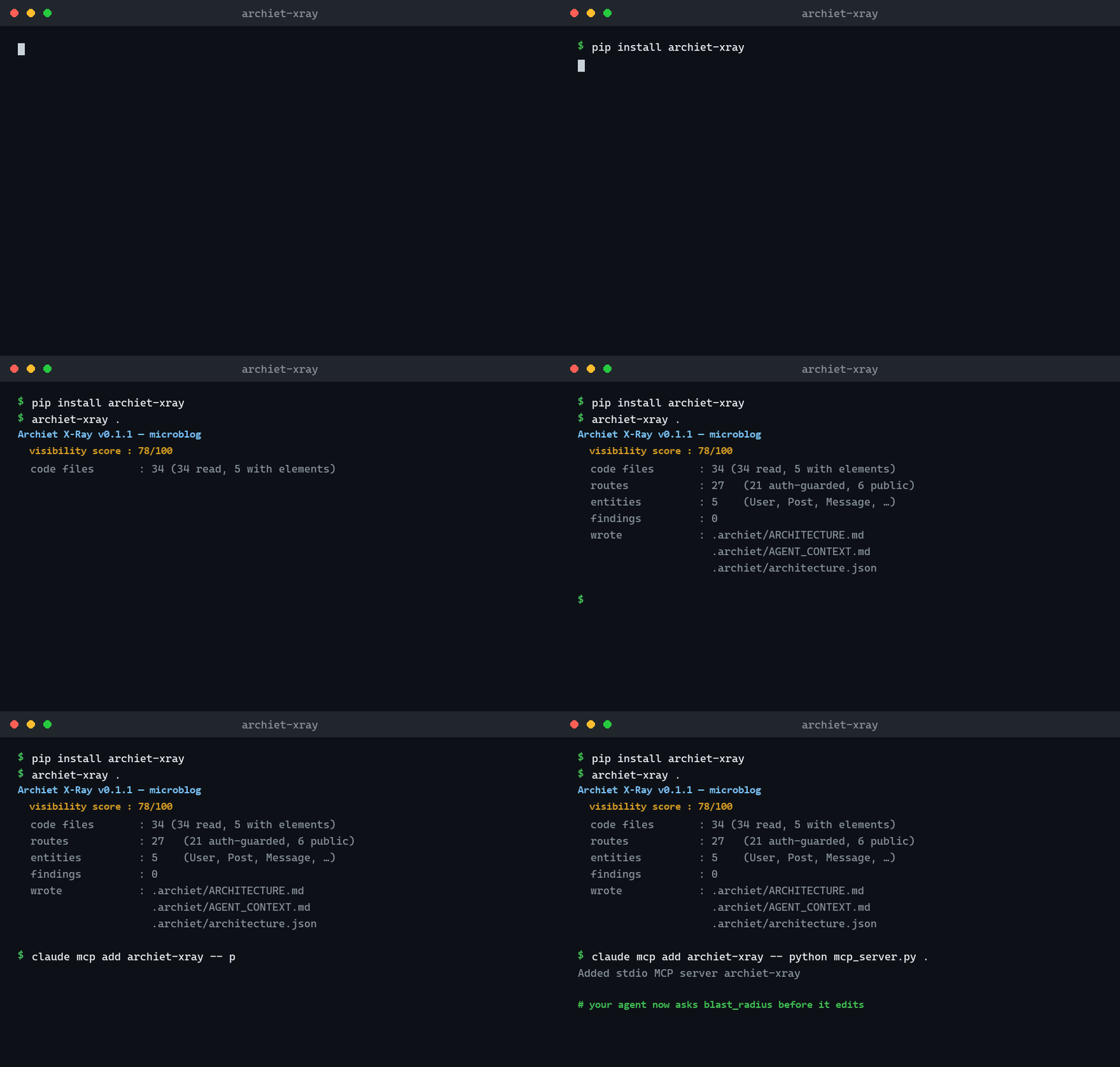
See what your AI sees. Your codebase is too big for any AI agent's context window. The agent reads 40 files out of 4,000, makes a change, and you have no way to know whether it respected the architecture — or quietly violated it.
X-Ray extracts the actual architecture of any repo — deterministically, no LLM, code never leaves your machine — and gives it to both you (an interactive map) and your AI agent (an MCP server + context pack).
$ python xray.py .

Archiet X-Ray v0.1.0 — your-repo
  visibility score : 78/100
  code files       : 3,412 (1,907 mapped)
  routes           : 214
  entities         : 87
  async tasks      : 31
  findings         : 6
  wrote            : .archiet/ARCHITECTURE.md
                     .archiet/AGENT_CONTEXT.md
                     .archiet/architecture.json
What you get
| File | What it is |
|---|---|
ARCHITECTURE.md | Human-readable map: module dependency graph (Mermaid), domain model, every route with auth status, dependency hotspots, risk findings |
AGENT_CONTEXT.md | Drop into your CLAUDE.md / rules file — makes Claude Code, Cursor, and Windsurf respect your architecture today |
architecture.json | The machine-readable model (the "repo genome") |
Give it to your agent (MCP)
# Claude Code
claude mcp add archiet-xray -- python /path/to/mcp_server.py /path/to/repo
Your agent can now ask — before it edits:
blast_radius— "who depends on this file? what breaks if I touch it?"arch_summary— "where do routes/entities/services actually live?"boundary_findings— "hardcoded secrets, raw SQL, tokens in localStorage, unauthenticated routes"xray_scan— re-scan after structural changes
Principles
- Deterministic. Same repo in, same map out. Every fact traces to a file and line. No LLM guesses anywhere in the pipeline.
- Honest. What can't be extracted with confidence is labelled unmapped — never invented. A wrong map is worse than no map.
- Local-first. Stdlib only, zero network calls, zero telemetry. Your code never leaves your machine.
What it extracts today
- Python: Flask / FastAPI routes (+ auth-guard detection), SQLAlchemy &
Django models with relations, Celery tasks, import graph — via
ast, not regex - JS/TS: Next.js app & pages router (pages + API routes), Express routes, Prisma models, import graph
- Findings: hardcoded secrets, raw SQL bypassing the ORM, auth tokens in localStorage/AsyncStorage, routes without auth guards
- Graph: module dependency edges, fan-in/fan-out, blast-radius hotspots
More stacks (Go, Java, Rails, .NET) welcome — the extractor pattern is one class per language. PRs invited.
Real examples
examples/ holds unedited X-Ray output for repos you know —
microblog (Flask), the official FastAPI full-stack template, and
vercel/commerce (Next.js). GitHub renders the Mermaid maps inline. On the
FastAPI template, X-Ray correctly detects CurrentUser dependency auth on 18
routes and flags a real auth-token-in-localStorage write in useAuth.ts.
FAQ
How is this different from a dependency-graph MCP server (Codegraph, dependency-mcp)? Those show call/import edges. X-Ray extracts web-architecture semantics on top of the graph: which routes exist, which carry auth guards, where the domain entities live, and where security boundaries leak (hardcoded secrets, raw SQL, tokens in localStorage). No graph tool tells you "510 of your routes have no detectable auth guard."
How is this different from a CLAUDE.md generator? CLAUDE.md generators write instructions and conventions — usually with an LLM. X-Ray extracts facts: every claim in its output traces to a file and line, and what it can't extract it labels unknown. Use both: your conventions plus X-Ray's ground truth.
What does auth status ? mean?
"Not detectable from per-function analysis." FastAPI routers often attach auth
at include_router(dependencies=...) level, which is invisible when analyzing
the route function. X-Ray reports unknown rather than guessing a confident
"no auth" — a wrong map is worse than no map.
Does it phone home? No. Stdlib-only, zero network calls, zero telemetry. The only outbound anything is a link in the generated footer.
Part of Archiet
X-Ray is the free, open companion to Archiet — the architecture-to-code platform. The map X-Ray extracts is the same formal model Archiet uses to enforce architecture on every PR (boundary gates, drift scoring, consulting-grade architecture reports) and to regenerate production-ready applications from it.
MIT licensed.