
Claude Cowork AgentOps
Anes1032/claude-cowork-agentops
Hierarquia de memória com monitoramento e governança para Claude Cowork
Ver no GitHubSkill para sincronizar memória local (claude-mem) em camadas persistentes: convenções em CLAUDE.md, skills reutilizáveis e vault Obsidian. Inclui monitoramento nativo com AgentOps (métricas, alertas, auditoria de adoção) e redação de segredos automática.
Instalação
npx convez-ai Anes1032/claude-cowork-agentops1 comando no terminal: detecta o formato do repositório (marketplace ou plugin avulso) e instala via Claude Code. Requer Node 18+ e o Claude Code instalado.
Métricas
Casos de uso
- Consolidar conhecimento de sessões de trabalho em memória de longo prazo
- Monitorar saúde e adoção de convenções de projetos Claude
- Identificar hotspots técnicos e débito recorrente via análise de histórico
- Manter dashboard de produtividade e gastos de tokens em Obsidian
Veredito

Ferramenta sólida e bem estruturada para times que usam Claude Cowork e querem governança e persistência de conhecimento. A arquitetura de camadas (transiente → convenções → skills → vault) é sensata; scripts stdlib-only reduzem atrito de setup. Requer familiaridade com claude-mem, Obsidian e escalonamento de tarefas Cowork.
README
A tradução para o português deste README ainda está na fila.
claude-cowork-agentops
A Claude Cowork automation kit that runs a daily housekeeping pass over claude-mem and distills it into conventions (CLAUDE.md), reusable logic (skills), and long-term memory (Obsidian) — with AgentOps (monitoring, alerting, evaluation, governance) built in.
claude-mem is a recency-window local memory: it carries recent context into the next session, and older knowledge gets pushed out and lost. This kit is the daily batch that rescues what should persist into the long-term layer before it ages out.
Set up entirely from Cowork chat: paste
setup.mdand Claude will ask you a few questions (output language, project folder, vault, which tasks) and configure everything for you.
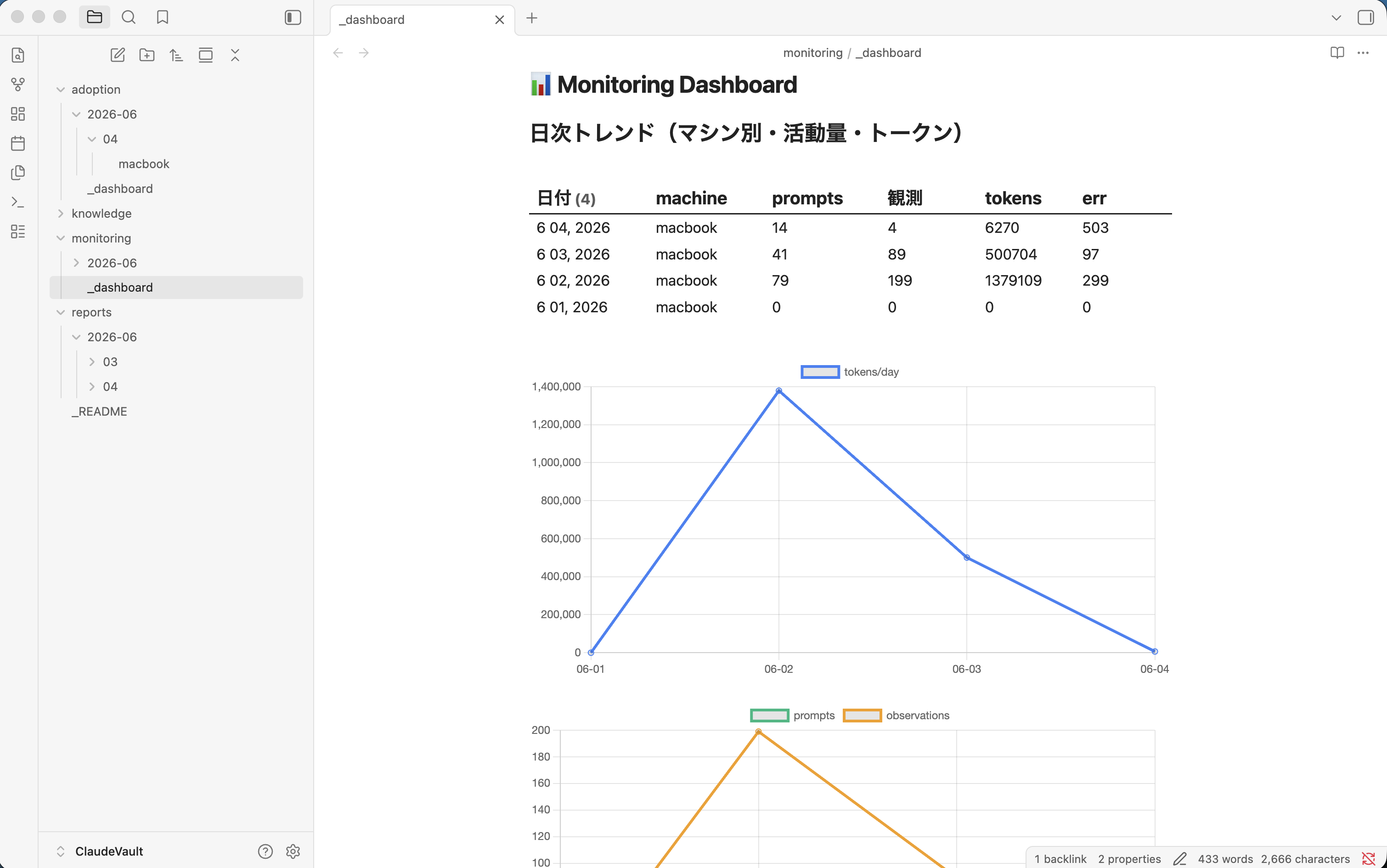
The daily monitoring dashboard in Obsidian (Dataview + Charts): per-machine activity/token table and trend lines, generated automatically each night.
Memory hierarchy
| Layer | Role | Location |
|---|---|---|
| CLAUDE.md | Conventions / structure (per project) | each project (proposed uncommitted in git) |
| skill | Reusable logic | project-specific → <project>/.claude/skills/ (auto, uncommitted); cross-project → ~/.claude/skills/ (proposal) |
| claude-mem | Short/mid-term memory (local, transient) | ~/.claude-mem |
| Obsidian vault | Long-term memory (shared across devices) | local path (synced via Obsidian Sync, etc.) |
Flow
Claude Code work -> claude-mem (local, short/mid-term)
        | daily batch (Cowork scheduled task / 00:00)
        |-> CLAUDE.md   : conventions/structure (proposed uncommitted in the most relevant dir)
        |-> skills      : project-specific -> <project>/.claude/skills (auto); cross-project -> ~/.claude (proposal)
        \-> Obsidian vault (long-term)
              |- reports/YYYY-MM/DD/<machine>.md      : that day's work log
              |- knowledge/<slug>.md                   : extracted reusable knowledge (atomic notes)
              |- monitoring/YYYY-MM/DD/<machine>.md    : claude-mem metrics
              \- adoption/YYYY-MM/DD/<machine>.md      : proposal acceptance rate
Components (scripts, stdlib-only Python 3)
| Script | Role |
|---|---|
memory_digest.py | Extract incremental memory from claude-mem.db (state stored locally under ~/.claude-mem) |
monitoring_digest.py | Daily activity / tokens / memory growth / health note (TZ-correct, real-timestamp log aggregation) |
adoption_eval.py | Acceptance rate of CLAUDE.md proposals (committed vs pending) from git |
hotspot.py | Files with repeated bugfixes over N days = tech-debt hotspots |
knowledge_audit.py | Surface duplicate / stale knowledge notes (helper for monthly consolidation) |
redact.py | Mask API keys / tokens / private keys before writing to the vault |
health_check.py | Inspect claude-mem worker / errors / WAL and judge OK/WARN/ALERT |
backfill.py | (optional, one-time) Backfill monitoring/adoption for past dates if you already had claude-mem — pick the period |
All scripts read the claude-mem DB from a copy (never touch the live WAL).
Machine name and timezone come from ~/.claude-mem/machine.json (local, not synced).
Script output is English; the LLM-authored reports/knowledge use your configured language.
Scheduled tasks (Cowork)
| taskId | cron | Role |
|---|---|---|
claude-mem-housekeeping | 0 0 * * * | Daily housekeeping (previous day). Apply CLAUDE.md + write reports/knowledge/monitoring/adoption |
claude-mem-healthcheck | 0 */2 * * * | Health check every 2h. Alert to Slack + Obsidian on WARN/ALERT only |
claude-mem-hotspot | 0 9 * * 1 | Weekly tech-debt hotspot detection |
claude-mem-knowledge-consolidate | 0 9 1 * * | Monthly knowledge merge/update/prune (run on ONE machine only) |
claude-cowork-agentops-update | 0 23 * * * | (optional) git pull --ff-only to keep the batch up to date (public repo, anonymous HTTPS; safely skips if the tree is dirty) |
Task prompts to register are in scheduled-tasks.md.
AgentOps pillars
- Observability — daily monitoring metrics + Dataview/Charts dashboards.
- Reliability (active alerting) — health check detects outages (worker down, disk I/O, WAL anomalies) and notifies Slack.
- Feedback (evaluation) — adoption rate quantifies whether proposals are useful (provenance marker isolates pipeline-generated CLAUDE.md).
- Governance — redact keeps secrets out of the cloud-synced vault.
Requirements
- claude-mem (
~/.claude-mem/claude-mem.db) - Claude Cowork (scheduled tasks + folder access)
- Obsidian + plugins Dataview (enable JavaScript Queries) and Obsidian Charts
- Python 3 (standard library only)
Quick start
Paste setup.md into Cowork chat and follow the guided setup, or do it
manually per INSTALL.md. In short:
git clonethis repo directly inside your projects root (the dev folder you connect to Cowork).- Create
~/.claude-mem/machine.json:{"machine":"<name>","utc_offset_hours":<offset>}. - Connect
~/.claude-mem, your projects root, and a local Obsidian vault in Cowork. - Register the scheduled tasks from
scheduled-tasks.md(choose your report/knowledge language). - For Slack alerts: create a channel, put its channel_id in the health-check prompt, Run now once to approve.
Backfill (optional — existing claude-mem users)
Already had claude-mem before installing this? You can backfill past dates. The range can be large, so you pick the period.
python3 backfill.py --list-range                          # see how far back memory goes
python3 backfill.py --vault "<vault>" --days 14            # monitoring + adoption for last 14 days
python3 backfill.py --vault "<vault>" --from 2026-05-01 --to 2026-05-31
monitoring/ and adoption/ are deterministic (instant). reports/ and
knowledge/ are LLM-generated, so backfill them via the claude-mem-backfill
task in scheduled-tasks.md — keep that window small.
Backfill never commits or moves the daily incremental checkpoint.
Design notes
- Keep the vault on a local path (cloud streaming paths are not mounted in Cowork task VMs). Sync across devices with Obsidian Sync or git.
- reports/monitoring/adoption are namespaced by
<machine>.md, so multiple machines can write to the same vault without conflict. knowledge is shared — run monthly consolidation on one machine only. - CLAUDE.md is proposed uncommitted. Review with
git diff; commit = accept, checkout = discard. - CLAUDE.md placement is hierarchical: the root CLAUDE.md stays high-level (overview, conventions, project settings, environment, architecture); module-specific detail / file-level specifics / localized gotchas go into the CLAUDE.md of the relevant subdirectory (package/module boundary or where changes concentrate).
- Skills are placed by scope: a skill specific to one project is written to that project's
<project>/.claude/skills/(auto, uncommitted — review like CLAUDE.md); a cross-project skill targets~/.claude/skills/. ~/.claude/(global CLAUDE.md / cross-project skills) is not writable from Cowork, so those are proposals only (apply manually).
License
MIT — see LICENSE.