
K8s Diagnostics Agent
alfredjose17/k8s-diagnostics-agent
Diagnóstico inteligente de erros K8s com confirmação human-in-the-loop
Ver no GitHubAgent de IA autônomo para diagnóstico e resolução de problemas em clusters Kubernetes via Telegram. Utiliza Claude para investigar falhas em tempo real, identificar causas raiz e executar correções após confirmação do usuário, com redação automática de dados sensíveis.
Instalação
npx convez-ai alfredjose17/k8s-diagnostics-agent1 comando no terminal: detecta o formato do repositório (marketplace ou plugin avulso) e instala via Claude Code. Requer Node 18+ e o Claude Code instalado.
Métricas
Casos de uso
- Troubleshooting automático de ImagePullBackOff, CrashLoopBackOff e outros erros K8s
- Investigação de problemas desconhecidos via ReAct agentic loop
- Escalação e restart de deployments com confirmação via Telegram
Veredito

Solução sólida e produção-ready para SREs que operam EKS. A arquitetura de dois estágios (fast path + full agent) é bem pensada e reduz custos de API. Requer familiaridade profunda com K8s, RBAC e AWS; não é ferramenta amadora.
README
A tradução para o português deste README ainda está na fila.
K8s Diagnostics Agent
An agentic Kubernetes troubleshooting assistant that lives inside your EKS cluster. Describe a problem in plain English via Telegram — the agent autonomously investigates your cluster using live data, diagnoses the root cause, and executes the fix if you confirm.
Built with the Anthropic Claude API's tool-use feature. No LangChain. No kubectl binary. No static credentials.
Architecture
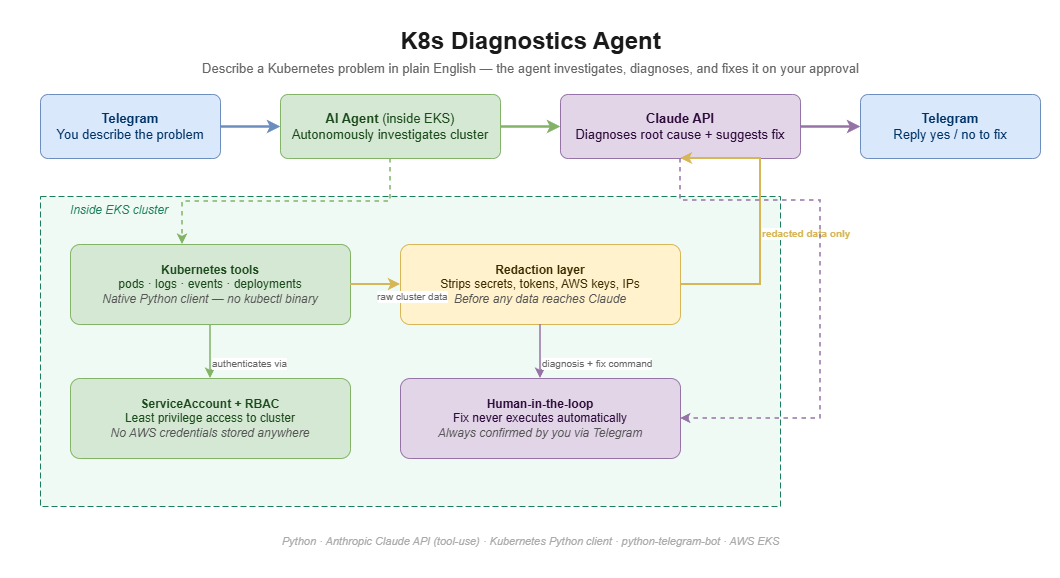
Telegram (user prompt)
        ↓
Bot handler (python-telegram-bot)
        ↓
Two-stage agent pipeline
  Stage 1 — Local triage (zero API tokens)
            Pattern match known errors → fetch targeted data
  Stage 2a — Focused Claude call (~800 tokens, known error)
  Stage 2b — Full ReAct loop (~3500 tokens, unknown error)
        ↓
Regex redaction layer (strips secrets, ARNs, tokens, IPs)
        ↓
Claude API (claude-sonnet-4-6) — diagnosis + fix command
        ↓
Telegram — "Apply this fix? yes/no"
        ↓
Kubernetes API (via ServiceAccount) — executes fix if confirmed
Features
- Agentic investigation — Claude autonomously decides which tools to call based on what it observes, rather than following a hardcoded script
- Two-stage pipeline — local pattern matching handles ~80% of common errors cheaply; full agent loop handles unknown issues
- Human-in-the-loop — fix commands are never executed automatically; Telegram confirmation is always required
- Data redaction — regex layer strips AWS credentials, tokens, connection strings, and internal IPs before any data reaches the Claude API
- In-cluster deployment — runs as a Pod with a ServiceAccount; no kubeconfig, no static AWS credentials
- Native Kubernetes API — uses the official Python client; no kubectl binary required in the container
Supported error types (fast path)
| Error | Tools called | Tokens |
|---|---|---|
ImagePullBackOff | get_pods + get_events | ~800 |
CrashLoopBackOff | get_pods + get_logs | ~800 |
OOMKilled | get_pods + describe_pod | ~800 |
Pending | get_pods + get_events | ~800 |
| Unknown | Full agent loop (up to 5 tools) | ~3500 |
Supported fix commands
The agent can propose and execute the following fix types after Telegram confirmation:
kubectl rollout restart deployment/<name>kubectl scale deployment/<name> --replicas=<n>kubectl delete pod/<name>
All other fixes are surfaced as manual instructions.
Project structure
k8s-diagnostics-agent/
├── agent/
│   ├── agent.py          # two-stage pipeline + ReAct agentic loop
│   ├── tools.py          # Kubernetes API wrappers
│   ├── redactor.py       # regex redaction layer
│   └── prompts.py        # Claude system prompt
├── bot/
│   ├── telegram_bot.py   # message handling + yes/no confirmation flow
│   └── state.py          # pending fix state store
├── k8s/
│   └── manifests/
│       ├── deployment.yaml
│       ├── serviceaccount.yaml
│       ├── rbac.yaml
│       └── secret.yaml       # not committed — see setup
├── .github/
│   └── workflows/
│       └── deploy.yml        # build → push → rollout on push to main
├── main.py
├── Dockerfile
└── requirements.txt
Prerequisites
- EKS cluster (any version)
- AWS CLI configured locally
- kubectl installed locally
- Telegram bot token (create via @BotFather)
- Anthropic API key (console.anthropic.com)
- Docker Hub account
Local setup
1. Clone and install dependencies
git clone https://github.com/<your-username>/k8s-diagnostics-agent.git
cd k8s-diagnostics-agent

python -m venv .venv
source .venv/bin/activate

pip install -e .
2. Configure environment variables
cp .env.example .env
# Edit .env and fill in your keys
# .env
ANTHROPIC_API_KEY=sk-ant-...
TELEGRAM_BOT_TOKEN=your-telegram-token
3. Connect kubectl to your EKS cluster
aws eks update-kubeconfig \
  --region <your-region> \
  --name <your-cluster-name>
4. Run locally
python main.py
Send your bot a message in Telegram:
are there any issues in kube-system?
check payment-service -n production
why are my pods crashing -n staging
Deploying to EKS
1. Create Kubernetes secrets
cp k8s/manifests/secret.yaml.example k8s/manifests/secret.yaml
# Edit secret.yaml and fill in your keys
kubectl apply -f k8s/manifests/secret.yaml
2. Apply RBAC and ServiceAccount
kubectl apply -f k8s/manifests/serviceaccount.yaml
kubectl apply -f k8s/manifests/rbac.yaml
3. Build and push Docker image
docker build -t <your-dockerhub-username>/k8s-diagnostics-agent:latest .
docker push <your-dockerhub-username>/k8s-diagnostics-agent:latest
4. Deploy
Update the image name in k8s/manifests/deployment.yaml, then:
kubectl apply -f k8s/manifests/deployment.yaml
5. Verify
kubectl get pods -l app=k8s-diagnostics-agent
kubectl logs -f deployment/k8s-diagnostics-agent
CI/CD (GitHub Actions)
Every push to main triggers:
- Build and push Docker image to Docker Hub (tagged with git SHA)
- Authenticate to AWS via OIDC (no static credentials stored)
- Update EKS deployment to the new image SHA
- Wait for rollout to complete
Required GitHub secrets:
| Secret | Description |
|---|---|
DOCKERHUB_USERNAME | Docker Hub username |
DOCKERHUB_TOKEN | Docker Hub access token |
AWS_ROLE_ARN | IAM role ARN for OIDC auth |
AWS_REGION | EKS cluster region |
EKS_CLUSTER_NAME | EKS cluster name |
See .github/workflows/deploy.yml for the full pipeline.
Security
In-cluster auth — the agent uses a Kubernetes ServiceAccount with a minimal ClusterRole. It can read pods, logs, and events, and write only the three supported fix operations. It cannot read Secrets or access other namespaces.
No static credentials — AWS authentication in CI uses GitHub Actions OIDC. The IAM role trust policy is scoped to the main branch only.
Data redaction — the following patterns are stripped before any data reaches the Claude API:
- AWS credentials and ARNs
- Bearer tokens and JWT strings
password=,token=,secret=,api_key=key-value pairs- Database connection strings with embedded credentials
- Internal IP addresses (10.x, 172.16-31.x, 192.168.x)
- Long base64-encoded strings (likely encoded secrets)
Secret values are never fetched — the tools.py implementation never calls kubectl get secret or reads raw Secret resource values. This is defence-in-depth on top of the redaction layer.
Example interaction
You:   payment-service pods keep crashing -n production

Bot:   🔍 Investigating your cluster...
       📋 Checking pod status...
       📜 Reading pod logs...

       ## Diagnosis
       The payment-service pod is in CrashLoopBackOff due to a
       database connection failure on startup.

       ## Root Cause
       The DB_HOST environment variable points to an unreachable
       endpoint. The pod crashes immediately with exit code 1.

       ## Fix
       Restart the deployment after verifying the DB_HOST value
       in the ConfigMap is correct.

       ## Prevention
       Add a readiness probe so the pod only receives traffic
       after a successful database connection.

       ⚠️ Suggested fix:
       kubectl rollout restart deployment/payment-service -n production

       Apply this to the cluster? Reply yes to confirm or no to cancel.

You:   yes

Bot:   ✅ Deployment 'payment-service' rollout restart triggered.
Tech stack
| Layer | Technology |
|---|---|
| Language | Python 3.11 |
| LLM | Claude (claude-sonnet-4-6) via Anthropic API |
| Agent pattern | ReAct tool-use loop (no LangChain) |
| Kubernetes client | kubernetes Python SDK |
| Bot interface | python-telegram-bot (async) |
| Container runtime | Docker |
| Registry | Docker Hub |
| Cloud | AWS EKS |
| CI/CD | GitHub Actions + OIDC |
Environment variables
| Variable | Required | Description |
|---|---|---|
ANTHROPIC_API_KEY | Yes | Anthropic API key |
TELEGRAM_BOT_TOKEN | Yes | Telegram bot token from BotFather |
K8S_NAMESPACE | No | Default namespace (defaults to default) |
License
MIT