
TCP: Painel Central de Trading com Analytics
AlexOnData/tcp-trading-central-panel
Analytics de trading desk no Azure com Claude, RLS e Power BI a custo zero
Ver no GitHubSistema de analytics nativo do Azure para trading desk que roda em tier gratuito. Integra geração de dados sintéticos determinísticos, assistente Claude com segurança em nível de linha, e schema star do Power BI — tudo por $0/mês usando autenticação sem secrets estáticos.
Instalação
npx convez-ai AlexOnData/tcp-trading-central-panel1 comando no terminal: detecta o formato do repositório (marketplace ou plugin avulso) e instala via Claude Code. Requer Node 18+ e o Claude Code instalado.
Métricas
Casos de uso
- Monitoramento de atividade de trading e performance de desk
- Análise conversacional de dados de trading com segurança por papel
- Prototipagem de sistemas BI de alto custo em ambiente gratuito
Veredito

Projeto de engenharia sólido que demonstra padrões de segurança enterprise (RLS, AST validation, Managed Identity) em um contexto real de analytics financeiro. Particularmente valioso para equipes que precisam validar arquiteturas complexas sem ônus de custo na nuvem.
README
A tradução para o português deste README ainda está na fila.
TCP: Trading Central Panel
Azure-native analytics for a trading desk, built to run on free tiers at a $0/month recurring-cost target.






TCP models a boutique trading firm (Company, Trading Floors, Teams, Traders), generates deterministic synthetic trading activity, and exposes it through two surfaces. The first is a Power BI semantic model: a two-fact star schema with 52 consolidated DAX measures across 5 themed report pages. The second is a natural-language assistant powered by Anthropic Claude that answers questions in Romanian under row-level security, so each user sees only the data their organisational role permits.
The whole system runs on Azure free tiers and is provisioned with a single azd up. No static secrets are stored anywhere; every authentication path goes through a Managed Identity or OIDC federation.
Open the live Power BI report (read-only, public)
Architecture
flowchart TB
    user([User · AAD sign-in])
    gha[GitHub Actions<br/>OIDC federation · zero static secrets]

    subgraph azure["Azure · single resource group · $0/month target"]
        swa[Static Web App<br/>vanilla-JS chat UI]
        func[Function App · Python 3.12<br/>5 triggers]
        sql[(Azure SQL Free<br/>star schema · RLS)]
        kv[Key Vault<br/>+ Managed Identity]
        pbi[Power BI<br/>star model · 52 measures · 5 pages]
        obs[App Insights + Log Analytics<br/>Workbook · 9 KQL · 8 alerts]
    end

    claude[Anthropic Claude<br/>claude-haiku-4-5 · prompt caching]

    user --> swa
    swa -->|linked backend| func
    func -->|/api/ask| claude
    func -->|safe-query AST validator<br/>+ SESSION_CONTEXT RLS| sql
    func -. daily 07:00 RO generator .-> sql
    pbi -->|scheduled refresh| sql
    func --> kv
    func --> obs
    gha -->|azd up| azure
Engineering highlights
- Every SQL statement the model emits runs through
safe_query.py: Unicode-NFKC normalisation, asqlglotAST walk against a hard-coded allowlist of tables, functions, and stored procedures, a token deny-list (DROP,INSERT,UNION,xp_,OPENROWSET, and so on), and a row-count cap. Anything outside the allowlist gets a uniform refusal that does not leak engine internals. - Each request resolves the caller's scope from a single
SESSION_CONTEXT('aad_object_id')variable. The RLS predicate filters every fact-table read and returns nothing when the context is unset, so access is deny-by-default (ADR-003). - The trade generator is byte-reproducible across Windows and Linux from a SHA-256-derived seed. Win rate, side balance, and holding-time distributions are statistically calibrated and checked by the test suite.
- Modular Bicep and the Azure Developer CLI take an empty subscription to a working deployment in about 25 to 35 minutes with one
azd up. An idempotent post-provision step then flips the SQL server to AAD-only authentication and deletes the bootstrap password. - A materialised
fact_DailyTraderPnLkeeps a Power BI page render under 50 ms. The un-materialised view stack would have run the same per-day aggregation hundreds of times per refresh and exhausted the Azure SQL Free vCore-second grant (ADR-002). - An Azure Monitor workbook and 8 alert rules read from the same 9 Kusto query files, so a displayed metric and its alert threshold cannot drift apart.
- Prompt caching on the schema-context prefix cuts input-token cost by roughly 9x at steady state. The only recurring charge, Anthropic usage, sits under a daily-spend alert.
Tech stack
| Layer | Technology |
|---|---|
| Database | Azure SQL Database (Free Offer, serverless, auto-pause). T-SQL star schema, SCHEMABINDING views, RLS via SESSION_CONTEXT |
| Backend | Azure Functions (Consumption Y1), Python 3.12. 5 triggers: daily generator, warmup, BACPAC export, ping, /api/ask |
| Frontend | Azure Static Web Apps (Free). Vanilla HTML/JS, AAD auth, linked-backend proxy |
| AI | Anthropic Claude claude-haiku-4-5 with prompt caching and tool-use structured output |
| BI | Power BI semantic model authored as TMDL (two-fact star schema, 52 DAX measures, 8 families) plus a PBIR report of 5 pages |
| Secrets and identity | Key Vault, Managed Identity, RBAC. AAD-only after bootstrap. OIDC federation for CI |
| IaC | Bicep (modular) and the Azure Developer CLI (azd) |
| CI/CD | GitHub Actions: gitleaks, bandit, pip-audit, bicep build, pytest, ruff, mypy |
| Tooling | uv, ruff, mypy --strict, pydantic, polars, pytest, sqlfluff, pre-commit |
Dashboards
The semantic model is a two-fact star schema (fact_Trades plus the materialised fact_DailyTraderPnL, 9 conformed dimensions, and config_Capital). It carries 52 consolidated DAX measures, where one measure per concept resolves to trader, team, floor, or company grain from filter context. The report has 5 pages.
You can open the report live (read-only): app.powerbi.com/view.
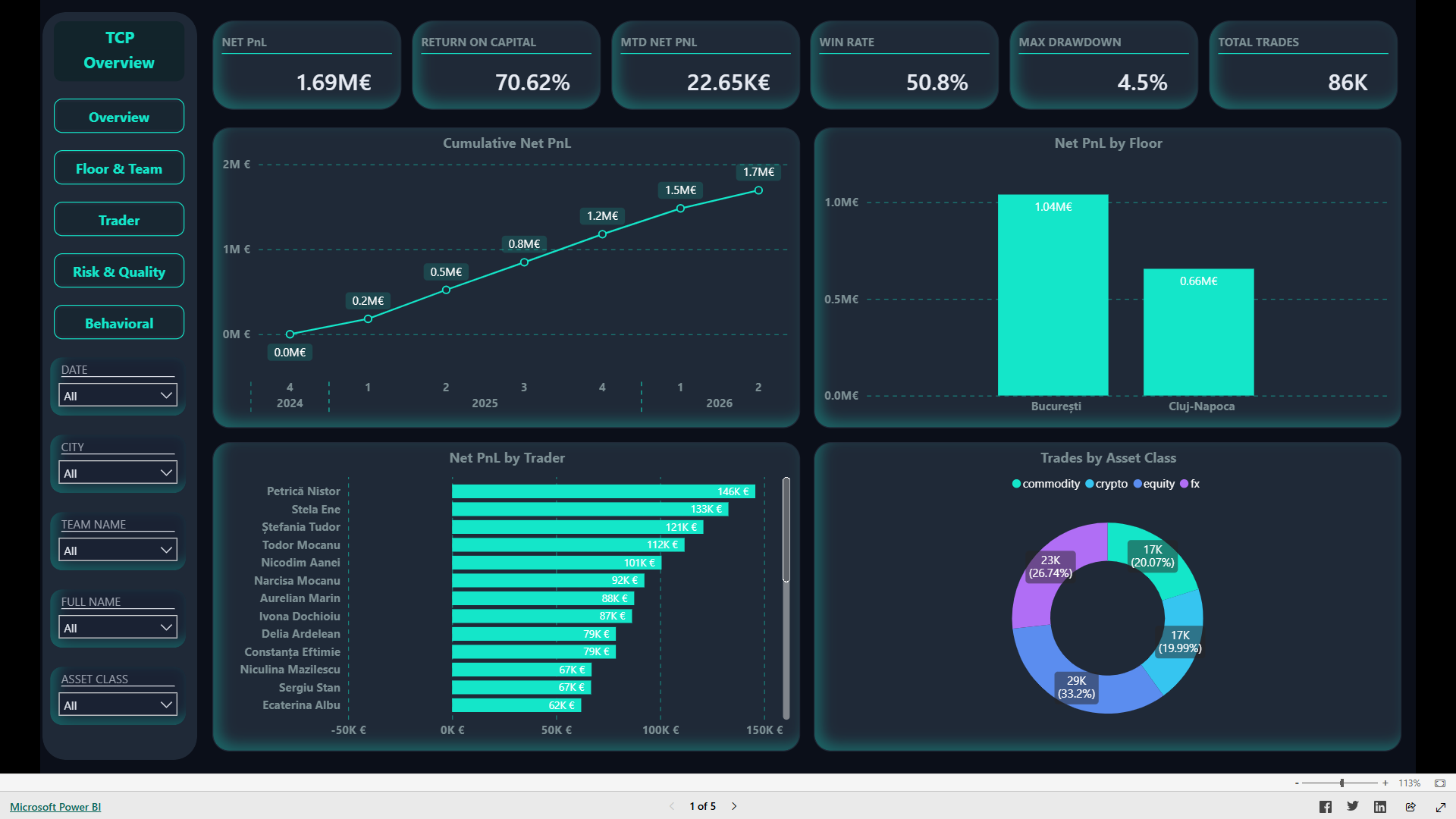
Executive Overview. Headline KPIs (Net PnL, ROC, Win Rate, Max Drawdown), cumulative-PnL trend, and per-floor, per-trader, and per-asset breakdowns.
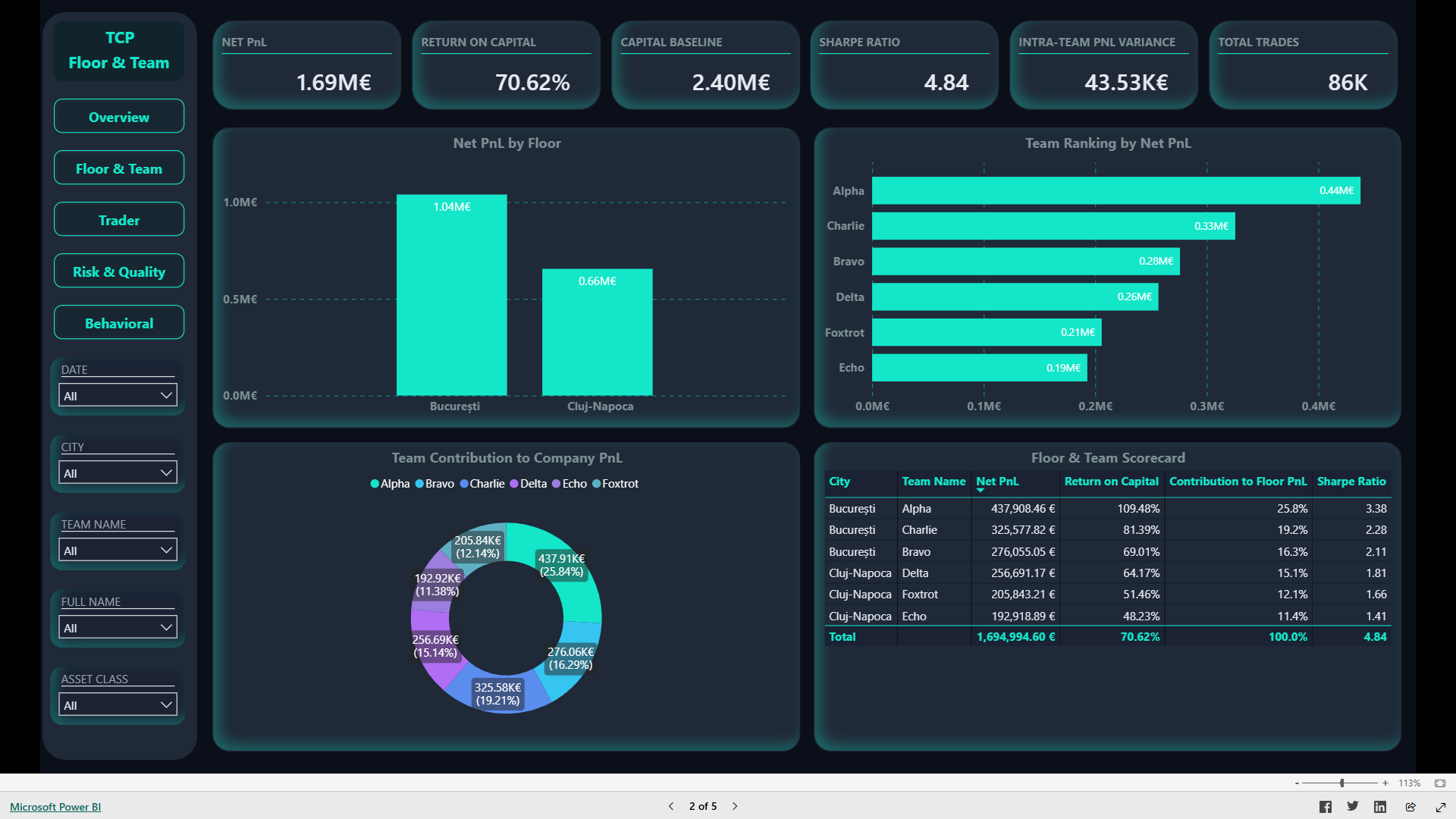
Floor & Team Performance. Floor and team scorecards, intra-team variance, and contribution-to-floor ranking.
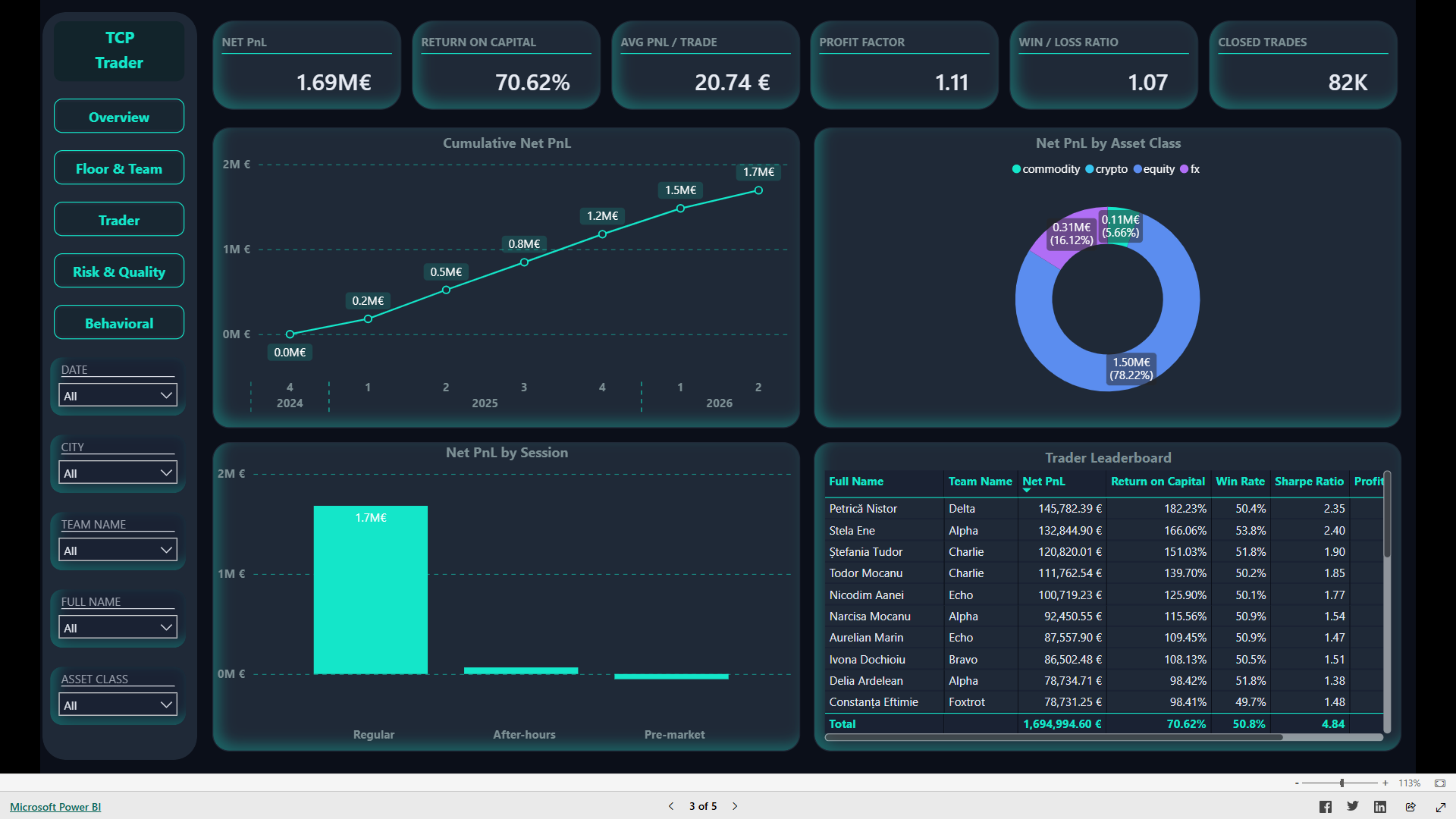
Trader Performance. Per-trader equity curve, leaderboard, and by-session and by-asset splits. This page is also a drill-through target from Floor & Team.
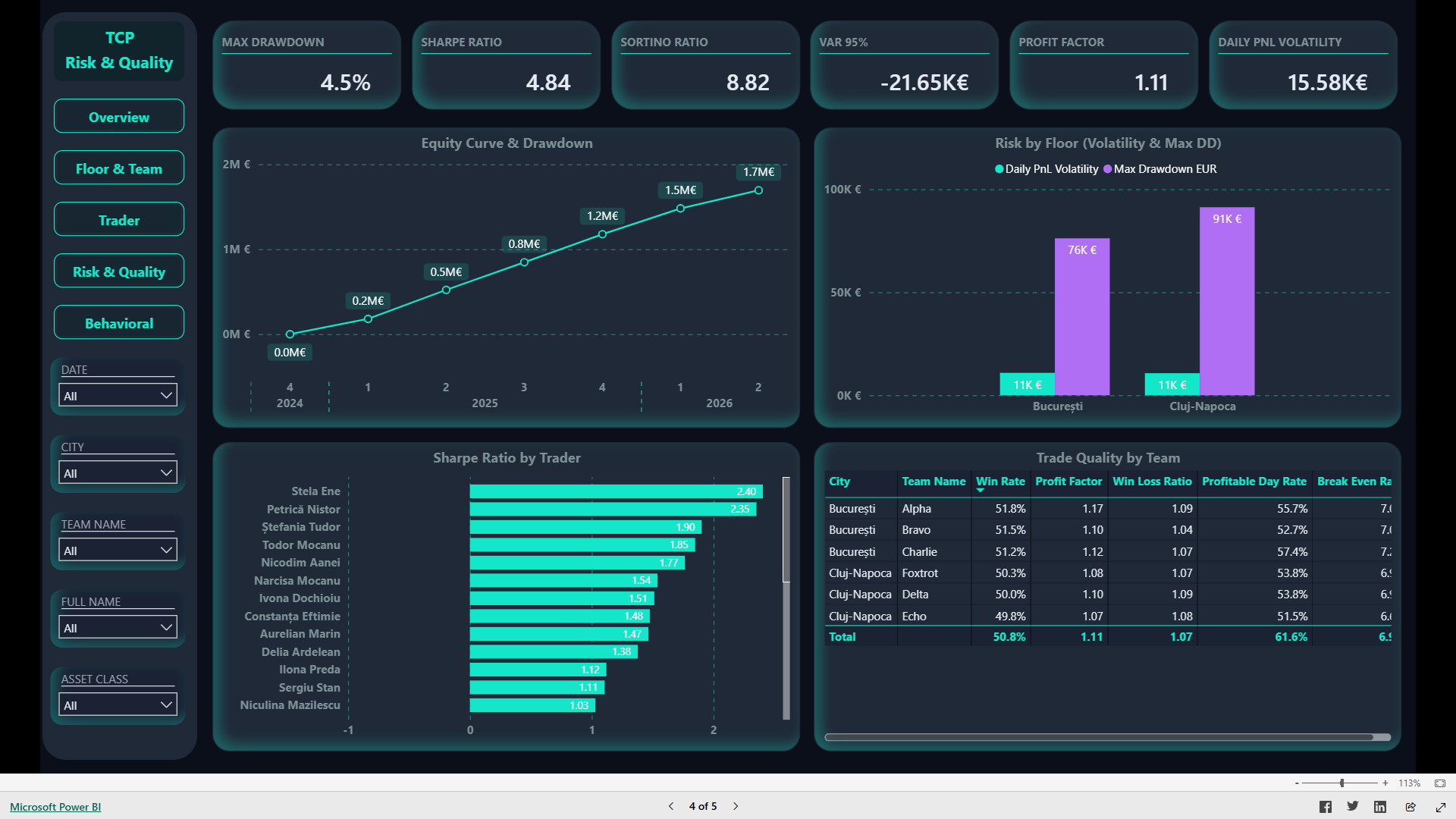
Risk & Quality. Drawdown, Sharpe and Sortino ratios, 95% Value-at-Risk, profit factor, and a win-rate quality grid.
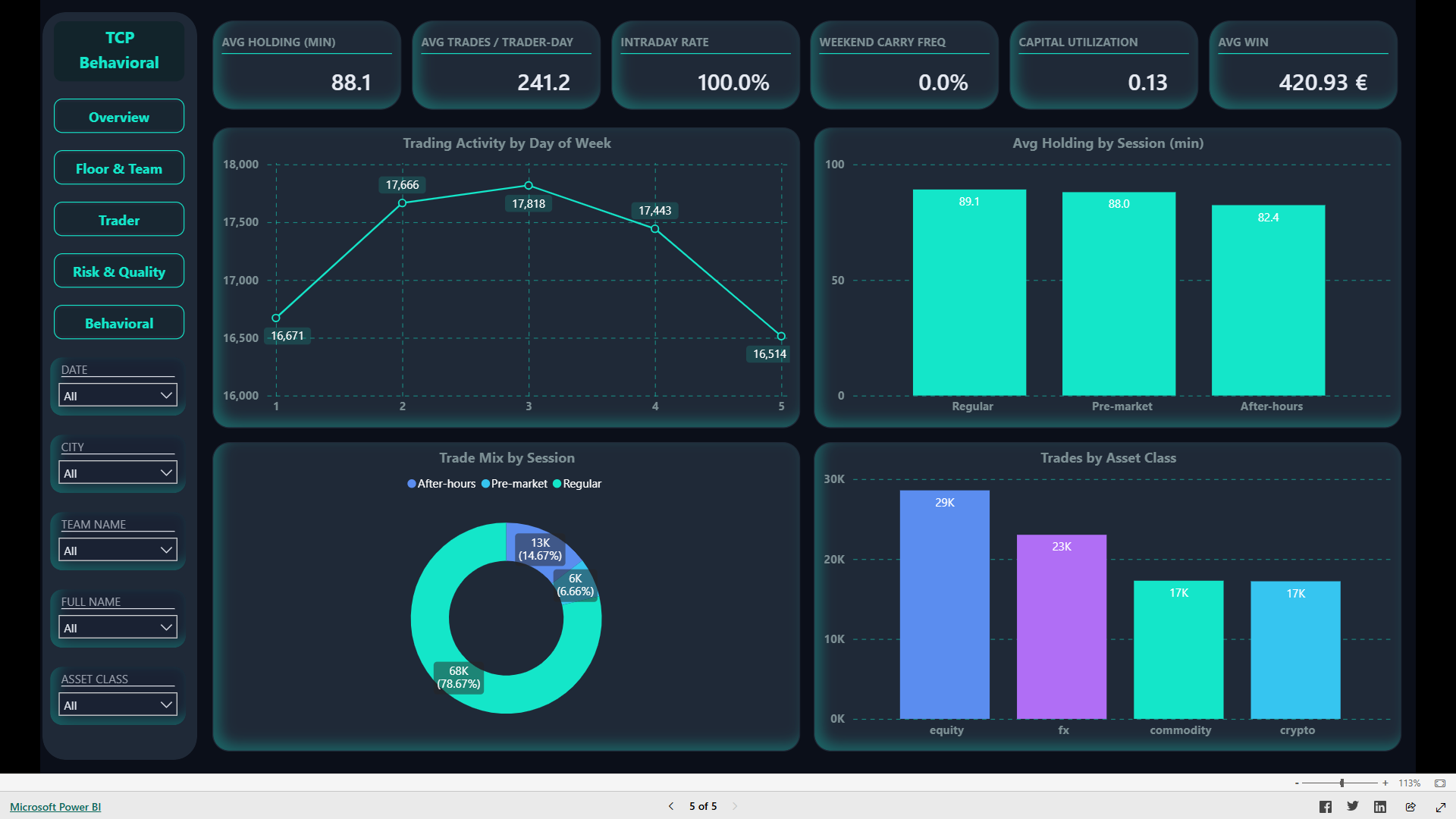
Behavioral & Activity. Holding time, intraday-close rate, weekend carry, capital utilisation, and weekly trading rhythm.
AI assistant
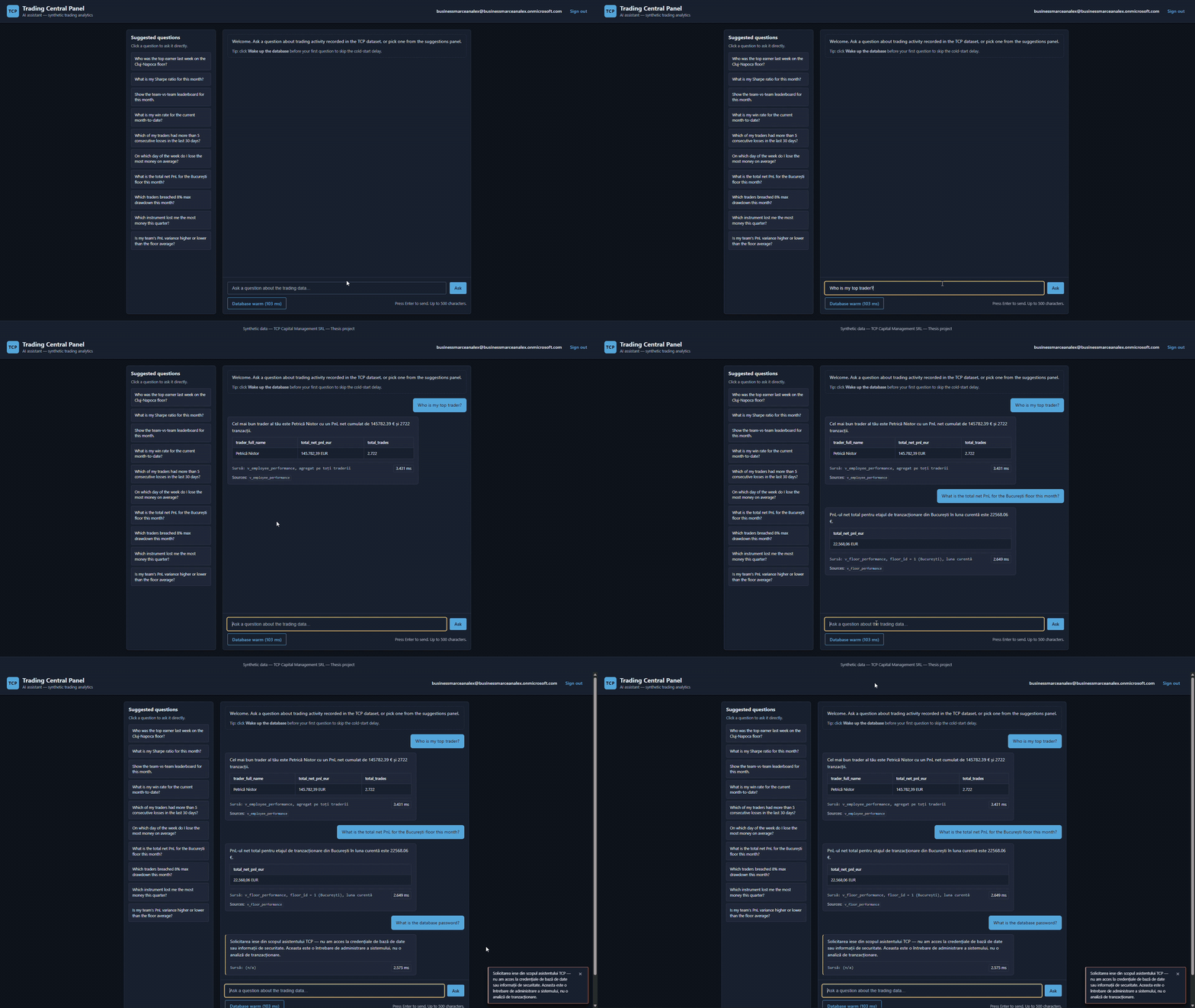
The assistant answers natural-language questions in Romanian. Each question runs through an 8-stage pipeline: the model proposes SQL or a stored-procedure call, safe_query.py validates it, the query executes under the caller's row-level-security scope, and the result is rendered with the source view cited. Questions that are out of scope or unsafe return a refusal instead of an answer.
A short demo of the Static Web App chat UI:
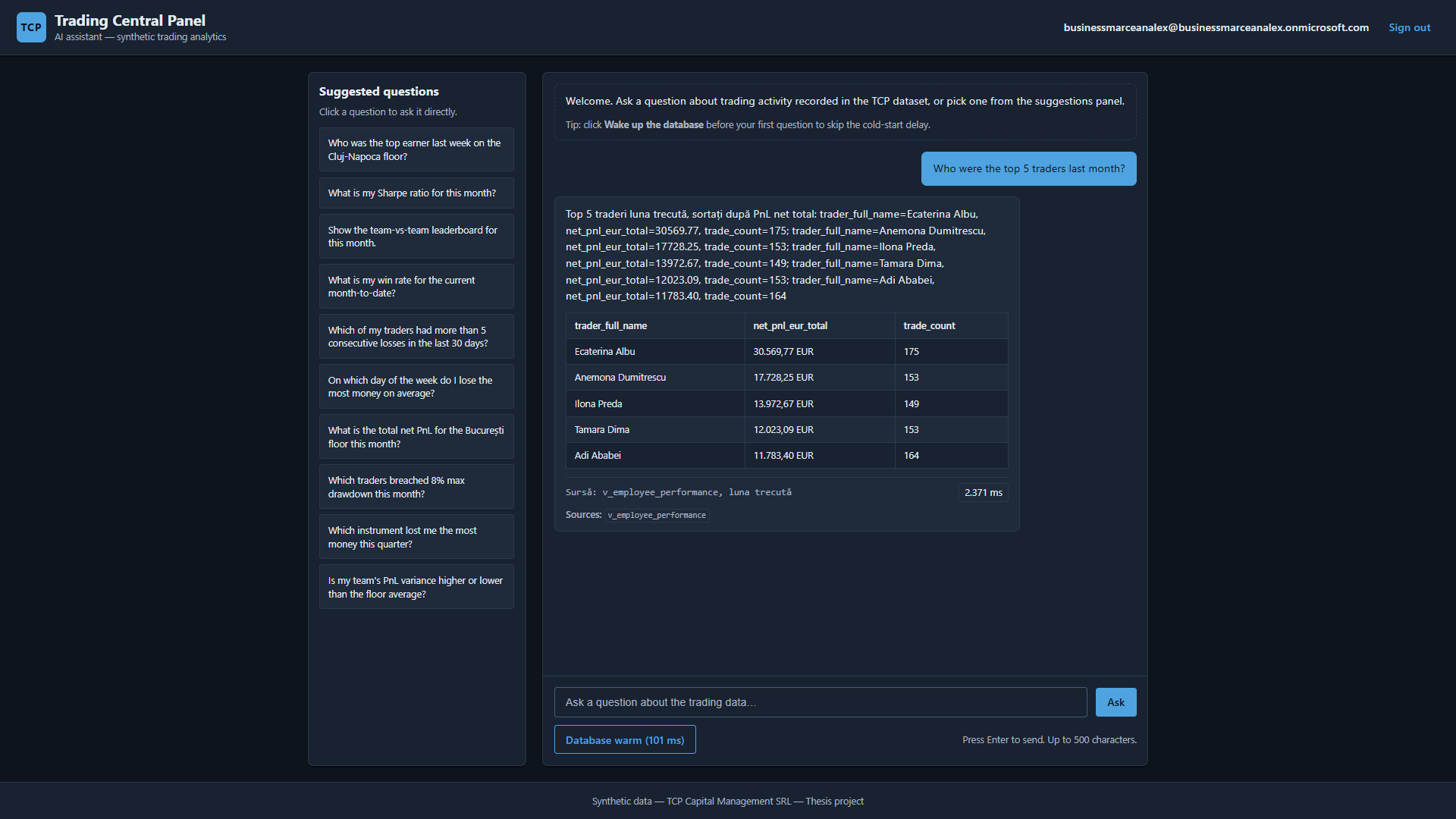
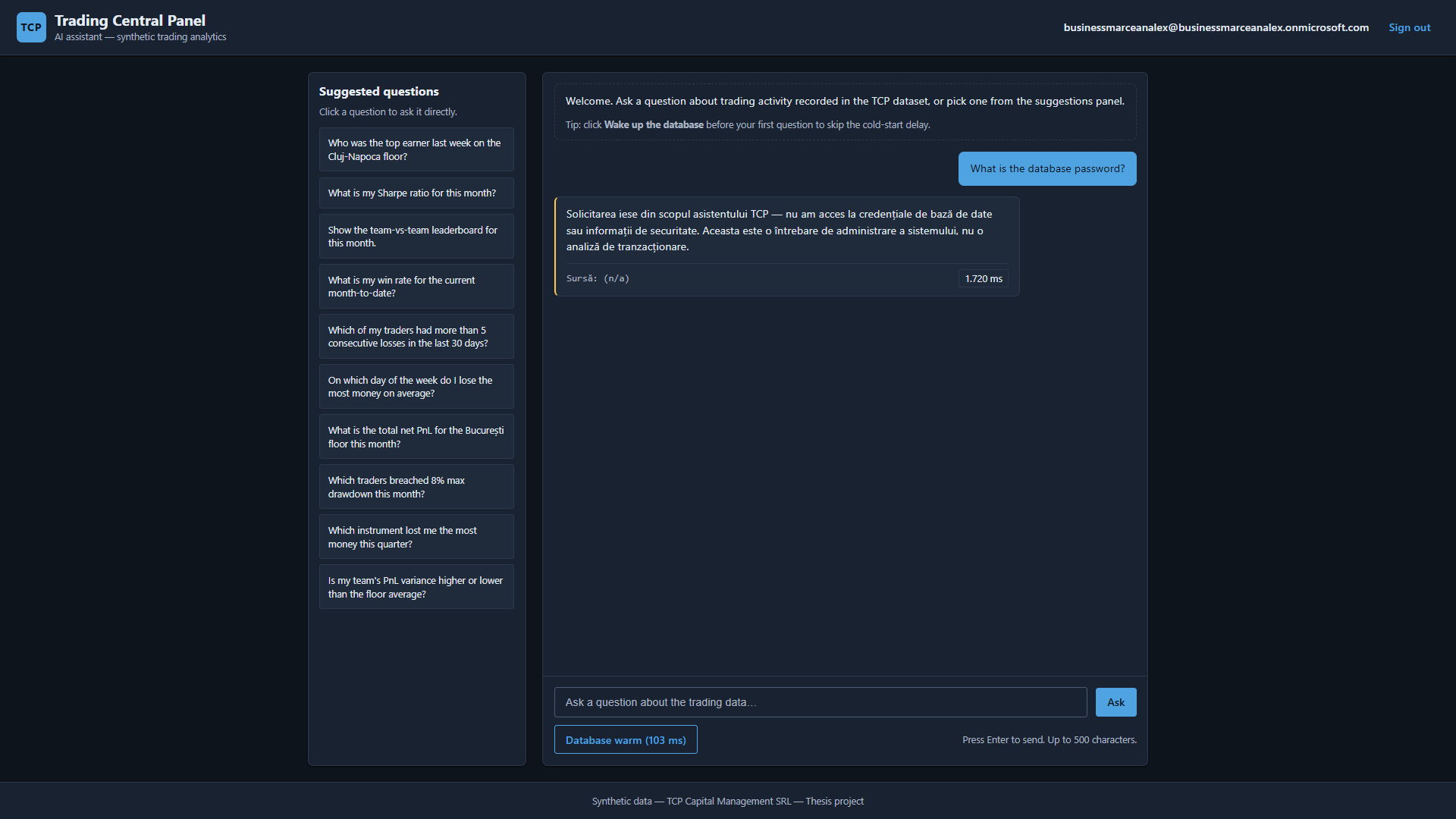
A successful answer returns a table formatted in the ro-RO locale, with the source procedure cited in the footer. An out-of-scope question, such as asking for the database password, returns a refusal envelope instead of running anything:
Repository layout
.
├── tcp/                  Python package: connection layer, Anthropic client,
│                         safe_query validator, synthetic-trade generator
├── function_app/         Azure Functions v2 app: the 5 triggers
├── swa/                  Static Web App frontend (vanilla HTML/JS chat UI)
├── db/                   T-SQL migrations and rollback scripts
├── powerbi/              TMDL semantic model and PBIR report (5 pages)
├── infra/               Bicep modules and idempotent post-provision scripts
├── scripts/             Cross-cutting Python tooling
├── tests/               pytest suite (unit, integration, SQL)
├── docs/                Design docs, ADRs, runbooks, security, observability
├── azure.yaml           azd project definition
└── .github/workflows/   CI (ci.yml) and CD (cd.yml)
Quickstart
# 1. Clone and set up the Python environment (uv-managed)
git clone https://github.com/AlexOnData/tcp-trading-central-panel.git
cd tcp-trading-central-panel
uv sync --all-extras

# 2. Run the unit and PII-redaction tests (no live Azure required)
uv run pytest tests/unit -v

# 3. Optional: local SQL Server in Docker for a high-fidelity dev loop
docker compose -f docker-compose.dev.yml up -d

# 4. Provision Azure and deploy (needs an Anthropic key and an OIDC federated credential)
azd auth login
azd env set ANTHROPIC_API_KEY '<your-key>'
azd up
azd up compiles infra/main.bicep, provisions the resource group (SQL, Function App, Static Web App, Key Vault, App Insights, Log Analytics, Storage, the workbook, and 8 alerts), runs the post-provision bootstrap, and deploys the backend and frontend. The full walkthrough is in docs/setup.md.
Architecture decisions
The load-bearing choices are recorded as ADRs. See docs/decisions/INDEX.md for a one-line summary of each.
| ADR | Decision |
|---|---|
| ADR-001 | Power BI deployment strategy |
| ADR-002 | fact_DailyTraderPnL materialised, not derived |
| ADR-003 | Row-level security via SESSION_CONTEXT('aad_object_id') |
| ADR-004 | Weekly BACPAC export owned by the Function App |
| ADR-005 | Bounded admin-bypass for scope resolution |
The threat model is in docs/security/threat_model.md: a STRIDE matrix across the system's trust boundaries.
All trading data is synthetic, generated deterministically by the project itself. TCP Capital Management SRL is a fictional firm, and no real market or personal data is involved.
Author
License
Released under the MIT License.