
ONMC - Compilador de Memória e Contexto para Agentes de Código
adaline-ankit/oh-no-my-claudecode
Memória adaptativa para agentes: objetivo, restrições e decisões sem redundância
Ver no GitHubAgent que mantém a memória de trabalho adaptativa do Claude Code sincronizada com mudanças no repositório, sem chamadas à API. Armazena em SQLite contexto específico da sessão (objetivo, restrições, decisões) e retira automaticamente informações obsoletas quando arquivos-fonte mudam, garantindo contexto sempre relevante e atualizado.
Instalação
npx convez-ai adaline-ankit/oh-no-my-claudecode1 comando no terminal: detecta o formato do repositório (marketplace ou plugin avulso) e instala via Claude Code. Requer Node 18+ e o Claude Code instalado.
Métricas
Casos de uso
- Manter contexto consistente em sessões longas de coding com Claude
- Automatizar remoção de informações obsoletas quando código fonte muda
- Rastrear decisões arquiteturais e próximos passos com âncoras no repositório
- Integrar memória persistente em agentes MCP e Codex
Veredito

Solução técnica madura que resolve um problema real: agentes de coding perdem contexto relevante ou carregam informação obsoleta. ONMC traz transparência (inspecionável via CLI/hooks) e eficiência (SQLite local, zero overhead de modelo), ideal para fluxos de desenvolvimento iterativo com IA. Requer Python 3.11+ e familiaridade com hooks do Claude.
README
A tradução para o português deste README ainda está na fila.
oh-no-my-claudecode (onmc)




Your code changed. Your agent's memory should too.
Keep the task. Refresh the evidence. ONMC gives Claude Code an adaptive working context: the goal, constraints, decisions, and next step survive compaction; recalled claims lose eligibility when their source files change.
Local SQLite. No model calls to compile working context. Inspect every inclusion, exclusion, and withdrawal. Use native Claude hooks, or the same state through CLI and MCP with other coding agents.
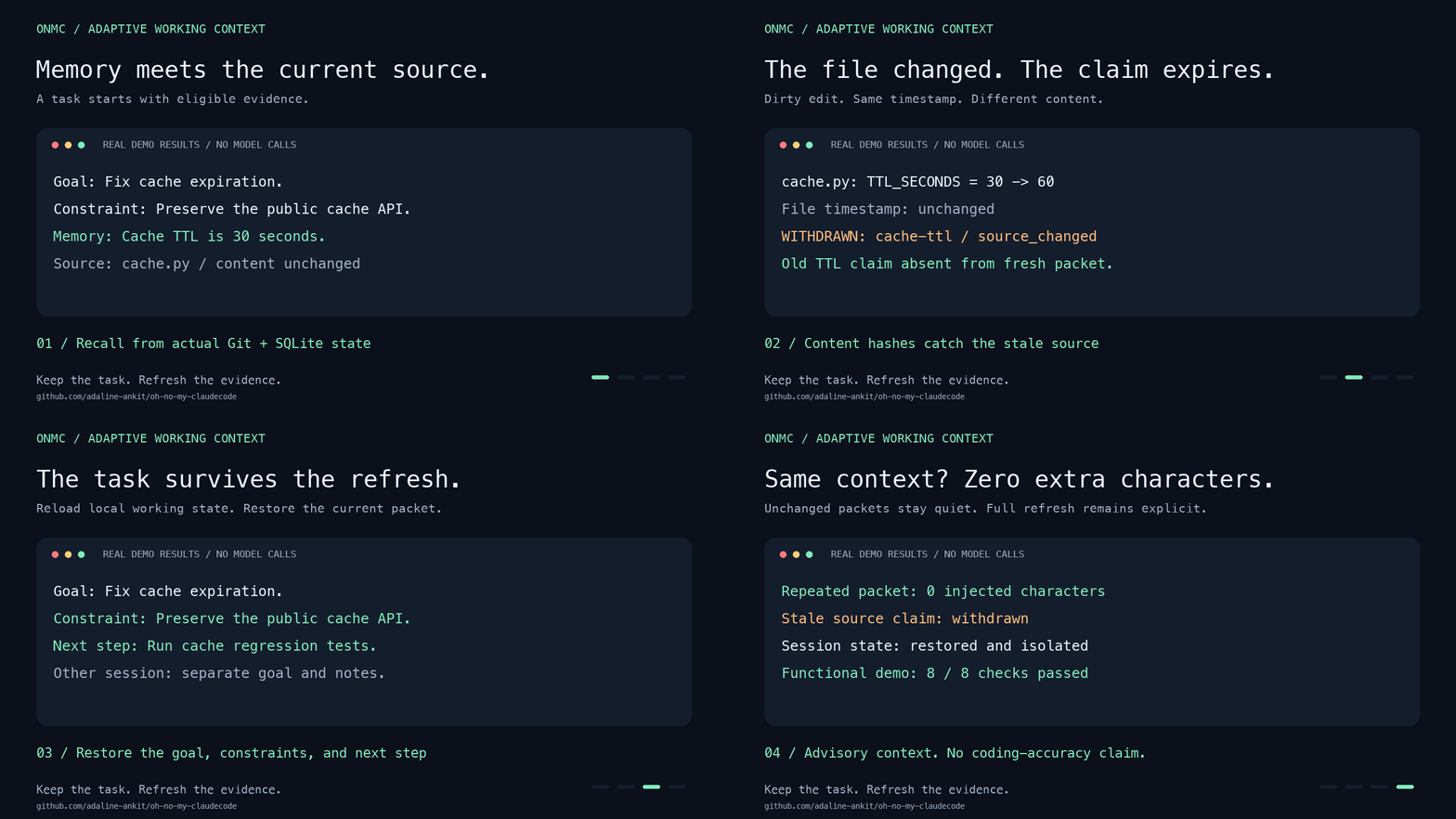
Animated rendering of real Git, SQLite, and hook results. Eight checks, no model calls. Static image · Run it yourself
What changes in your workflow
| When this happens | ONMC supplies |
|---|---|
| You start a task | A session-specific goal and explicit constraints |
| You move between files | Relevant repository memory within a fixed character budget |
| A recalled fact's source changes, even before commit | A withdrawal notice and a refreshed packet |
| Claude compacts or resumes | Current goal, constraints, saved decisions, and next step |
| Nothing relevant changed | No duplicate packet |
| You need to inspect the decision | Source anchors and inclusion/exclusion reasons |
This is advisory context. ONMC cannot erase old conversation text or guarantee that an agent follows instructions. Source freshness is not semantic correctness. Read the exact behavior and limits.
Try it in your repo
Adaptive working context is on main; it is not in the latest PyPI release,
v0.113.0. Install from Git for this feature. Python 3.11+, Git, and uv required.
uv tool install --force 'git+https://github.com/adaline-ankit/oh-no-my-claudecode.git@main'
cd your-repo
onmc init
onmc ingest --no-llm
onmc working enable \
  --constraint "Preserve existing public APIs" \
  --constraint "Add no new runtime dependencies"
claude
Start or resume Claude after enabling so it reloads project hooks and MCP settings.
Existing custom hooks are preserved. Automatic CLAUDE.md refresh preserves
user-authored or edited files. onmc working disable stops adaptive injection.
Claude can save decisions and next steps with record_working_note. A new session
gets a separate goal and notes; working notes are not automatically promoted to
repository memory.
Codex and other MCP clients: use start_working_context,
get_working_context, and record_working_note with an explicit session ID.
Native automatic working-context hooks currently target Claude Code.
CLI examples and MCP setup
· Codex integration
For the latest released package and its existing memory/runtime features:
uv tool install oh-no-my-claudecode
onmc setup --no-llm
More than a context packet
Working context sits on ONMC's existing repository memory and execution harness. Use the pieces independently.
| Capability | Entry point | What it provides |
|---|---|---|
| Repository memory | onmc ingest, onmc brief, onmc guard | Provenance, ranked recall, and recorded failed approaches |
| Adaptive working context | onmc working | Session state, source checks, bounded packets, repeat suppression |
| Controlled execution | onmc run | Plan preview, explicit execution, configured verifier, durable run state |
| Inspectable evidence | Receipts, trace, eval, replay | Tamper-evident records and reproducible checks |
| Portable knowledge | onmc sync | Git-portable repository memory in .agent-memory |
| Agent access | CLI, Python API, hooks, MCP | Multiple interfaces to the same local store |
Preview a task without invoking a model:
onmc run "fix cache expiration"
Then explicitly execute with an installed, authenticated agent and a verifier appropriate to your project:
onmc run "fix cache expiration" --execute \
  --agent codex \
  --verifier "python -m pytest -q --cov=your_package --cov-report=json" \
  --max-iterations 3 \
  --isolate
Replace your_package with your package name; the example needs pytest-cov.
A passing command alone may not satisfy the configured proof requirements.
ONMC evaluates repository evidence rather than accepting the agent's claim of
completion. The verifier still needs to test the behavior you care about.
Mutation checks, full adjudication, external attestation, and optional provider integrations have their own configuration and dependencies. They do not all run by default. Cost is only known when the selected provider reports it. Execution guide · Capability catalog
What the measurements show
All numbers below come from internal experiments with published protocols and artifacts. They are not a general coding-accuracy claim.
| Experiment | Result | What it establishes |
|---|---|---|
| Synthetic working-context event suite | 117/117 eligibility/delivery checks; legacy path 99/117 | Covered transitions behave as specified; legacy delivered 18 stale/deleted claims |
| Adaptive vs forced-refresh delivery | 36.5% fewer injected characters | Repeat suppression in this event suite; adaptive still used more characters than legacy |
| 10,000-memory synthetic corpus | 2.48 ms p50, 20.20 ms p95 | In-process packet compilation on one Apple M4; excludes process startup |
| Live Codex pilot, three tasks per arm | 3/3 vs 3/3; 18 grader tests passed per arm | Successful pilot execution; no demonstrated accuracy improvement |
| Frozen code retrieval, 40 queries | BM25 R@5 0.950; hybrid 0.875 | BM25 won this corpus; it remains the default |
Working-context protocol · Raw results and limitations · Broader harness evidence
The broader publication gate remains blocked. ONMC publishes ties, losses, and missing evidence alongside favorable component results. Larger held-out, long-session coding evaluations are still needed.
Try the demo without an API key
From a source checkout:
git clone https://github.com/adaline-ankit/oh-no-my-claudecode.git
cd oh-no-my-claudecode
uv sync --extra dev --locked
uv run --locked python scripts/demo-working-context.py \
  --output /tmp/working-context-demo.json
The demo creates a temporary Git repo, remembers a 30-second cache TTL, changes the source to 60 seconds without changing its timestamp, and checks that the old claim is withdrawn. It also checks restoration, session isolation, budgets, and zero-character repeat delivery. It does not run Claude or Codex.
Explore or contribute
- Working context: hooks, notes, freshness rules, and budgets
- Architecture: storage, context compiler, runtime, and evidence boundaries
- CLI reference: generated command reference
- Shipped capabilities: broader feature catalog
- Roadmap: the next hard problems
- Contributing: setup and quality gates
- Share-ready demo and copy: current launch material
Useful contributions: a held-out long-session benchmark, independent child-agent working state, richer source anchors, and failure cases where context was fresh but the agent still made the wrong decision. Open an issue with a reproducible case. The project is MIT licensed and welcomes independent replication.