
pdp11-emulator
a2v10/pdp11-emulator
A PDP-11 emulator, a MACRO-11 assembler and Arkanoid written in PDP-11 assembly — built in a single Claude Code session, guided by an engineer who remembers the real thing.
Instalação
npx convez-ai a2v10/pdp11-emulator1 comando no terminal: detecta o formato do repositório (marketplace ou plugin avulso) e instala via Claude Code. Requer Node 18+ e o Claude Code instalado.
Métricas
README
A tradução para o português deste README ainda está na fila.
PDP-11 / Arkanoid
A PDP-11 emulator in TypeScript: a dependency-free core, an assembler (MACRO-11 subset), a React shell for the browser — and two games written in PDP-11 assembly: Arkanoid and Tetris. Switch between them with the tabs above the screen.
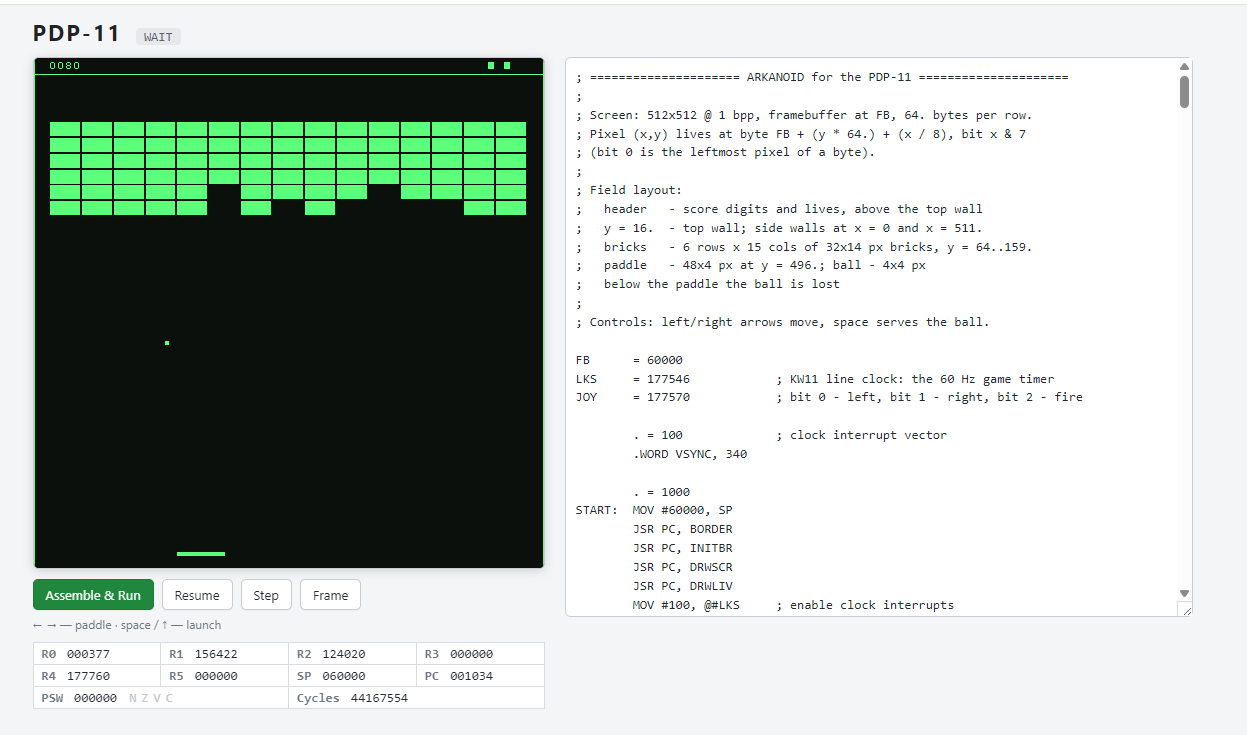
Live: https://pdp11-arkanoid.azurewebsites.net/
Controls — Arkanoid: ← → move the paddle, Space (or ↑) launches the ball. Tetris: ← → move, ↑ / Space rotate, ↓ soft-drop. On a phone an on-screen joystick appears. Pause the emulator to inspect the CPU registers mid-game.
Tetris on a PDP-11 is no accident: the original was written by Alexey Pajitnov in 1984 on an Elektronika-60, a Soviet PDP-11 clone — so this runs it on (an emulation of) the machine it was born on.
The experiment
This project is an experiment in AI-assisted development: the entire thing — the emulator core, the assembler, the React shell, the Arkanoid game in PDP-11 assembly, the tests and the deployment pipeline — was written in a single conversation with Claude Code, guided by an engineer with 40+ years of experience who remembers the real PDP-11 era. The human set the architecture straight more than once (no 64K decode lookup table in 1975 — the decoder is a switch cascade mirroring the combinational logic of the real machine); the AI typed fast and kept the test suite green. Total time from "let's sketch the modules" to the deployed public site: one day.
Memory map (addresses in octal)
| Range | Size | Purpose |
|---|---|---|
| 000000–000377 | 256 B | Interrupt and trap vectors |
| 000400–057777 | ~24 KB | Code, data, stack |
| 060000–157777 | 32 KB | Framebuffer 512×512, 1 bpp, 64 bytes per row |
| 160000–177777 | 8 KB | I/O page |
Pixel (x, y): byte 060000 + (y << 6) + (x >> 3), bit x & 7.
Device registers
| Address | Device | Description |
|---|---|---|
| 177544 | Speaker | bit 0 is the cone position, Sinclair Spectrum style. There is no tone generator: the program toggles the bit and the toggle rate is the pitch. Music costs CPU cycles, like it did in 1982. |
| 177546 | KW11 line clock | bit 6 — interrupt enable, bit 7 — tick flag. Ticks at 60 Hz, interrupts through vector 100 at priority 6. This is the game's "vsync". |
| 177570 | Joystick | read-only: bit 0 — left, bit 1 — right, bit 2 — fire, bit 3 — down. A mask of the currently held buttons. |
The game uses the speaker for bounce/brick effects and plays Korobeiniki while the ball waits on the paddle — the tune Tetris made famous, and Tetris was written on an Elektronika-60, a Soviet PDP-11 clone.
Modules
src/core/— the emulator core, pure TS, knows nothing about the browser:memory.ts— 64 KB, oneArrayBufferwith byte and word views;bus.ts— address routing, I/O page dispatch, anonAccesshook;cpu.ts— registers R0–R7, PSW, all 8 addressing modes, step(), traps and interrupts;instructions.ts— two cooperating forms of the instruction set:decode()— a cascade of nested switches over the octal fields of the instruction word, the software analog of the combinational decode network in the real processor (the structure mirrors the opcode map in the PDP-11 Processor Handbook); andDEFS— the "programmer's reference card": data that feeds the assembler, the disassembler and the UI. A test cross-checks the two on all 65536 opcode words;machine.ts— the assembled machine + state snapshots (rewind/replay);devices/— KW11, joystick, one-bit speaker.
src/asm/— a two-pass assembler, MACRO-11 subset: labels,SYM = expr,. = addr,.WORD/.BYTE/.ASCII/.ASCIZ/.BLKW/.BLKB/.EVEN/.END, expressions (octal by default,64.for decimal,'Afor a character, left-to-right evaluation with no operator precedence — just like the real MACRO-11), all addressing modes. Output: an image + a symbol table + an address ↔ source line map for the debugger.src/web/— the React shell: a canvas screen (framebuffer → ImageData once per frame), keyboard → joystick, Run/Pause/Step/Frame, a register panel, an assembly editor.npm run dev→ http://localhost:5173.programs/arkanoid.s— Arkanoid: a 6×15 brick field, a 4×4 ball with per-pixel movement (bit mask tables), bounce angle controlled by where the ball hits the paddle, a score rendered in a 5×7 digit font, lives.programs/tetris.s— Tetris: a 10×20 well of 24×24 cells, seven pieces × four rotations packed as 4×4-box cell tables, the board as 20 row bitmasks, full-line clears with BCD scoring, levels that speed up gravity, an LFSR piece bag, delayed auto-shift, and one-bit sound. No multiply or divide — the whole layout is powers of two, so addressing stays additive.programs/demo.s— a simple bouncing-ball demo.
Slots for the future "learning mode"
Designed in and covered by tests; a UI can plug in without touching the core:
cpu.tracer— an event per executed instruction (PC, opcode, name, PSW);bus.onAccess— observes every memory/device access;Machine.snapshot()/restore()— the full machine state; the core is deterministic, so "initial state + per-frame inputs" gives exact replay and rewind;InstrDef.units— which functional units an instruction engages (for a future animated CPU schematic);cpu.cycles— an approximate cycle counter.
Authenticity and simplifications
The base instruction set is implemented (no EIS, FPU or MMU — with a 512-pixel row all address arithmetic reduces to shifts). Faithfully done: byte order, autoincrement by 1/2, MOVB sign-extension into registers, the odd-address trap (vector 4), bus timeout on unmapped I/O addresses, interrupt priorities, WAIT, RTI/RTT, EMT/TRAP, double-fault handling.
Commands
npm run dev        # Vite dev server
npm run build      # production build
npm test           # vitest, core/asm/game tests
npm run typecheck  # tsc --noEmit